
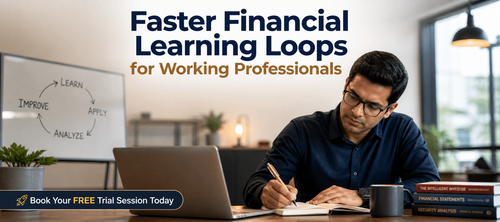
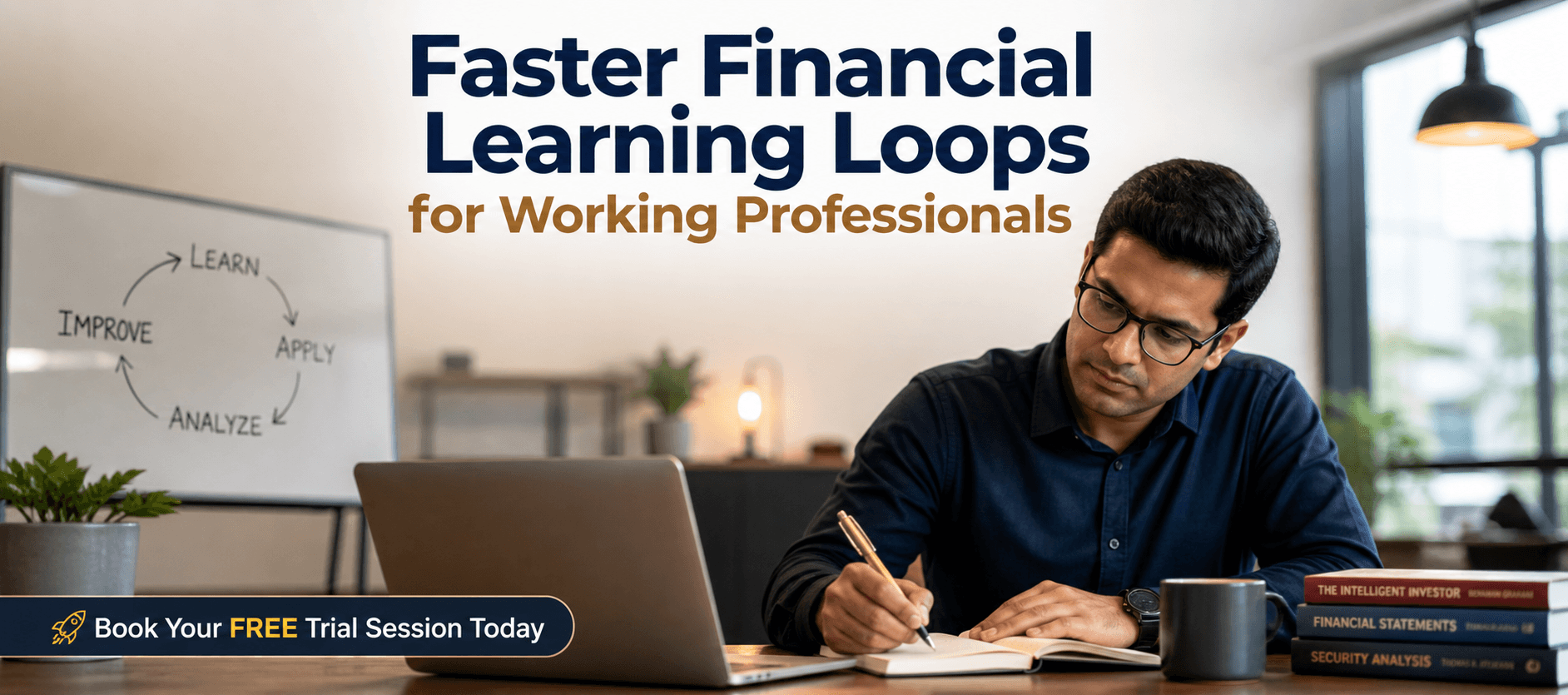
Faster Financial Learning Loops for Working Professionals

Build Faster Financial Intelligence: A Practical Guide to Reflection Loops for Smarter Decisions
Most working professionals believe that improving financial intelligence requires more reading, more courses, or more exposure to financial concepts. Yet, despite consuming endless content, many still struggle to make confident, high-quality financial decisions at work or in personal life.
The real problem is not lack of information—it is the absence of a system to convert experience into learning. Professionals often make financial decisions, observe outcomes, and move on without extracting structured insights. As a result, mistakes repeat, good decisions remain unexplained, and knowledge never compounds.
This is where financial learning loops through reflection become transformative. By systematically capturing what you expected, what actually happened, and how your thinking should evolve, you turn every financial experience into a growth engine. This guide translates a powerful worksheet-based framework into a practical, actionable approach you can use immediately.
Download these resources and apply them alongside your daily work for improved clarity, productivity, and professional growth. You can also book a free trial to gain expert guidance and enhance your communication, problem-solving, and decision-making skills. The materials are designed in a clear, structured format to help professionals learn efficiently and implement insights with confidence.
Who Is This Blog For?
- Working professionals handling budgets, projects, or financial decisions
- Managers and team leads responsible for cost, revenue, or pricing decisions
- Individuals looking to improve personal finance decision-making
- Professionals transitioning into roles with financial responsibility
- Anyone who wants to think more clearly and confidently about money
Why This Topic Matters Today?
In today’s fast-paced professional environment, financial decisions are constant—whether it’s approving budgets, evaluating investments, or managing project costs. Yet, most professionals rely on fragmented learning.
According to the guide, financial knowledge is often accumulated passively—through scattered reading, occasional mistakes, and sporadic advice. This leads to:
- Poor decision consistency
- Repeated financial mistakes
- Weak forecasting and planning ability
- Lack of confidence in high-stakes situations
The biggest gap is not knowledge—it is structured reflection. Without it, professionals fail to connect actions with outcomes, making growth slow and inconsistent.
Core Concept or Framework Explained
At the heart of this system is the Financial Learning Loop—a structured cycle that transforms experience into actionable intelligence.
The framework follows four key stages:
- Experience: You make a financial decision or encounter a financial situation
- Reflect: You analyse what happened versus what you expected
- Apply: You use the insights in future decisions
- Update: You refine your mental models and assumptions
As illustrated in the visual framework (page 14), this loop compounds over time—each cycle strengthens your financial thinking and decision-making ability.
The power of this model lies in repetition. Professionals who run 3–5 structured loops per month experience significantly faster financial skill development compared to those relying on experience alone.
How This Blog and Guidebook Help You?
This framework helps you move from passive learning to active financial intelligence. By using structured templates and reflection methods, you can:
- Improve decision quality by up to 10 times through deliberate reflection
- Identify and correct recurring financial mistakes
- Build strong forecasting and budgeting skills
- Develop clearer, data-driven thinking
- Accelerate learning without needing more content
Ultimately, this approach transforms your financial growth from random to systematic.
Step-by-Step Breakdown
The guide provides 10 practical templates, each designed for a real-world professional scenario. Here is how they work and how you can apply them.
Post-Decision Financial Debrief
After any major financial decision—such as pricing, investment, or budget allocation—you should:
- Define your original expectation or hypothesis
- Compare predicted vs actual outcomes
- Identify gaps and root causes
- Update your financial belief system
This ensures every decision becomes a learning opportunity rather than a one-time event.
Monthly Financial Knowledge Audit
At the end of each month:
- List all financial concepts you encountered
- Rate your clarity and ability to apply them
- Identify your biggest confusion
- Set learning priorities for the next month
This turns passive exposure into structured knowledge building.
Budget Variance Reflection Log
When your budget deviates from expectations:
- Analyse whether the variance was due to volume, price, timing, or assumptions
- Separate emotional reactions from factual analysis
- Identify flawed assumptions
- Improve your forecasting model
This builds sharper financial planning instincts over time.
Financial Concept Stress-Test
After learning a new concept:
- Explain it in simple terms
- Apply it to real-world scenarios
- Identify where your understanding breaks down
- Commit to applying it in real decisions
This ensures knowledge becomes usable, not theoretical.
Peer Financial Conversation Debrief
After discussions with mentors or experts:
- Capture key insights in full sentences
- Compare their thinking with yours
- Identify gaps in your understanding
- Define follow-up actions
This helps you absorb high-quality thinking more effectively.
Project P&L Reflection Guide
At the end of a project:
- Compare planned vs actual financial outcomes
- Identify where costs or margins deviated
- Evaluate assumptions made at the start
- Define improvements for future projects
This builds strong financial judgment in project execution.
Financial Mistake Pattern Tracker
Instead of treating mistakes individually:
- Log each financial error
- Identify recurring patterns
- Analyse root causes such as bias or data gaps
- Design interventions to prevent repetition
This converts mistakes into long-term learning assets.
Quarterly Financial Growth Review
Every 90 days:
- Assess your financial skill growth
- Measure confidence improvement
- Identify learning loops closed and opened
- Set goals for the next quarter
This provides a high-level view of your progress.
New Role Financial Onboarding Reflection
When starting a new role:
- Assess your financial baseline
- Identify key learning gaps
- Create a 90-day learning plan
- Define key questions to ask stakeholders
This accelerates your effectiveness in new environments.
Financial Reading Integration Worksheet
After reading financial content:
- Extract actionable insights
- Challenge previous beliefs
- Update your mental models
- Plan real-world application
This ensures learning translates into behaviour change.
Common Mistakes or Pitfalls to Avoid
The guide highlights several critical mistakes professionals make:
- Treating financial mistakes as isolated events instead of learning opportunities
- Reflecting only on failures, not on successful decisions
- Skipping the hypothesis stage before making decisions
- Allowing emotions to distort analysis
- Failing to revisit past reflections
These mistakes prevent learning from compounding and keep professionals stuck in reactive thinking.
How Should You Use This Guidebook Effectively?
To get the most value from this system, follow a structured approach:
- Use the right template for the right situation
- Complete every section honestly and thoroughly
- Allocate dedicated time for reflection (15–90 minutes depending on template)
- Maintain consistency—monthly, quarterly, and after key events
- Revisit past reflections to identify patterns
The guide recommends completing 3–5 reflection loops per month and maintaining consistency for at least 90 days to build a lasting habit.
Key Takeaways
- Financial intelligence grows faster through reflection than through passive learning
- Structured learning loops turn every experience into a growth opportunity
- Consistency is more important than complexity
- Tracking mistakes reveals powerful patterns and blind spots
- Applying insights is the key to compounding knowledge
- A system-driven approach outperforms intuition-based decision-making
Your Next Step: Accelerate Your Career with PlanetSpark
Creating an impact-driven resume is not just about landing your next job—it’s about owning your professional story and presenting it with clarity, confidence, and credibility. When your resume clearly communicates value, results, and impact, opportunities follow naturally.
At PlanetSpark, we are committed to empowering working professionals with practical, outcome-focused resources that drive real career growth. From resume building and workplace communication to leadership presence and professional writing, our programs are designed to help you succeed in today’s fast-evolving job market.
Visit https://www.planetspark.in/resources to explore:
- Career and resume-building guides
- Workplace communication and professional writing resources
- Skill-development tools curated for working professionals
Want a deeper, hands-on experience?
You can also book a free trial session to learn more about PlanetSpark’s Working Professional Courses, designed to accelerate your career through personalised coaching, real-world practice, and expert guidance.
Your career deserves more than generic advice.
It deserves clarity, confidence, and measurable impact.
Personalized Communication Roadmaps
Record a video to get a AI generated personalized communication reports