
Final Cover Letter Checklist for Working Professionals
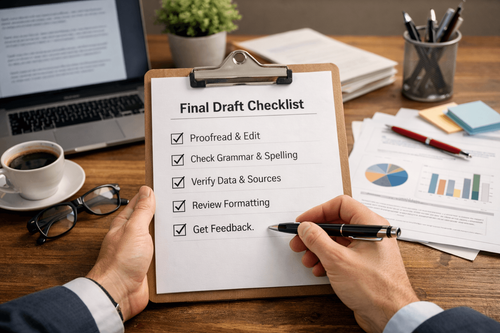

Final Resume & Cover Letter Submission Checklist
You’ve written your resume. You’ve crafted
your cover letter. You’ve customised the content for the role.
And then you click “Submit.”
But here’s the uncomfortable truth: many strong candidates lose opportunities not because of weak experience—but because of avoidable errors in formatting, clarity, alignment, or technical optimisation.
A single typo.
A misaligned job title.
An ATS-incompatible file.
An outdated contact detail.
Small mistakes can silently eliminate you before you ever reach the interview stage.
This guide provides a structured, professional submission checklist that ensures your application is polished, optimised, and strategically aligned before it reaches a recruiter’s inbox.
Who Is This Blog For?
This blog and guidebook are designed for:
- Working professionals applying for new roles
- Mid-career professionals targeting promotions
- Candidates submitting applications to multiple companies
- Career switchers repositioning their profiles
- Professionals who want to increase interview callbacks
If you’ve ever wondered, “Why am I not getting responses?”, this checklist may reveal the answer.
Why This Topic Matters Today?
Hiring today is fast, automated, and competitive. Recruiters often:
- Spend less than 10 seconds scanning resumes
- Use Applicant Tracking Systems (ATS) for keyword filtering
- Shortlist only highly aligned candidates
- Move quickly to fill roles
This means your application must meet three standards simultaneously:
1. Technical optimisation (ATS compatibility)
2. Strategic alignment (role-specific relevance)
3. Professional polish (clarity and credibility)
Missing even one of these can reduce your chances dramatically.
Core Concept or Framework Explained
The Submission Readiness Framework (S.R.C.A.P.)
Before sending your application, evaluate it across five dimensions:
- Structure
- Relevance
- Clarity
- Accuracy
- Presentation
Each dimension protects you from common application errors.
How This Blog and Guidebook Help You?
Together, this blog and guidebook help you:
- Catch hidden mistakes before recruiters do
- Improve ATS compatibility
- Strengthen keyword alignment
- Enhance clarity and readability
- Ensure consistency across resume and cover letter
- Avoid credibility-damaging errors
The result is a submission-ready application that reflects professionalism at every level.
Step-by-Step Breakdown
Step 1: Structure Review
Your resume should follow a logical hierarchy:
- Professional summary
- Core skills aligned to role
- Professional experience
- Education and certifications
Checklist questions:
- Is the layout clean and easy to scan?
- Are section headings consistent?
- Are bullet points aligned properly?
- Is font style professional and readable?
- Is spacing consistent throughout?
Avoid decorative formatting that may break ATS parsing.
Step 2: Relevance Audit
Tailoring is not optional—it is essential.
Ask yourself:
- Have I customised keywords from the job description?
- Do my skills align with the required competencies?
- Are my strongest and most relevant achievements listed first?
- Have I removed irrelevant or outdated experience?
Generic resumes reduce callback rates significantly.
Step 3: Clarity & Impact Check
Strong resumes prioritise measurable results over vague duties.
Review each bullet point:
Weak example:
“Responsible for managing client accounts.”
Stronger example:
“Managed 25+ client accounts, increasing retention rate by 18% within one year.”
Checklist questions:
- Does each bullet start with a strong action verb?
- Are results quantified where possible?
- Is language concise and direct?
- Have I eliminated filler words?
Clarity increases credibility.
Step 4: Accuracy & Consistency Verification
Errors damage trust instantly.
Verify:
- Correct spelling of company names
- Accurate employment dates
- Consistent job titles
- Matching contact information
- Correct grammar and punctuation
- Functional hyperlinks (if included)
Also ensure consistency between resume and LinkedIn profile.
Step 5: ATS Optimisation Check
Applicant Tracking Systems scan for keyword alignment.
Ensure:
- Keywords mirror the job description naturally
- Standard section headings are used (Experience, Education, Skills)
- File format is ATS-friendly (usually PDF unless specified otherwise)
- No graphics, tables, or text boxes that may confuse parsing
Optimisation improves visibility.
Step 6: Cover Letter Alignment Review
If submitting a cover letter:
- Is it tailored to the company?
- Does it reflect the role’s priorities?
- Does it reinforce your most relevant achievements?
- Is the tone professional and confident?
- Does it end with a clear call-to-action?
A mismatched cover letter weakens the overall application.
Step 7: Final Presentation Check
Before submitting:
- Rename your file professionally (FirstName_LastName_Resume)
- Double-check email subject line
- Ensure attachments are included
- Proofread once more after a short break
- Confirm application instructions are followed precisely
Many candidates lose opportunities simply by missing instructions.
Common Mistakes or Pitfalls to Avoid
The guidebook highlights frequent submission errors:
- Sending the wrong file version
- Using unprofessional email addresses
- Submitting without proofreading
- Overloading resume with dense text
- Ignoring role-specific tailoring
- Including irrelevant personal details
- Forgetting to update contact information
Professionalism is demonstrated in details.
How Should You Use This Guidebook Effectively?
Recommended workflow:
1. Complete your resume draft
2. Step away for 30 minutes
3. Review using the S.R.C.A.P. checklist
4. Make corrections
5. Conduct a final read-aloud review
6. Submit confidently
Time required:
- Full checklist review: 30–45 minutes
- Correction phase: 15–30 minutes
This small investment can dramatically increase interview rates.
Key Takeaways
- Submission quality influences interview outcomes
- Structure, relevance, and clarity are non-negotiable
- Tailoring improves visibility
- Quantification strengthens credibility
- ATS optimisation ensures discoverability
- Proofreading protects professionalism
- Small errors create large consequences
A strong application is not just written—it is quality-checked.
Your Next Step: Accelerate Your Career with PlanetSpark
Submitting a polished application is more than a final step—it is a strategic move in your career journey. When your resume and cover letter reflect clarity, accuracy, and measurable impact, you position yourself as a serious professional.
At PlanetSpark, we empower working professionals with structured frameworks that enhance resume writing, interview performance, leadership communication, and workplace confidence. Our programs focus on real-world, outcome-driven skill development.
Visit https://www.planetspark.in/resources to explore:
- Resume and cover letter mastery guides
- Interview preparation frameworks
- Professional communication toolkits
- Career advancement resources
You can also book a free trial session to learn more about PlanetSpark’s Working Professional Courses, designed to help you communicate impact clearly and secure better opportunities.
Opportunities favour the prepared.
Before you click submit, make sure your application reflects your true professional value.
Start building that advantage today—with PlanetSpark.