
Financial Growth Roadmap Across Life Stages for Professionals
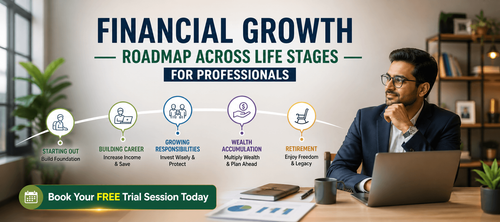

Mapping Financial Growth Across Life Stages: A Practical, Scorecard-Driven Guide for Working Professionals
Most professionals work hard to increase their income, yet very few systematically track whether that income is actually translating into long-term wealth. Promotions, job switches, and investment decisions are often made reactively—driven by urgency, peer influence, or incomplete information.
This creates a critical gap: you may be earning more, but not necessarily building financial stability or independence.
The solution lies in structured financial evaluation. Instead of relying on guesswork, you need a clear system to assess your current financial position, identify opportunities, and track progress over time. This is exactly what financial growth scorecards enable.
Based on the framework from the resource, this blog breaks down how professionals at every stage—from first salary to pre-retirement—can use scenario-specific scorecards to make smarter financial decisions and accelerate wealth creation.
Download these resources and apply them alongside your daily work for improved clarity, productivity, and professional growth. You can also book a free trial to gain expert guidance and enhance your communication, problem-solving, and decision-making skills. The materials are designed in a clear, structured format to help professionals learn efficiently and implement insights with confidence.
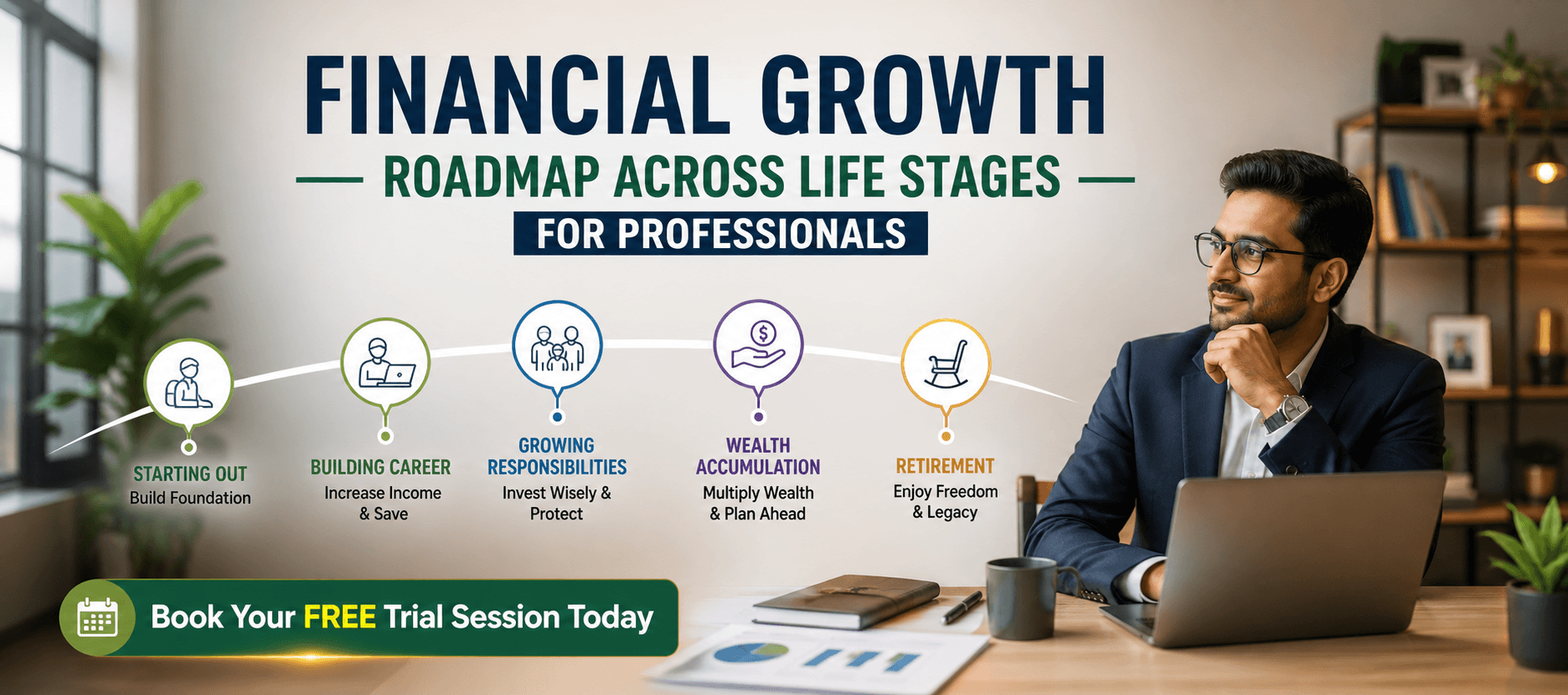
Who Is This Blog For?
- Fresh graduates starting their financial journey with their first salary
- Mid-career professionals aiming to optimise income and investments
- Freelancers managing variable income and financial uncertainty
- Managers and senior leaders looking to maximise compensation and tax efficiency
- Professionals planning major life events like marriage, relocation, or retirement
Why This Topic Matters Today?
Modern professionals face a paradox: increasing access to financial information but decreasing clarity in decision-making.
According to the resource, many professionals:
- Operate reactively instead of strategically
- Focus on income instead of wealth-building rate
- Ignore opportunity cost in career decisions
- Use generic financial advice that does not match their life stage
This leads to inconsistent growth, missed opportunities, and long-term financial stress.
Financial growth is not linear. As highlighted in the guide, opportunities vary significantly based on your career phase, risk appetite, and personal responsibilities.
This makes life-stage-specific financial planning not just useful—but essential.
Core Concept or Framework Explained
The core idea behind this guidebook is simple but powerful: use scorecards to evaluate financial decisions objectively.
Instead of vague goals like “save more” or “invest better,” scorecards:
- Break financial health into measurable metrics
- Assign scores to key areas like savings, debt, and growth potential
- Help compare options objectively
- Enable periodic review and course correction
Each scorecard is tied to a real-world scenario. As shown in the template directory on page 3, there are 10 distinct templates covering moments like:
- First salary planning
- Job offer evaluation
- Career pivots
- Freelance income health
- Investment portfolio alignment
- Retirement readiness
This ensures that your financial decisions are always context-driven, not generic.
How This Blog and Guidebook Help You?
This framework transforms financial planning from abstract thinking into structured execution.
You will be able to:
- Evaluate financial decisions with clarity and confidence
- Identify high-impact opportunities specific to your life stage
- Track measurable progress using scoring systems
- Avoid costly mistakes driven by incomplete analysis
- Build a repeatable system for long-term wealth creation
Most importantly, it helps you shift from reactive money management to proactive financial strategy.
Step-by-Step Breakdown
Step 1: Establish Your Financial Baseline
Start with understanding your current position.
The First Salary Financial Baseline Scorecard (page 4) focuses on:
- Income vs expenses
- Savings rate
- Emergency fund coverage
- Debt-to-income ratio
For example:
- Emergency fund coverage is calculated as savings divided by monthly expenses
- Savings rate is measured as savings divided by take-home income
This gives you a clear starting point for growth.
Step 2: Evaluate Career Decisions Financially
When considering job offers, don’t just compare salaries.
The Job Offer Wealth Potential Scorecard (page 5) evaluates:
- Compensation structure (fixed vs variable)
- ESOP or equity upside
- Benefits and long-term growth
- 5-year wealth trajectory
It even assigns weightage:
- 40 percent to compensation
- 30 percent to life-stage compatibility
- 30 percent to long-term growth
This ensures you make decisions aligned with wealth creation, not just short-term gains.
Step 3: Plan for Career Transitions and Freelancing
For mid-career professionals or freelancers, financial stability becomes critical.
The Career Pivot and Freelance Scorecards (page 6) assess:
- Financial runway (how long savings can sustain you)
- Income gap during transition
- Stability of freelance income
- Client concentration risk
For freelancers, metrics like:
- Percentage of revenue from top client
- Pipeline value for next 90 days
- Emergency fund coverage
help determine income health and resilience.
Step 4: Prepare for Life Events Strategically
Major life events can significantly impact finances.
The Life Event Financial Impact Scorecard (page 7) evaluates:
- One-time costs
- Post-event monthly expenses
- Insurance readiness
- Debt levels
It also identifies gaps such as:
- Insufficient emergency funds
- Inadequate insurance coverage
- Lack of long-term planning
This ensures you enter life transitions financially prepared.
Step 5: Optimise Investments Based on Life Stage
Investment strategies must evolve with age and goals.
The Investment Portfolio Scorecard (page 7) checks:
- Asset allocation across equity, debt, gold, and real estate
- Alignment with life stage
- SIP automation
- Tax-efficient instruments
For example:
- Younger professionals may have higher equity allocation
- Mid-career individuals may balance risk and stability
This ensures your portfolio supports long-term growth.
Step 6: Accelerate Wealth in Mid-Career
The Mid-Career Scorecard (page 8) focuses on milestones like:
- Net worth relative to income
- Retirement corpus progress
- Emergency fund adequacy
- Insurance coverage
It also identifies acceleration opportunities such as:
- Increasing SIP contributions
- Tax optimisation
- Building secondary income streams
This stage is critical for long-term wealth accumulation.
Step 7: Maximise Income as a Manager or Leader
Senior professionals must optimise total compensation, not just salary.
The Manager Income Optimisation Scorecard (page 8) evaluates:
- Tax efficiency (80C, NPS, deductions)
- ESOP strategies
- Benefits utilisation
- Additional income opportunities
This helps reduce tax leakage and maximise wealth-building potential.
Step 8: Plan for Retirement and Financial Independence
The Pre-Retirement Scorecard (page 9) focuses on:
- Retirement corpus vs required corpus
- Passive income readiness
- Debt-free status
- Estate planning
For example:
- Target corpus is typically 25 times annual expenses
- Passive income streams become critical
This ensures a smooth transition to financial independence.
Step 9: Conduct Annual Financial Reviews
The Annual Life-Stage Review Scorecard (page 9) enables:
- Tracking yearly financial goals
- Measuring savings and income growth
- Resetting priorities for the next year
This builds a habit of continuous improvement.
Step 10: Build a Review Habit
As shown in the visual summary on page 10:
- Quarterly: Review income health
- Semi-annual: Rebalance investments
- Annual: Conduct full financial audit
- Event-based: Evaluate major decisions
Consistency is what drives long-term results.
Common Mistakes or Pitfalls to Avoid
- Using generic financial plans without life-stage context
- Focusing only on income instead of wealth-building rate
- Ignoring emergency fund readiness
- Not accounting for opportunity cost in career decisions
- Failing to review finances regularly
Avoiding these mistakes can significantly improve financial outcomes.
How Should You Use This Guidebook Effectively?
To maximise impact:
- Select the scorecard relevant to your current life stage
- Fill in real data honestly
- Use scoring rubrics to evaluate your position
- Identify top 2 to 3 high-impact actions
- Revisit every 6 to 12 months as your situation evolves
Suggested workflow:
- Week 1: Complete one scorecard
- Week 2–4: Implement action steps
- Monthly: Track progress
- Quarterly: Review and adjust
This ensures consistent and structured financial growth.
Key Takeaways
- Financial growth depends on structured evaluation, not just income growth
- Life-stage-specific scorecards provide clarity and relevance
- Measuring savings, debt, and investments improves decision-making
- Career and financial decisions should be evaluated together
- Regular reviews ensure continuous progress and course correction
- Consistency in using these frameworks leads to long-term wealth creation
Your Next Step: Accelerate Your Career with PlanetSpark
Creating an impact-driven resume is not just about landing your next job—it’s about owning your professional story and presenting it with clarity, confidence, and credibility. When your resume clearly communicates value, results, and impact, opportunities follow naturally.
At PlanetSpark, we are committed to empowering working professionals with practical, outcome-focused resources that drive real career growth. From resume building and workplace communication to leadership presence and professional writing, our programs are designed to help you succeed in today’s fast-evolving job market.
Visit https://www.planetspark.in/resources to explore:
- Career and resume-building guides
- Workplace communication and professional writing resources
- Skill-development tools curated for working professionals
Want a deeper, hands-on experience?
You can also book a free trial session to learn more about PlanetSpark’s Working Professional Courses, designed to accelerate your career through personalised coaching, real-world practice, and expert guidance.
Your career deserves more than generic advice.
It deserves clarity, confidence, and measurable impact.
Personalized Communication Roadmaps
Record a video to get a AI generated personalized communication reports