
First Principles Thinking Guide for Career Growth


10 First Principles Thinking Strategies to Solve Problems Faster and Make Better Decisions
Modern professionals are expected to solve bigger problems, make faster decisions, and create better outcomes than ever before. Yet many people approach challenges by copying what others do, relying on assumptions, or repeating outdated processes. This often leads to poor decisions, slow progress, and limited innovation.
Whether you are trying to improve business performance, grow your career, lead a team, or transition into a new role, the ability to think clearly is a competitive advantage. The professionals who stand out are not always the busiest or most experienced—they are often the ones who can break down problems, question assumptions, and rebuild smarter solutions from the ground up.
This is where first principles thinking becomes powerful. Instead of accepting conventional wisdom, it helps you identify what is fundamentally true and reason upward from there. It is a practical framework used by top founders, leaders, strategists, and high performers to solve difficult problems with clarity.
Download these resources and apply them alongside your daily work for improved clarity, productivity, and professional growth. You can also book a free trial to gain expert guidance and enhance your communication, problem-solving, and decision-making skills. The materials are designed in a clear, structured format to help professionals learn efficiently and implement insights with confidence.
Who Is This Blog For?
- Working professionals facing complex decisions at work
- Managers and team leaders solving operational challenges
- Career switchers looking for strategic clarity
- Entrepreneurs and consultants improving business outcomes
- Professionals who want stronger critical-thinking skills
- Anyone tired of surface-level solutions and repeated mistakes
Why This Topic Matters Today?
Today’s workplace rewards people who can think independently, adapt quickly, and solve problems creatively. Many industries are changing faster than traditional playbooks can keep up with. If professionals only rely on existing models, they risk becoming outdated.
Common challenges include:
- Teams repeating inefficient systems because “that is how it has always been done”
- Professionals making decisions based on assumptions instead of facts
- Leaders reacting to symptoms rather than root causes
- Individuals feeling stuck because they cannot see new options
First principles thinking matters because it helps professionals move beyond imitation and toward innovation. It creates clarity when complexity increases.
Core Concept or Framework Explained
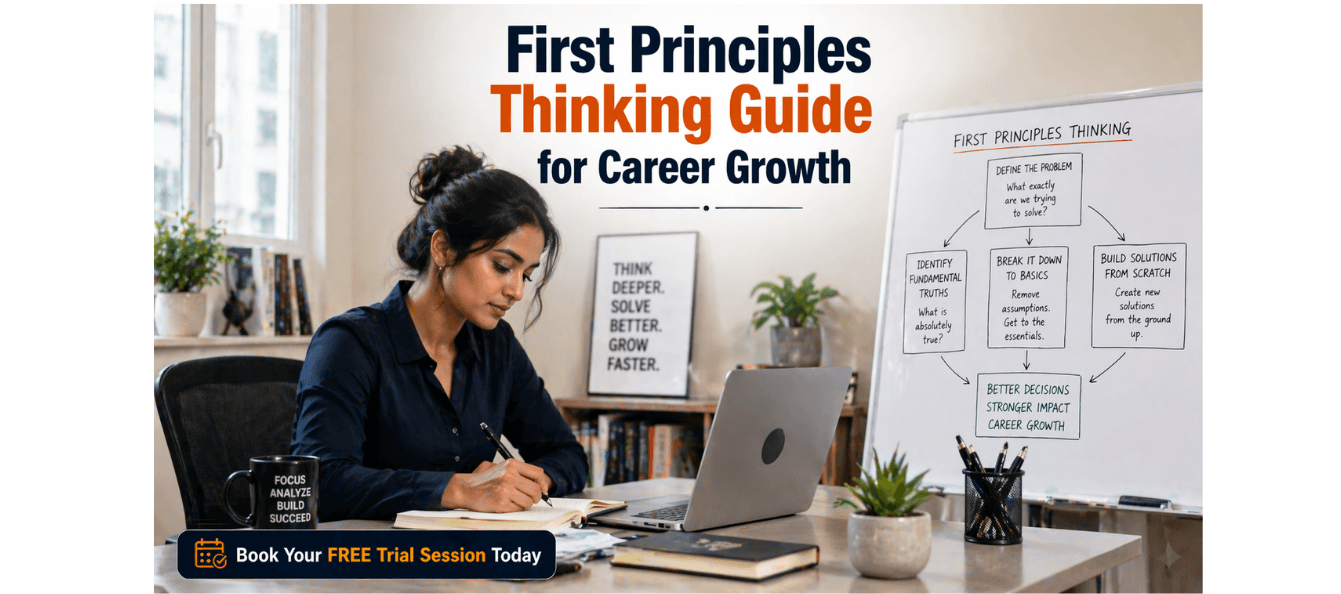
First principles thinking is the process of breaking a problem down into its most basic truths and then rebuilding a solution from those truths.
Instead of asking:
- What do others normally do?
- What is the standard industry approach?
- What worked before?
You ask:
- What do I know to be true?
- What assumptions am I making?
- What are the essential components of this problem?
- If I started from zero, how would I solve this?
The framework typically follows three stages:
Identify Assumptions
Most problems are surrounded by inherited beliefs, habits, and limitations that may no longer be valid.
Break Down the Problem
Separate the challenge into smaller components so each part can be examined clearly.
Rebuild from Fundamentals
Design a better solution based on evidence, logic, and core realities rather than convention.
How This Blog and Guidebook Help You?
This blog and guidebook help professionals develop a smarter decision-making process that can be applied immediately.
You will learn how to:
- Think more clearly under pressure
- Solve recurring workplace problems at the root level
- Make better strategic decisions
- Challenge inefficient systems respectfully
- Improve creativity and innovation
- Build confidence in high-stakes situations
This approach is useful in careers, leadership, productivity, communication, and long-term planning.
Step-by-Step Breakdown
Step 1: Define the Real Problem
Many professionals waste time solving the wrong issue. Before taking action, clearly state the challenge.
Instead of saying:
- Sales are down
Go deeper:
- Why are qualified leads not converting after the proposal stage?
Specific problems lead to useful solutions.
Step 2: List Existing Assumptions
Write down everything you currently believe about the situation.
Examples:
- Clients only care about price
- Our team needs more meetings
- I need another certification before applying for better roles
- This process cannot be changed
Seeing assumptions on paper helps you question them objectively.
Step 3: Separate Facts from Opinions
Now identify what is proven versus what is guessed.
Facts:
- Response rates dropped 18 percent last quarter
- Team project delays increased after adding approval layers
Opinions:
- Clients think we are expensive
- The team is not motivated
This step creates stronger decision-making.
Step 4: Break the Problem into Components
Complex problems become manageable when divided into parts.
For example, career stagnation may involve:
- Weak visibility inside the company
- Limited skill positioning
- Poor networking habits
- Unclear promotion conversations
Once separated, each area can be improved individually.
Step 5: Rebuild from First Principles
Now ask what would work if no old system existed.
Example:
Instead of adding more meetings to improve collaboration, rebuild communication around:
- Clear ownership
- Better written updates
- Faster approvals
- Defined deadlines
This often produces simpler and stronger systems.
Step 6: Test Small Before Scaling
Use experiments rather than assumptions.
Examples:
- Try one new outreach strategy for two weeks
- Run a shorter meeting format for one month
- Test a revised resume with quantified achievements
- Pilot a new workflow with one team first
Small tests reduce risk and improve learning speed.
Step 7: Review Results Objectively
Measure outcomes honestly.
Ask:
- What improved?
- What stayed the same?
- What assumptions were wrong?
- What should be adjusted next?
First principles thinking is iterative, not one-time.
Common Mistakes or Pitfalls to Avoid
Many people misuse strategic thinking by making avoidable errors.
Common mistakes include:
- Overcomplicating simple problems
- Rejecting all existing methods automatically
- Confusing opinions with facts
- Skipping testing and going straight to major changes
- Using first principles only in theory, not action
- Ignoring people impact while redesigning systems
A better approach is to stay practical, evidence-based, and balanced.
How Should You Use This Guidebook Effectively?
Use this guidebook as a weekly decision-making tool.
Suggested workflow:
- Choose one recurring problem at work
- Define the real issue clearly
- List assumptions around it
- Identify core facts
- Build one smarter alternative solution
- Test it on a small scale
- Review results and refine
Key Takeaways
- First principles thinking helps solve problems from the root level
- It replaces assumptions with facts and logic
- Breaking problems into smaller parts improves clarity
- Better solutions often come from rebuilding systems simply
- Small experiments reduce risk and improve decisions
- This framework is valuable for careers, leadership, and business growth
- Professionals who think independently create stronger outcomes
Your Next Step: Accelerate Your Career with PlanetSpark
Creating an impact-driven resume is not just about landing your next job—it’s about owning your professional story and presenting it with clarity, confidence, and credibility. When your resume clearly communicates value, results, and impact, opportunities follow naturally.
At PlanetSpark, we are committed to empowering working professionals with practical, outcome-focused resources that drive real career growth. From resume building and workplace communication to leadership presence and professional writing, our programs are designed to help you succeed in today’s fast-evolving job market.
Visit https://www.planetspark.in/resources to explore:
- Career and resume-building guides
- Workplace communication and professional writing resources
- Skill-development tools curated for working professionals
Want a deeper, hands-on experience?
You can also book a free trial session to learn more about PlanetSpark’s Working Professional Courses, designed to accelerate your career through personalised coaching, real-world practice, and expert guidance.
Your career deserves more than generic advice.
It deserves clarity, confidence, and measurable impact.
Personalized Communication Roadmaps
Record a video to get a AI generated personalized communication reports