
Future-Proof Skills: A 2026 Guide for Global Career Growth
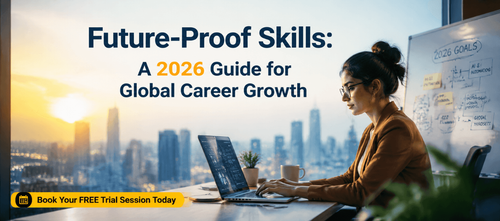

Determine Future Skills That Will Be Globally Valuable
The world of work is evolving at an unprecedented pace. New technologies, geopolitical shifts, and societal changes are shaping what skills will be valuable in the future. Many professionals feel uncertain about how to adapt, with many wondering if their current skill sets will remain relevant. The challenge lies not in lack of information, but in sifting through the noise to identify truly valuable, future-proof skills.
This guide is for professionals who want to future-proof their careers by identifying the skills that will remain valuable in the years to come. The goal is not to guess, but to rely on a structured, repeatable system that enables you to make informed, confident decisions about where to invest your time and learning energy.
Download these resources and apply them alongside your daily work for improved clarity, productivity, and professional growth. You can also book a free trial to gain expert guidance and enhance your communication, problem-solving, and decision-making skills. The materials are designed in a clear, structured format to help professionals learn efficiently and implement insights with confidence.
Who Is This Blog For?
This guide is ideal for professionals looking to future-proof their careers by identifying globally valuable skills:
- Career changers exploring new directions
- Mid-career professionals feeling stagnant
- Consultants positioning for premium work
- Managers building future-ready teams
- Early-career professionals building strategically
Why This Topic Matters Today?
In a world where career paths are constantly shifting, staying ahead of the curve has become essential. As automation, AI, and other disruptive technologies rapidly evolve, the skill sets that were once in high demand are now being replaced or automated. The key is not just being aware of emerging trends, but understanding which skills will remain valuable in the long term. This guide provides a framework to help professionals identify these skills and make informed decisions about their learning investments.
Core Concept or Framework Explained
The framework presented in this guide is designed to help you identify valuable future skills systematically. It’s built on a six-step system that moves from global awareness to personal action, ensuring that you don’t just learn about trends but are equipped to make decisions that align with both global demands and your personal strengths.
The six steps include:
1. Scan the Horizon: Identify global signals that indicate future skill demand.
2. Filter for Durability: Separate short-lived trends from sustainable skills using a durability framework.
3. Map to Your Strengths: Align global demand with your existing strengths and interests.
4. Validate with the Market: Confirm that the skill is in demand by testing it against real market data.
5. Build Your Learning Plan: Create a 90-day plan for focused skill development.
6. Review and Recalibrate: Continuously evaluate your progress and adjust your learning plan.
How This Blog and Guidebook Help You?
This blog and the guidebook provide a clear framework for identifying future skills that are globally valuable. By following the six-step system, you will:
- Understand global trends and their implications for your career
- Filter out trends that are short-lived and focus on durable skills
- Align your learning with your personal strengths and professional goals
- Validate skill demand through market research and real-world data
- Create a structured, time-bound learning plan to ensure progress
- Build habits that keep your skill strategy alive and adaptable
The result is not just a list of skills, but a strategic, actionable plan to build and refine your skills in alignment with long-term career growth.
Step-by-Step Breakdown
Step 1: Scan the Horizon
The first step in the system is scanning the global signals for emerging skills. This involves reviewing sources like labor market data, investment flows, technology milestones, and policy announcements. Rather than searching for individual tools, look for broad capabilities that will be valuable across industries and regions.
Step 2: Filter for Durability
Once you’ve identified potential skills, assess whether they will remain valuable in the long term. The **DEEP Durability Framework** helps you evaluate skills based on:
- **Depth of Application**: Can the skill be applied across multiple industries and roles?
- **Exposure to Automation**: How much of the skill can be automated by AI?
- **Exportability**: Is the skill valued globally, or only in specific regions?
- **Pace of Demand Growth**: Is the skill in high, growing demand, or is it already mature?
Skills that score highly on the **DEEP** framework are worth investing in, while those that score low should be approached with caution.
Step 3: Map to Your Strengths
Next, map the identified skills to your personal strengths. The **Three-Circle Intersection Model** helps you find the overlap between:
- **Global Skill Demand**
- **Your Existing Strengths**
- **Your Authentic Interests**
By focusing on skills that are aligned with your strengths and passions, you will maximize your ability to succeed and remain engaged with your learning journey.
Step 4: Validate with the Market
Before investing significant time in learning a new skill, validate its market demand. Use tools like job posting volumes, salary premiums, freelance market checks, and community engagement data to ensure that the skill is in real demand.
Step 5: Build Your Learning Plan
The 90-day sprint model is the foundation of your learning plan. Each sprint focuses on building one skill in a structured, time-bound way:
- **Days 1–15**: Concept immersion — understand the landscape and core frameworks.
- **Days 16–45**: Application — work on a real or simulated project to apply concepts.
- **Days 46–75**: Credibility — build visible proof by contributing to a community or creating a portfolio piece.
- **Days 76–90**: Review — assess progress and plan your next learning sprint.
By committing to one skill at a time with defined milestones, you’ll ensure steady progress without overwhelming yourself.
Step 6: Review and Recalibrate
Review your progress at regular intervals — weekly, monthly, and quarterly. This continuous review ensures that you stay on track, adapt to new trends, and refine your learning strategy as needed.
Common Mistakes or Pitfalls to Avoid
Many professionals make these common mistakes when building their future skills:
- **Chasing Tools, Not Capabilities**: Focus on learning transferable skills rather than specific tools that may become obsolete.
- **Treating Certificates as Credentials**: A certificate alone does not demonstrate capability; apply your learning in real-world projects.
- **Learning in Isolation**: Make your learning visible to others to build professional value.
- **Skipping the Strengths Audit**: Always ensure the skills align with your existing strengths to avoid a steep learning curve.
- **Learning Without a Time Constraint**: Without a set deadline, your learning may lose momentum.
- **One-Time Planning**: Regularly revisit your learning strategy to ensure it remains relevant and effective.
How Should You Use This Guidebook Effectively?
To get the most out of this guide:
- Start by identifying your career goal and reflecting on your strengths
- Use the **DEEP** framework to filter skills based on durability
- Validate skill demand through market research and real-world data
- Create a 90-day learning sprint plan for focused skill development
- Regularly review and update your plan to stay on track
Key Takeaways
- Future skills are telegraphed in advance by global trends and signals.
- Use the **DEEP** framework to evaluate the durability of skills before committing to them.
- Find the intersection between what the world needs and what aligns with your strengths and interests.
- Validate demand using real market data before investing time in acquiring a new skill.
- Build your learning plan using the 90-day sprint model for focused, consistent growth.
- Continuously review and adjust your learning strategy to stay ahead of the curve.
Your Next Step: Accelerate Your Career with PlanetSpark
Creating an impact-driven resume is not just about landing your next job—it’s about owning your professional story and presenting it with clarity, confidence, and credibility. When your resume clearly communicates value, results, and impact, opportunities follow naturally.
At PlanetSpark, we are committed to empowering working professionals with practical, outcome-focused resources that drive real career growth. From resume building and workplace communication to leadership presence and professional writing, our programs are designed to help you succeed in today’s fast-evolving job market.
Visit https://www.planetspark.in/resources to explore:
- Career and resume-building guides
- Workplace communication and professional writing resources
- Skill-development tools curated for working professionals
Want a deeper, hands-on experience?
You can also book a free trial session to learn more about PlanetSpark’s Working Professional Courses, designed to accelerate your career through personalised coaching, real-world practice, and expert guidance.
Your career deserves more than generic advice.
It deserves clarity, confidence, and measurable impact.
Personalized Communication Roadmaps
Record a video to get a AI generated personalized communication reports