
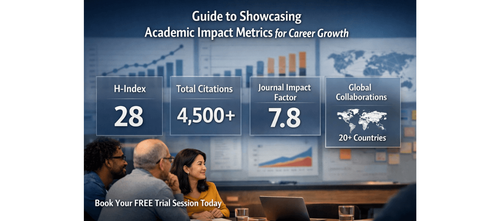
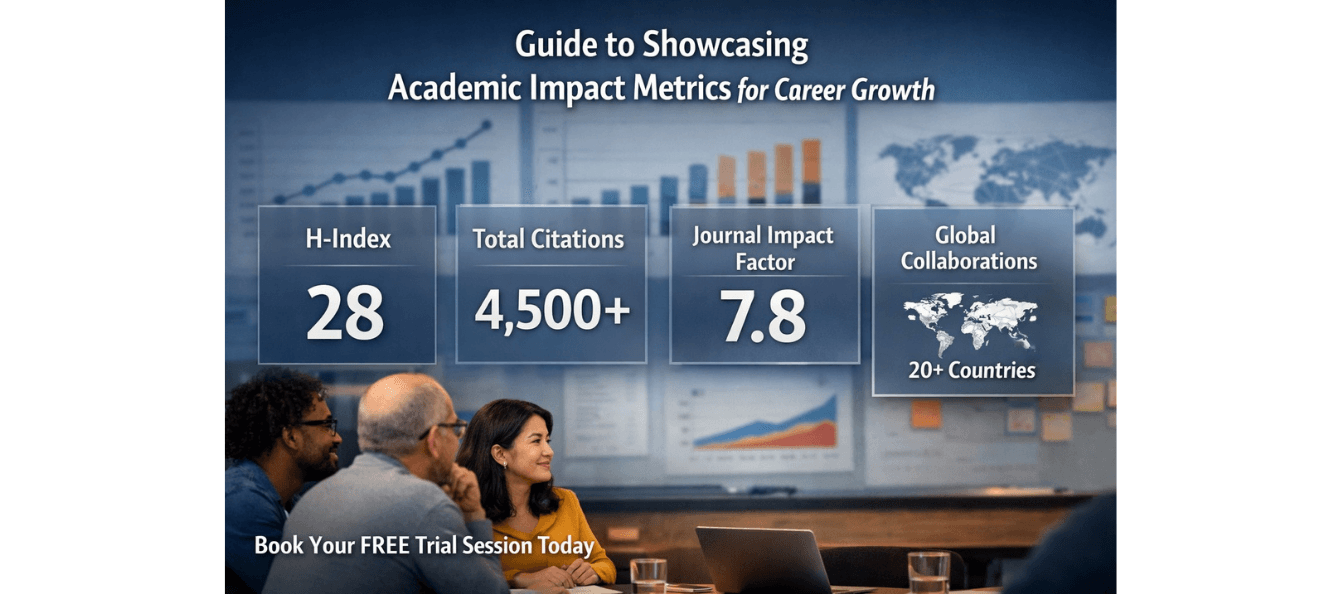
Guide to Showcasing Academic Impact Metrics for Career Growth

Academic CV Templates to Showcase Impact Metrics: Create a Recruiter-Ready CV That Gets You Shortlisted
In today’s competitive academic and research landscape, qualifications alone are no longer enough to secure interviews. You may have strong publications, solid teaching experience, and meaningful research contributions—but if your CV fails to present them clearly and convincingly, it simply gets overlooked. Hiring committees, funding panels, and institutional reviewers often scan hundreds of applications, spending only seconds on each profile.
The real challenge is not what you’ve done—it’s how effectively you communicate your academic impact. Metrics like citations, h-index, grants secured, and student outcomes are powerful signals, but only when they are structured, visible, and easy to interpret.
This is exactly where well-designed, metrics-driven CV templates make a difference. They help you transform scattered achievements into a compelling academic narrative that gets noticed quickly and positions you as a credible, high-impact professional.
Download these resources and apply them alongside your daily work for improved clarity, productivity, and professional growth. You can also book a free trial to gain expert guidance and enhance your communication, problem-solving, and decision-making skills. The materials are designed in a clear, structured format to help professionals learn efficiently and implement insights with confidence.
Who Is This Blog For?
- PhD holders and postdoctoral researchers applying for academic positions
- Faculty members seeking teaching or lecturer roles in universities and colleges
- Researchers applying for grants, fellowships, or funded programmes
- Industry professionals transitioning into academia or research roles
- Early-career academics building their first structured CV
- Senior academics showcasing consulting, advisory, or interdisciplinary work
- Professionals applying for international academic roles or global research bodies
Why This Topic Matters Today?
Academic hiring has become increasingly competitive, with institutions receiving hundreds of applications for a single role. In such a crowded environment, decision-makers rarely read CVs in detail during the first screening—they scan for signals of impact.
This creates a critical gap. Many professionals list responsibilities and achievements but fail to present measurable outcomes. Without clear metrics such as publication counts, citation impact, grant funding, or student success rates, even strong profiles appear average.
Additionally, different roles demand different emphasis. A research-focused role prioritises publications and citations, while a teaching role values student outcomes and curriculum innovation. A one-size-fits-all CV no longer works.
This is why structured, scenario-specific CV templates that highlight academic impact metrics are essential. They align your profile with what decision-makers are actively looking for.
Core Concept or Framework Explained
The central idea behind these CV templates is simple but powerful: academic impact must be quantified, structured, and immediately visible.
Instead of presenting information in a generic format, the templates are built around specific professional scenarios. Each template is designed to highlight the most relevant metrics for that context.
For example:
- Research-focused CVs prioritise h-index, citations, and publications
- Teaching-focused CVs highlight student satisfaction, pass rates, and course design
- Grant CVs focus on funding secured and project delivery outcomes
- Metrics-first CVs place numbers at the very top for immediate attention
The framework follows three key principles:
Clarity
Information is organised into clearly defined sections so reviewers can scan quickly.
Relevance
Each template aligns with a specific career stage or application type.
Quantification
Every major achievement is supported by measurable data wherever possible.
This structured approach ensures that your CV communicates value within seconds.
How This Blog and Guidebook Help You?
This blog, along with the template pack, helps you shift from a generic CV to a high-impact, results-driven academic profile.
You will be able to:
- Present your academic achievements in a structured, professional format
- Highlight metrics that matter most to hiring committees and funding bodies
- Choose the right CV format based on your career stage and goals
- Customise your CV for different roles without starting from scratch
- Improve your chances of shortlisting by making your profile easy to scan
Ultimately, the goal is to help you move from being “qualified” to being “clearly impactful.”
Step-by-Step Breakdown
Choose the Right Template for Your Scenario
The template pack includes 10 distinct CV formats, each designed for a specific use case:
- Academic Research CV for publication-heavy roles
- Faculty Application CV for teaching positions
- Grant and Funding CV for research funding applications
- Industry-to-Academia Transition CV for career pivots
- Early-Career Academic CV for beginners
- Metrics-First Impact CV for senior professionals
- Interdisciplinary Research CV for cross-domain work
- Academic Consultant CV for advisory roles
- International Academic CV for global applications
- Teaching-Focused CV for education-centric roles
Selecting the right template ensures your strengths are presented in the most relevant way.
Replace Placeholder Content with Real Data
Each template uses bracketed placeholders such as [Full Name] or [Publication Title]. These act as guided prompts to ensure you include all necessary information.
Replace each placeholder with:
- Accurate academic credentials
- Verified publication details
- Real metrics such as citations, h-index, or funding amounts
- Specific teaching or research outcomes
Leaving placeholders incomplete reduces credibility and signals lack of attention to detail.
Lead with Metrics That Matter
One of the most important steps is positioning your strongest metrics at the top of your CV.
Examples include:
- h-index and total citations
- Number of publications
- Total funding secured
- Student satisfaction scores
- Pass rates or placement outcomes
These metrics act as quick decision-making signals for reviewers.
Customise for Each Application
Even with templates, customisation is critical.
For example:
- A research role should emphasise publications and citations
- A teaching role should highlight course outcomes and pedagogy
- A consulting role should focus on client impact and deliverables
The structure remains consistent, but the emphasis changes based on the role.
Convert and Format Professionally
The templates are designed to be flexible and editable.
You can:
- Convert PDF to Word using tools like Adobe Acrobat
- Upload and edit in Google Docs
- Adjust fonts, spacing, and section order
Always review formatting after conversion to ensure alignment and readability.
Export and Submit Correctly
Before submission:
- Export your CV as a PDF
- Ensure formatting is intact
- Verify all details are accurate
- Save both a master version and a customised version
Submitting a polished, consistent document reinforces professionalism.
Common Mistakes or Pitfalls to Avoid
Generic summaries
Avoid vague statements like “passionate researcher.” Replace them with specific, measurable impact statements.
Missing metrics
Failing to include numbers such as citations, funding, or student outcomes weakens your profile significantly.
Inconsistent formatting
Formatting errors during conversion can make your CV look unprofessional and difficult to read.
Irrelevant information
Including unnecessary sections dilutes focus. Tailor each CV to the specific role.
Incomplete placeholders
Leaving bracketed text unfilled signals carelessness and reduces credibility.
Lack of verification
Incorrect publication details or mismatched dates can raise concerns during evaluation.
How Should You Use This Guidebook Effectively?
To get the best results from this template pack, follow a structured workflow:
Start with the right template
Choose one that matches your career stage and target role.
Invest focused time
Spend 2–4 hours gathering accurate data, metrics, and achievements before filling the template.
Build a master CV
Create a comprehensive version that includes all your achievements.
Customise for each application
Adjust sections and emphasis based on the role you are applying for.
Review and refine
Ask a mentor or colleague to review your CV before submission.
Update regularly
Keep your CV updated with new publications, metrics, and achievements.
This approach ensures consistency, accuracy, and long-term usability.
Key Takeaways
- Academic CVs must highlight impact, not just responsibilities
- Metrics such as citations, funding, and student outcomes are critical
- Different roles require different CV structures and emphasis
- Templates simplify formatting but require strong content to be effective
- Customisation for each application significantly improves success rates
- Clean formatting and accurate data are essential for credibility
- A well-structured CV helps you stand out in seconds
Your Next Step: Accelerate Your Career with PlanetSpark
Creating an impact-driven resume is not just about landing your next job—it’s about owning your professional story and presenting it with clarity, confidence, and credibility. When your resume clearly communicates value, results, and impact, opportunities follow naturally.
At PlanetSpark, we are committed to empowering working professionals with practical, outcome-focused resources that drive real career growth. From resume building and workplace communication to leadership presence and professional writing, our programs are designed to help you succeed in today’s fast-evolving job market.
Visit https://www.planetspark.in/resources to explore:
- Career and resume-building guides
- Workplace communication and professional writing resources
- Skill-development tools curated for working professionals
Want a deeper, hands-on experience?
You can also book a free trial session to learn more about PlanetSpark’s Working Professional Courses, designed to accelerate your career through personalised coaching, real-world practice, and expert guidance.
Your career deserves more than generic advice.
It deserves clarity, confidence, and measurable impact.
Personalized Communication Roadmaps
Record a video to get a AI generated personalized communication reports