
Handling Communication Breakdowns at Work: Practical Guide
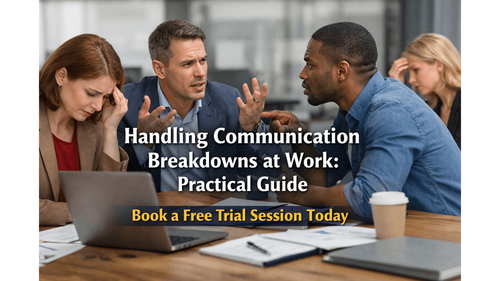

Mastering Communication Breakdowns at Work: A Practical Framework to Resolve Conflict and Build Stronger Professional Relationships
Have you ever walked out of a meeting feeling misunderstood, frustrated, or unsure of what just went wrong? In today’s fast-paced workplace, communication breakdowns are not rare—they are inevitable. But what separates high-performing professionals from the rest is not avoiding these breakdowns, but knowing how to handle them effectively.
When communication fails, projects stall, trust erodes, and opportunities slip away. Most professionals don’t lack communication skills—they lack a structured approach to fixing conversations when they go off track. This is where a proven framework becomes critical.
This guide transforms a powerful communication framework into a practical, actionable strategy to help you identify, address, and resolve communication breakdowns before they damage your professional growth.
Book your free trial session today with Planetspark.
Download for more details
Who Is This Blog For?
- Working professionals navigating team dynamics
and workplace communication challenges
- Managers and team leaders responsible for alignment and collaboration
- Consultants and client-facing professionals managing expectations
- Mid-career professionals aiming to strengthen leadership communication
- Individuals struggling with recurring misunderstandings or unresolved conflicts
Why This Topic Matters Today?
Communication breakdowns are one of the most underestimated productivity killers in modern workplaces. They often appear as small issues—a missed email, a confusing brief, or a tense conversation—but their hidden impact is far greater.
They delay decisions, reduce efficiency, and damage relationships that take years to build. Research shows that most workplace conflicts arise not from intent, but from miscommunication—unclear expectations, misinterpreted tone, and unspoken assumptions.
In an environment driven by collaboration, speed, and cross-functional work, the ability to repair communication breakdowns is no longer optional—it is a core professional skill.
Core Concept or Framework Explained
At the heart of effective communication repair is the CLEAR Framework—a structured, five-stage approach designed to move conversations from confusion to clarity.
Each stage represents a deliberate action:
- Catch It Early by recognising warning signs
- Listen to Understand before reacting
- Express with Precision to communicate clearly
- Align on Shared Ground to move forward collaboratively
- Reset and Rebuild to restore trust and prevent recurrence
The power of this framework lies in its sequence. Skipping steps—especially listening and alignment—is the most common reason breakdowns repeat. When applied correctly, it transforms reactive conversations into intentional, outcome-driven dialogue.
How This Blog and Guidebook Help You?
This blog and the underlying framework equip you to:
- Identify communication issues before they escalate
- Diagnose the root cause instead of reacting to symptoms
- Communicate difficult messages without triggering defensiveness
- Build alignment even in high-conflict situations
- Strengthen long-term professional relationships through trust and clarity
The result is not just better conversations—but stronger credibility, influence, and leadership presence.
Step-by-Step Breakdown
Step 1: Catch It Early — Recognising the Warning Signs
Communication breakdowns rarely happen suddenly. They build through subtle signals that professionals often ignore.
These signals fall into three categories:
- Verbal signals such as vague responses or repeated explanations
- Non-verbal signals like silence in meetings or delayed replies
- Structural signals including missed deadlines or decisions made without key stakeholders
The goal at this stage is awareness, not judgment. Instead of jumping to conclusions, focus on identifying patterns. Early detection allows you to address issues before they escalate into conflict.
Step 2: Listen to Understand — Diagnosing the Root Cause
The instinct to explain yourself is natural—but premature. Effective professionals resist this impulse and prioritise understanding first.
Listening in this context is an active diagnostic tool. It involves:
- Understanding what the other person actually said
- Recognising the emotions behind their words
- Identifying unmet needs such as clarity, respect, or inclusion
Before responding, you should be able to answer three questions confidently:
What do they mean?
How do they feel?
What do they need?
Only then can you move forward constructively.
Step 3: Express with Precision — Communicating Clearly
Once you understand the root cause, the next step is expressing your perspective in a way that opens dialogue instead of shutting it down.
Effective communication here follows a simple structure:
- Start with an observation, not a conclusion
- Describe the impact factually
- Clearly state your need
- Invite the other person’s perspective
For example, saying “I noticed the project brief changed after our last discussion” is far more effective than “You keep changing requirements.” Precision reduces defensiveness and increases clarity.
Step 4: Align on Shared Ground — Finding Mutual Understanding
Resolution does not require agreement about the past. It requires alignment on the future.
This stage focuses on:
- Identifying shared goals such as project success or team performance
- Acknowledging the other person’s experience without assigning blame
- Co-creating a solution that works for both parties
When both sides contribute to the solution, commitment increases significantly. Alignment shifts the conversation from conflict to collaboration.
Step 5: Reset and Rebuild — Restoring the Relationship
Many professionals stop after resolving the immediate issue. This is a mistake.
True resolution requires rebuilding trust through consistent follow-through. This includes:
- Sending a follow-up summary within 72 hours
- Delivering on agreed actions
- Proactively checking in
Small, consistent actions rebuild trust faster than one-time gestures. This stage ensures the same breakdown does not repeat.
Common Mistakes or Pitfalls to Avoid
Even experienced professionals make predictable mistakes during communication breakdowns:
- Jumping to solutions without understanding the root cause
- Defending intent instead of acknowledging impact
- Avoiding difficult conversations altogether
- Using email or text for emotionally complex discussions
- Escalating issues prematurely instead of resolving directly
- Addressing symptoms rather than underlying causes
- Skipping the rebuilding phase after resolution
Avoiding these mistakes significantly improves your ability to handle challenging conversations.
How Should You Use This Guidebook Effectively?
To maximise results, use the framework as a practical tool rather than just a concept:
- Read the framework once to understand the structure
- Apply one stage at a time in real workplace situations
- Use worksheets and templates to prepare for conversations
- Allocate short, focused practice sessions over 2–4 weeks
- Reflect after each interaction to identify improvement areas
Consistency is key. Communication is a skill that improves with deliberate practice, not passive reading.
Key Takeaways
- Communication breakdowns have early warning signals—learn to recognise them
- Always diagnose the root cause before responding
- Use precise, observation-based communication
- Focus on alignment, not winning the argument
- Follow through after resolution to rebuild trust
- Avoid common reactive mistakes that escalate conflict
- Practise consistently to build long-term communication strength
Your Next Step: Accelerate Your Career with PlanetSpark
Creating an impact-driven resume is not just about landing your next job—it’s about owning your professional story and presenting it with clarity, confidence, and credibility. When your resume clearly communicates value, results, and impact, opportunities follow naturally.
At PlanetSpark, we are committed to empowering working professionals with practical, outcome-focused resources that drive real career growth. From resume building and workplace communication to leadership presence and professional writing, our programs are designed to help you succeed in today’s fast-evolving job market.
Visit https://www.planetspark.in/resources to explore:
- Career and resume-building guides
- Workplace communication and professional writing resources
- Skill-development tools curated for working professionals
Want a deeper, hands-on experience?
You can also book a free trial session to learn more about PlanetSpark’s Working Professional Courses, designed to accelerate your career through personalised coaching, real-world practice, and expert guidance.
Your career deserves more than generic advice.
It deserves clarity, confidence, and measurable impact.
Start building that advantage today—with PlanetSpark.
Personalized Communication Roadmaps
Record a video to get a AI generated personalized communication reports