
High-Growth Leadership Resume Guide for Professionals 2026
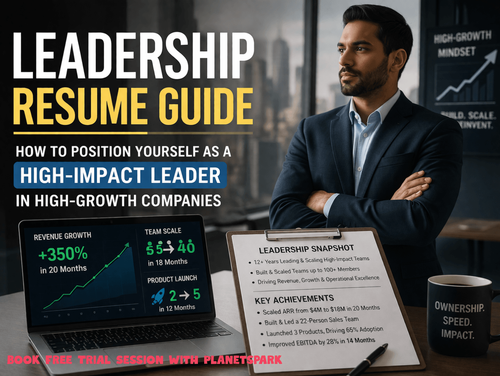

Leadership Resume Guide for High-Growth Companies: How to Position Yourself as a High-Impact Leader
You might have built teams, scaled operations, launched products, or driven revenue growth—but if your resume still reads like a traditional corporate document, you are likely being overlooked by high-growth companies.
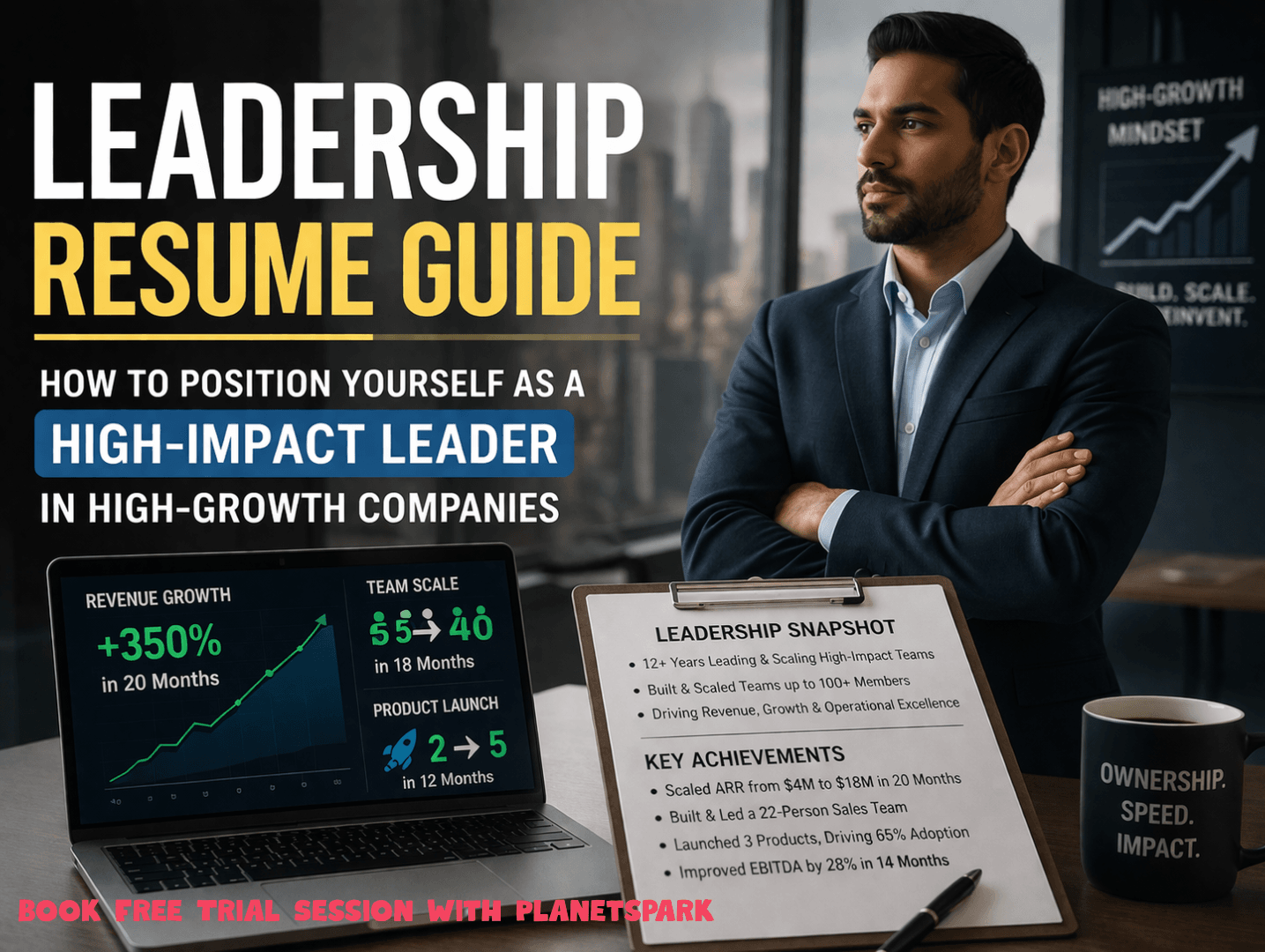
Book your free trial session today with Planetspark.
Download for more details or PDF file.
Startups, scaleups, and hypergrowth organisations don’t hire based on responsibilities. They hire based on proof of ownership, speed, and measurable impact. If your resume says “managed a team” instead of “built and scaled a team from 5 to 40,” you are already losing attention in the first few seconds.
As highlighted in the guide, recruiters in high-growth environments scan resumes in under eight seconds, searching for clear signals of leadership, execution, and growth. This blog shows you how to structure your resume to match exactly what these companies are looking for.
Who Is This Blog For?
- Managers, directors, and senior individual contributors working in fast-scaling companies
- Professionals transitioning from enterprise roles to startups or scaleups
- Leaders aiming for VP, Director, or C-suite roles in high-growth environments
- First-time managers building a leadership narrative
- Consultants and strategic operators moving into execution roles
Why This Topic Matters Today?
High-growth companies are redefining how hiring works. Unlike traditional organisations, they prioritise speed, adaptability, and measurable outcomes over tenure and job titles.
According to the resource, these companies are not hiring people to maintain systems—they are hiring people to build, scale, and reinvent them continuously.
This shift creates a major challenge for professionals:
- Traditional resumes fail to demonstrate ownership
- Generic language signals low impact
- Lack of quantified growth reduces credibility
- Leadership potential remains invisible
In this environment, your resume must act as proof that you can operate in ambiguity and deliver results under pressure.
Core Concept or Framework Explained
The core idea behind this guide is simple:
Leadership resumes for high-growth companies must demonstrate ownership, scale, and measurable outcomes.
This is achieved through three key principles:
Ownership-first language
Use verbs that signal accountability and action such as Built, Led, Launched, Scaled, Delivered
Growth-driven metrics
Every achievement should show measurable growth such as revenue, headcount, product adoption, or operational efficiency
Contextual storytelling
Explain the environment in which you operated, including company stage, team size, and growth trajectory
For example:
- Weak: Responsible for managing a sales team
- Strong: Built and led a 22-person sales team, scaling ARR from $4M to $18M in 20 months
This shift transforms your resume from descriptive to decisive.
How This Blog and Guidebook Help You?
This guidebook helps you reposition your experience for high-growth hiring environments by:
- Translating traditional experience into startup-ready narratives
- Highlighting leadership signals that recruiters actively scan for
- Structuring your resume for both ATS and human reviewers
- Helping you stand out in highly competitive leadership hiring pipelines
- Aligning your resume with real-world hiring scenarios
It ensures that your resume answers the most important question: What impact did you create?
Step-by-Step Breakdown
Step 1: Understand What High-Growth Recruiters Look For
Recruiters in these companies are looking for:
- Evidence of building or scaling something
- Measurable business outcomes
- Ability to operate in ambiguity
- Cross-functional leadership
Your resume must reflect these signals clearly within seconds.
Step 2: Choose the Right Leadership Scenario Template
The guide includes 10 scenario-specific templates designed for real leadership situations:
- The Scaleup Builder who builds teams and systems from scratch
- The Revenue Accelerator who drives exponential growth
- The Enterprise-to-Startup Pivot professional
- The First-Time People Manager
- The Chief of Staff transitioning into leadership
- The Turnaround Leader
- The Cross-Functional Catalyst
- The International Expansion Lead
- The Founding Team Leader
- The Consultant-turned-Operator
Selecting the right scenario ensures your experience is framed correctly.
Step 3: Lead with a Strong Leadership Snapshot
Your resume should begin with a concise summary that includes:
- Your leadership scope
- Team size managed or built
- One defining achievement
This creates immediate clarity for the recruiter.
Step 4: Use Ownership Language Consistently
Avoid passive or vague phrases such as:
- Helped
- Assisted
- Supported
Replace them with strong action verbs like:
- Built
- Led
- Owned
- Drove
- Delivered
This signals confidence and accountability.
Step 5: Quantify Growth and Impact
Every bullet point should include at least one measurable metric.
Examples include:
- Revenue growth
- Team expansion
- Product adoption
- Cost reduction
- Time-to-market improvement
The resource emphasises that every bullet must contain a number to demonstrate real impact.
Step 6: Provide Business Context
High-growth hiring decisions depend on context.
You should clearly mention:
- Company stage such as Series A, B, or C
- Business size such as ARR or headcount
- Your mandate when you joined
This helps recruiters understand the scale of your contribution.
Step 7: Highlight Scenario-Specific Achievements
Each template focuses on different leadership signals.
For example:
- Scaleup Builder highlights team growth and system creation
- Revenue Accelerator focuses on ARR and sales performance
- Turnaround Leader emphasises reversing decline
Tailor your achievements accordingly.
Step 8: Demonstrate Cross-Functional Leadership
High-growth leaders rarely operate in silos.
Your resume should show:
- Collaboration across teams
- Stakeholder alignment
- Influence without authority
This is especially critical for roles like program managers or strategic operators.
Step 9: Optimise for ATS and Readability
The guide emphasises practical ATS rules:
- Use standard section headings such as Experience and Education
- Avoid placing key information inside images or complex tables
- Mirror keywords from the job description
These steps ensure your resume is both searchable and readable.
Step 10: Finalise with a Strong Submission Checklist
Before submitting your resume:
- Ensure every bullet is quantified
- Replace passive language with ownership language
- Tailor your resume to the job description
- Keep it concise and structured
This final review can significantly increase your chances of shortlisting.
Common Mistakes or Pitfalls to Avoid
The guide highlights critical mistakes that weaken leadership resumes:
- Using traditional corporate language instead of ownership language
- Focusing on responsibilities instead of outcomes
- Failing to include measurable growth metrics
- Ignoring the context of company stage and scale
- Writing generic summaries that do not reflect leadership intent
These mistakes can make even strong leaders appear average.
How Should You Use This Guidebook Effectively?
To maximise the value of this resource:
- Select the template that matches your leadership scenario
- Spend 1–2 focused hours inputting accurate and quantified data
- Tailor your resume for each application
- Align your resume with your LinkedIn and personal brand
- Continuously update it as your leadership scope grows
The templates are designed for immediate use—simply customise and apply.
Key Takeaways
- High-growth companies hire based on impact, not responsibilities
- Leadership resumes must demonstrate ownership, scale, and outcomes
- Scenario-based templates improve clarity and relevance
- Quantification is essential for credibility
- Strong action verbs signal leadership and accountability
- Context such as company stage and team size strengthens your narrative
- Tailored resumes outperform generic ones in competitive hiring
Your Next Step: Accelerate Your Career with PlanetSpark
Creating an impact-driven resume is not just about landing your next job—it’s about owning your professional story and presenting it with clarity, confidence, and credibility. When your resume clearly communicates value, results, and impact, opportunities follow naturally.
At PlanetSpark, we are committed to empowering working professionals with practical, outcome-focused resources that drive real career growth. From resume building and workplace communication to leadership presence and professional writing, our programs are designed to help you succeed in today’s fast-evolving job market.
Visit https://www.planetspark.in/resources to explore:
- Career and resume-building guides
- Workplace communication and professional writing resources
- Skill-development tools curated for working professionals
Want a deeper, hands-on experience?
You can also book a free trial session to learn more about PlanetSpark’s Working Professional Courses, designed to accelerate your career through personalised coaching, real-world practice, and expert guidance.
Your career deserves more than generic advice.
It deserves clarity, confidence, and measurable impact.
Personalized Communication Roadmaps
Record a video to get a AI generated personalized communication reports