
High-Stakes Brand Storytelling Guide for Professionals
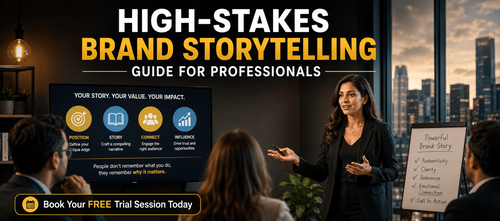

Communicate Your Brand Story in High-Stakes Situations: Scripts, Frameworks, and Professional Communication Strategies
Most professionals prepare for high-stakes conversations by reviewing their resume, rehearsing a few achievements, and hoping the right words come out at the right moment. But when the stakes are high, such as a job interview, client pitch, promotion conversation, salary negotiation, networking event, or panel interview, improvisation is risky. What you say about yourself matters, but how you structure that story matters even more.
A strong brand story is not a spoken version of your CV. It is a deliberate professional narrative that connects your background, values, experience, and unique contribution to the needs of a specific audience. The challenge is that most professionals have substance, but not structure. They know what they have done, but struggle to communicate why it matters, who it matters to, and what opportunity it prepares them for next.
The guidebook, How to Communicate Your Brand Story in High-Stakes Situations, solves this problem with 10 ready-to-use scripts and language frameworks for real professional scenarios. It helps you move from scattered self-description to confident narrative clarity, so you can walk into important conversations prepared, focused, and persuasive.
Download these resources and apply them alongside your daily work for improved clarity, productivity, and professional growth. You can also book a free trial to gain expert guidance and enhance your communication, problem-solving, and decision-making skills. The materials are designed in a clear, structured format to help professionals learn efficiently and implement insights with confidence.
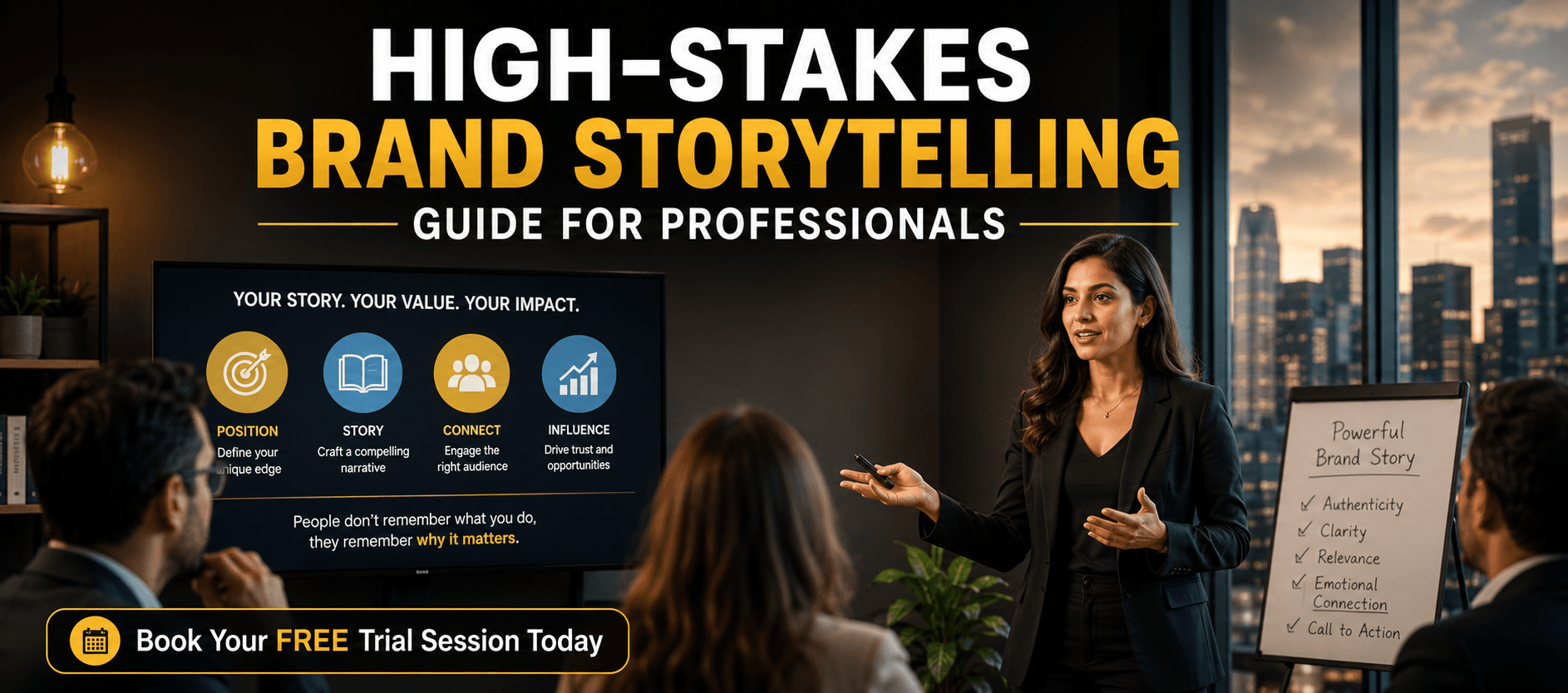
Who Is This Blog For?
This blog is designed for working professionals who want to communicate their value with more confidence in career-defining moments. It is especially useful for:
- Job seekers preparing for formal interviews and the question, Tell me about yourself
- Career switchers who need to explain a pivot without sounding uncertain
- Freelancers pitching prospective clients in discovery calls or proposal meetings
- Consultants starting new engagements and building trust with client teams
- Managers preparing for performance reviews, promotions, or salary discussions
- Professionals attending networking events where they need a crisp elevator pitch
- Speakers preparing conference bios, webinar introductions, or panel positioning
- LinkedIn users who want an About section that sounds human, credible, and strategic
- Candidates facing panel interviews with multiple evaluators and expectations
- Working professionals who want to stop underselling their experience under pressure
Why This Topic Matters Today?
High-stakes professional conversations are no longer limited to job interviews. Today, your brand story appears everywhere: in your LinkedIn profile, client introductions, networking chats, performance reviews, consulting meetings, salary negotiations, and public speaking opportunities. Every one of these moments shapes how others judge your credibility.
The guidebook explains that professional opportunity often depends on narrative clarity. In a competitive landscape, what you say about yourself, and how you say it, can determine whether you get the client, promotion, job offer, speaking invitation, or deal.
Many professionals fail in these moments not because they lack capability, but because they present their experience in the wrong way. They recite job titles instead of telling a story. They start with background instead of impact. They use jargon that distances the listener. They fail to connect their story to the audience’s immediate need. They undersell career transitions as gaps rather than growth. They close weakly or never make a clear ask.
This matters because professional communication is now a career skill, not a soft extra. The ability to tell a relevant, evidence-backed brand story helps you build trust faster, differentiate yourself clearly, and make decision-makers feel certain that they are speaking to the right person.
Core Concept or Framework Explained
The core concept in the guidebook is that your brand story must be structured for the situation. There is no single version of your professional story that works everywhere. A strong answer in a job interview may be too long for an elevator pitch. A strong client pitch may not work in a salary negotiation. A LinkedIn summary requires a different tone from a panel interview introduction.
The guidebook provides 10 scenario-specific templates:
- The First Impression Script
- The Career Pivot Narrative
- The Freelancer Credibility Pitch
- The Executive Elevator Pitch
- The Promotion Business Case Story
- The LinkedIn Summary Script
- The Panel Interview Brand Story
- The Consulting Onboarding Narrative
- The Conference Speaker Bio Script
- The Salary Negotiation Story
Each template helps you organise your message around purpose, audience, proof, and next step. The First Impression Script uses a hook, arc, value, and bridge. The Career Pivot Narrative frames transition as an intentional decision. The Freelancer Credibility Pitch establishes authority before the client sees your work. The Executive Elevator Pitch uses a sharp 60-second architecture. The Promotion Business Case Story turns self-advocacy into a business case. The LinkedIn Summary Script makes your digital profile work as an always-on brand story. The Panel Interview Brand Story addresses functional, strategic, and cultural evaluators together. The Consulting Onboarding Narrative builds trust on Day 1. The Conference Speaker Bio Script controls how you are introduced publicly. The Salary Negotiation Story anchors compensation to value, not personal need.
The guidebook also gives a 5-point brand story self-check: specificity, relevance, evidence, clarity, and invitation. This means your story should name real outcomes, match the audience’s priorities, include proof, use plain language, and end by opening a conversation.
How This Blog and Guidebook Help You?
This blog helps you understand how to apply the guidebook in real professional situations. Instead of treating brand storytelling as a vague confidence exercise, it shows you how to prepare scripts that are clear, specific, and audience-aware.
By using the guidebook, you can:
- Answer interview questions with confidence instead of rambling
- Explain your career path as a purposeful arc, not a disconnected timeline
- Position career pivots as strategic decisions
- Introduce yourself to clients with authority and trust
- Deliver a 60-second pitch that earns a follow-up conversation
- Make promotion and salary conversations more evidence-based
- Write a LinkedIn About section that supports inbound opportunities
- Address multiple stakeholders in panel interviews
- Build credibility quickly at the start of consulting engagements
- Create speaker bios that position your expertise before you present
The biggest benefit is preparation. When you have the right structure, you do not need to memorise every word. You can speak naturally because you understand the logic of your story.
Step-by-Step Breakdown
Step 1: Use the First Impression Script for Interviews
The First Impression Script is designed for formal job interviews, especially when the hiring manager opens with Tell me about yourself. The guidebook makes it clear that this is not small talk. It is your most important opening brand story moment.
The structure has four parts: hook, arc, value, and bridge.
The hook is a one-sentence positioning statement. Instead of beginning with your name or job title, you open with your professional identity and core expertise. For example, the template frames this as: I am a customer experience strategist who specialises in a specific area for a specific industry or company type.
The arc gives two to three sentences about your career progression and the thread connecting your experience. The value section gives one measurable example of impact. The bridge connects your story to the specific role and organisation.
The guidebook recommends a timing structure of roughly 85 seconds: 10 seconds for the hook, 25 seconds for the arc, 30 seconds for value, and 20 seconds for the bridge. This helps you sound composed, not rushed.
Step 2: Use the Career Pivot Narrative to Explain Change
Career pivots can create doubt in the listener’s mind. A hiring manager may wonder why they should trust someone without a direct track record in the new role or industry. The Career Pivot Narrative helps you answer that concern before it becomes an objection.
The template begins with an intentional pivot statement. You clearly say that you are moving from one field to another and explain that the reason behind the move is central to what you bring.
Then you explain your foundation. This includes transferable skills, stakeholder experience, and lessons from your previous field. Next comes the catalyst, where you explain the genuine reason for the shift and the preparation you have completed, such as certifications, freelance projects, or independent work. The bridge to value shows why your background is an asset rather than a liability. The close signals commitment.
The key principle is to never apologise for the pivot. The guidebook advises professionals to frame change as a strategic decision, not as a desperate move.
Step 3: Use the Freelancer Credibility Pitch for Client Meetings
When a freelancer meets a prospective client, the client must believe in the person before believing in the proposal. The Freelancer Credibility Pitch helps establish professional trust early in the conversation.
The structure includes four parts. First is the authority opener, where you define your specialty clearly. The guidebook recommends specificity, such as B2B SaaS content strategist instead of simply writer.
Second is the proof point. You briefly describe a relevant project, the outcome, and the approach that made it successful. Third is the working style signal. This explains how you work, what kind of clients you work best with, and how you protect both sides’ time. Fourth is the invitation to dialogue, where you ask what success looks like for the client.
This works because it balances credibility with curiosity. You do not dominate the conversation. You position yourself, prove relevance, and then shift attention to the client’s desired outcome.
Step 4: Use the Executive Elevator Pitch for Senior Decision-Makers
The Executive Elevator Pitch is built for a 60-second opportunity with a C-suite executive or senior decision-maker. The guidebook warns that this is not the moment for your full story. It is the moment for precision.
The 60-second architecture has four parts:
- Identity statement in the first 10 seconds
- The problem you solve in the next 20 seconds
- Proof of credibility in the next 20 seconds
- The open door in the final 10 seconds
The rule is simple: one problem, one proof point, one ask. Executives are often pitch-fatigued, so the guidebook emphasises that precision is more persuasive than comprehensiveness.
A strong elevator pitch does not try to impress with everything you have done. It earns the next conversation.
Step 5: Use the Promotion Business Case Story for Career Growth
Promotion conversations often fail because professionals present them as personal hopes rather than business cases. The Promotion Business Case Story helps structure the conversation around contribution, readiness, and organisational value.
The template begins by setting the frame. You state that you want to discuss your contribution over a defined period and make the case for a promotion, salary increase, or title change.
Then you present your impact story with achievements, metrics, strategic scope, and leadership signals. The next section explains expanded scope, including work beyond your formal remit. The readiness signal shows that you understand the target level and are already demonstrating the required capability. Finally, you make a clear ask with a timeline.
The guidebook specifically warns against opening with uncertain language such as I just feel like or I was hoping maybe. A confident frame signals seriousness and preparation.
Step 6: Use the LinkedIn Summary Script as an Always-On Brand Story
Your LinkedIn About section works even when you are not in the room. Recruiters, clients, collaborators, and decision-makers can read it at any time. The guidebook explains that this section should not read like a recycled job description. It should be a first-person brand story.
The template includes five sections:
- Opening hook
- Career story
- Proof points
- Human layer
- Call to action
The opening hook should stop the scroll because the first few lines appear before the reader clicks to expand. The career story gives context to your expertise without listing every role. Proof points ground the story in evidence. The human layer makes you memorable. The call to action tells people what to do next.
The guidebook recommends a length of 220 to 280 words and encourages generous line breaks instead of dense blocks of text.
Step 7: Use the Panel Interview Brand Story for Multiple Evaluators
Panel interviews are challenging because each evaluator may care about something different. HR may assess culture fit. A functional head may evaluate technical depth. A senior leader may look for strategic thinking.
The Panel Interview Brand Story helps you speak to all three without losing coherence. It begins by acknowledging the room and the different perspectives present.
Then you tell your story through three layers:
- Functional layer for technical credibility
- Strategic layer for business thinking
- Culture or HR layer for working style and values
The guidebook recommends scanning the room, making eye contact, naming your layers explicitly, using transitions such as from a functional lens, referencing the role directly, and closing by inviting dialogue. Panel introductions can run 2 to 3 minutes, and the guidebook notes that panels reward composure.
Step 8: Use the Consulting Onboarding Narrative to Build Client Trust
Consultants need credibility quickly. On Day 1 or Week 1 of an engagement, the client team decides whether they see the consultant as a trusted partner or an expensive outsider.
The Consulting Onboarding Narrative includes four parts: professional positioning, why you are here, working style, and invitation.
The professional positioning section explains your domain and relevant client experience. The why you are here section defines the engagement objective and frames your approach as collaborative. The working style section communicates transparency, confidentiality, and respect for the client’s context. The invitation opens dialogue by asking what success looks like for each person.
This works because it establishes expertise while signalling humility. The guidebook highlights that clients trust consultants who listen before they prescribe.
Step 9: Use the Conference Speaker Bio Script for Public Positioning
A speaker introduction is a compressed public brand story. It shapes audience expectations before the session begins.
The guidebook provides two versions: a third-person bio for an MC to read and a first-person self-introduction if there is no MC.
The third-person bio includes expertise positioning, credibility, relevance bridge, and a warm handoff. The self-introduction includes a brief opening, identity and credibility, personal stake, and transition into the topic.
The recommended length is 120 to 150 words for the third-person bio and under 60 seconds for the self-introduction. The guidebook notes that brevity signals confidence.
Step 10: Use the Salary Negotiation Story to Anchor Value
Salary negotiations are often treated as number-only conversations. The guidebook argues that compensation conversations are won or lost on narrative, not arithmetic.
The Salary Negotiation Story begins with genuine enthusiasm. Then it anchors the ask to value, not personal need. You explain your market range based on relevant experience and outcomes. Next, you justify the ask through specific value points connected to what the role needs. Then you offer flexibility around base salary, equity, bonus structure, accelerated review, or benefits. Finally, you keep the relationship warm by making it clear that you are negotiating terms, not rejecting the opportunity.
The principles are clear: anchor to value, name specific assets, offer flexibility, and protect the relationship.
Common Mistakes or Pitfalls to Avoid
The guidebook identifies several mistakes that weaken professional brand stories:
- Reciting your CV instead of telling a story
- Starting with job titles instead of impact
- Using jargon that creates distance
- Failing to connect your story to the audience’s need
- Underselling transitions as gaps instead of growth
- Being too humble or too boastful without calibration
- Ending without a crisp close or clear ask
- Using vague claims such as results-driven or passionate without proof
- Making the story too focused on your background and not enough on their need
- Forgetting that every story should invite dialogue, not end as a monologue
The better alternative is to make your story specific, relevant, evidence-backed, clear, and conversational.
How Should You Use This Guidebook Effectively?
Start by choosing the scenario that matches your immediate professional situation. If you have an interview coming up, begin with the First Impression Script or Panel Interview Brand Story. If you are changing roles or industries, use the Career Pivot Narrative. If you are preparing a client call, use the Freelancer Credibility Pitch or Consulting Onboarding Narrative. If you are preparing for a raise or offer discussion, use the Promotion Business Case Story or Salary Negotiation Story.
Next, fill in the placeholders with your own experience, metrics, examples, stakeholders, and language. Avoid generic phrases. The guidebook’s self-check makes it clear that if your story could be copied onto a colleague’s profile, it is not specific enough.
Then practise aloud at least three times. Speaking the script out loud helps you adjust rhythm, remove awkward phrasing, and make the language sound natural. Do not aim to sound memorised. Aim to sound prepared.
Finally, revise your story using the five tests:
- Specificity: Does it name outcomes, industries, and challenges?
- Relevance: Does it match what this audience cares about?
- Evidence: Does it include a proof point?
- Clarity: Can someone outside your field understand it?
- Invitation: Does it end with a question, offer, or next step?
The guidebook also recommends that at least one-third of your story should be about the audience’s need, not just your background. This keeps your brand story useful, not self-centred.
Key Takeaways
- Your brand story is not your CV recited aloud. It is a structured narrative built for a specific audience and moment.
- High-stakes situations demand preparation, clarity, and evidence.
- The First Impression Script helps you answer Tell me about yourself in about 90 seconds.
- The Career Pivot Narrative helps you frame professional change as a strategic decision.
- The Freelancer Credibility Pitch builds client trust before the proposal begins.
- The Executive Elevator Pitch works best when it focuses on one problem, one proof point, and one ask.
- The Promotion Business Case Story turns self-advocacy into an evidence-based career conversation.
- The LinkedIn Summary Script makes your profile an always-on professional brand story.
- The Panel Interview Brand Story helps you address functional, strategic, and cultural evaluators together.
- The Consulting Onboarding Narrative establishes trust, humility, and working norms with client teams.
- The Conference Speaker Bio Script helps you control public positioning before you speak.
- The Salary Negotiation Story anchors compensation to value, contribution, and market relevance.
- Every strong brand story must pass five tests: specificity, relevance, evidence, clarity, and invitation.
Your Next Step: Accelerate Your Career with PlanetSpark
Creating an impact-driven resume is not just about landing your next job—it’s about owning your professional story and presenting it with clarity, confidence, and credibility. When your resume clearly communicates value, results, and impact, opportunities follow naturally.
At PlanetSpark, we are committed to empowering working professionals with practical, outcome-focused resources that drive real career growth. From resume building and workplace communication to leadership presence and professional writing, our programs are designed to help you succeed in today’s fast-evolving job market.
Visit https://www.planetspark.in/resources to explore:
- Career and resume-building guides
- Workplace communication and professional writing resources
- Skill-development tools curated for working professionals
Want a deeper, hands-on experience?
You can also book a free trial session to learn more about PlanetSpark’s Working Professional Courses, designed to accelerate your career through personalised coaching, real-world practice, and expert guidance.
Your career deserves more than generic advice.
It deserves clarity, confidence, and measurable impact.
Personalized Communication Roadmaps
Record a video to get a AI generated personalized communication reports