
How AI-Driven Feedback Loops Can Supercharge Your Career Growth


Boost Your Professional Development Using AI-Augmented Feedback Loops
Most professionals receive feedback too infrequently, too vaguely, or too late. Annual reviews give you a snapshot of the past. Peer comments are often diplomatic rather than developmental. And self-reflection, while valuable, suffers from our own blind spots. The result? Growth that is slower than it should be, patterns that persist unchecked, and opportunities missed simply because the signal never arrived clearly enough or quickly enough to act on.
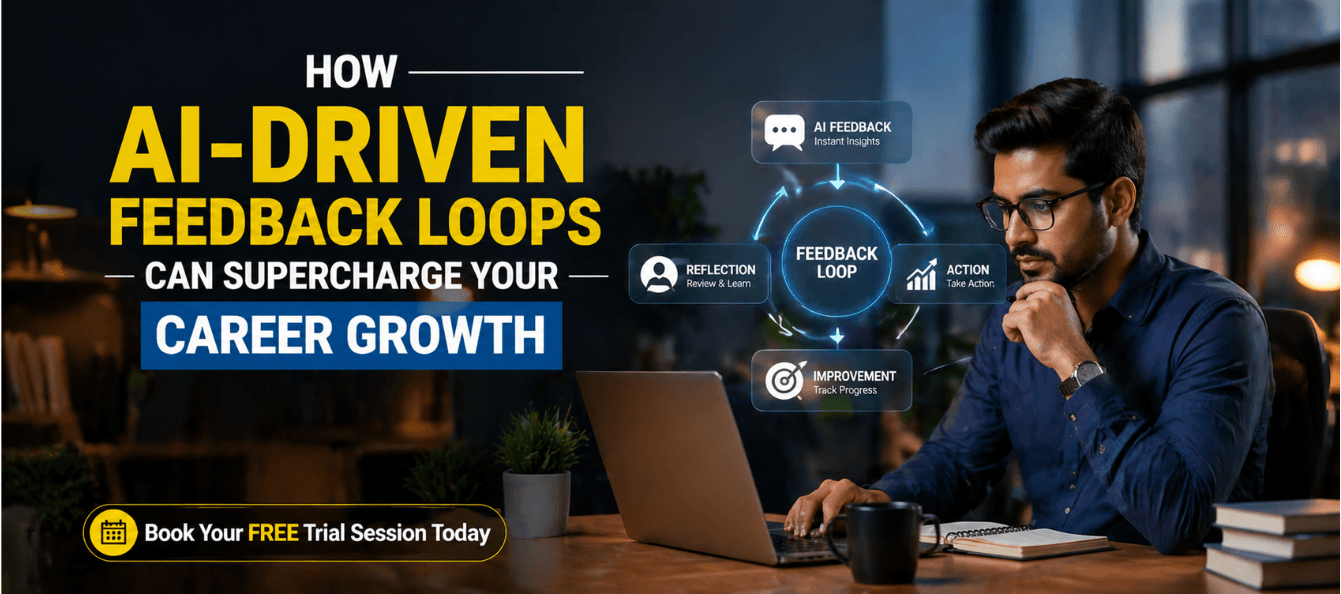
This is the problem that AI-augmented feedback loops are designed to solve. When you integrate AI tools into your feedback practice — whether that means using language models to analyze written work, leveraging sentiment analysis in team communications, or building automated reflection prompts into your workflow — you compress the time between action and insight. You move from annual feedback to weekly signals. From vague impressions to data-backed patterns. From reactive adjustment to proactive learning.
This planner is built specifically for working professionals navigating real constraints: back-to-back calendars, competing priorities, and a flood of new AI tools that promise transformation but rarely come with a practical instruction manual. Each section is designed to be immediately actionable. You will not find academic theory here. What you will find is a structured methodology you can begin applying this week — in your current role, with tools you likely already have access to.
The goal is not to make you dependent on AI. It is to make your feedback practice so sharp, consistent, and insightful that continuous improvement becomes a natural part of how you work — not an occasional event you schedule once a year.
Download these resources and apply them alongside your daily work for improved clarity, productivity, and professional growth. You can also book a free trial to gain expert guidance and enhance your communication, problem-solving, and decision-making skills. The materials are designed in a clear, structured format to help professionals learn efficiently and implement insights with confidence.
Who Is This Blog For?
This blog and resource are ideal for professionals who want to improve continuously but feel restricted by traditional feedback cycles. If you're a:
- Career switcher looking to accelerate your growth in a new role
- Job seeker needing actionable feedback for better self-improvement
- Consultant striving to deliver measurable results for clients
- Manager seeking to improve your leadership skills with actionable data
- Mid-career professional wanting structured, actionable feedback
Why This Topic Matters Today?
In today’s fast-paced work environment, feedback is a critical tool for growth. However, traditional feedback systems are often infrequent and fail to provide timely, actionable insights. This leads to slow progress, missed opportunities, and lack of clarity on how to improve. As AI becomes more integrated into workplaces, it offers the potential to provide real-time, data-driven feedback, allowing professionals to make quicker, more informed decisions.
Traditional feedback loops are often:
- Infrequent (annual or quarterly)
- Vague (lacking context or specifics)
- Late (arriving after it's too late to act)
- Biased (shaped by relationships and recency)
- Inconsistent (lacking a structured approach)
AI-augmented feedback loops solve these problems by providing continuous, actionable insights that improve performance and decision-making in real-time.
Core Concept or Framework Explained
The key framework in this planner is the ARIA Framework — Assess, Reflect, Implement, Adapt — a four-stage system designed to provide continuous feedback with AI assistance. Each stage has a distinct purpose:
- Assess: Collect feedback signals from multiple sources, such as written work, team interactions, and project outcomes. AI tools aggregate this data, allowing you to see the full scope of your performance.
- Reflect: AI helps identify patterns and anomalies in the feedback you’ve collected. This reflection enables you to pinpoint areas for improvement.
- Implement: Based on your reflections, AI suggests actionable steps, micro-experiments, or specific behavioral changes that can be tested in real-world situations.
- Adapt: Over time, AI tracks progress and adjusts recommendations based on your ongoing feedback. This ensures that the feedback loop evolves to better fit your needs.
How does this blog and Guidebook Help You?
The AI-augmented feedback loops in this guidebook help you to continuously assess your performance, reflect on insights, and implement improvements, all while saving time and providing data-backed clarity. These tools help you:
- Get actionable feedback on a more frequent basis
- Make more informed decisions with data-driven insights
- Improve consistently by focusing on specific, measurable changes
- Avoid the pitfalls of traditional feedback systems
Step-by-Step Breakdown
1. Step 1: Assess — Build Your Signal Collection System
In this stage, the focus is on collecting diverse feedback signals. Traditional feedback methods often rely on limited data sources like annual reviews or sporadic manager comments. AI expands this by pulling in signals from written communication, project outcomes, peer interactions, and self-reports.
- Identify Your Signal Sources: List all places where performance signals are available, such as emails, project retrospectives, and team feedback.
- Choose Your AI Tools: Use tools like GPT-4 for analyzing written work, Notion AI for meeting notes, or Lattice for peer feedback.
- Set Your Collection Cadence: Schedule daily, weekly, and bi-weekly collection periods to ensure a steady stream of insights.
- Centralize Data: Store all feedback in one place for easy access and to spot patterns more easily.
2. Step 2: Reflect — Turn Raw Data Into Actionable Patterns
AI’s role here is to identify recurring patterns in the feedback you’ve collected. Reflection becomes easier with AI assistance, which highlights the key areas for improvement.
- Use the Reflection Prompt Template to guide your reflection process, such as identifying patterns, gaps, and actionable areas for improvement.
- Regularly reflect on the data, challenging AI’s output when needed, and then focus on the most actionable insights.
3. Step 3: Implement — Apply Insights to Behavior Changes
The implementation stage involves converting insights into concrete behavioral changes. AI suggests micro-experiments, small actions that can be tested over a short period (1-2 weeks) to measure improvement.
- Define your micro-experiment based on your reflection insights and test it in your daily tasks.
- Schedule AI check-ins to track progress and identify what’s working and what needs adjustment.
4. Step 4: Adapt — Adjust Your Feedback Loop Design
After a few cycles, review and refine your feedback loop. Adaptation ensures the feedback system evolves to meet your needs.
- Regularly review your signal sources and cadence, adjusting your loop as necessary to stay relevant.
Common Mistakes or Pitfalls to Avoid
- Delegating reflection entirely to AI: Remember, AI can identify patterns, but you must provide the context and judgment.
- Collecting too many signals at once: Start with a couple of focused sources to avoid overwhelming yourself with data.
- Running overly broad experiments: Specific, small-scale experiments are far more effective than large, vague goals.
- Skipping the Adapt stage: Don’t stop after a few cycles—keep refining your feedback loop to make it more effective.
How Should You Use This Guidebook Effectively?
The best way to use this guidebook is by committing to the full ARIA cycle each week, even if it’s just a 20-minute session. Follow these steps to integrate it into your routine:
- Set your schedule: Block out time each week for reflection and feedback collection.
- Start small: Focus on a few signal sources and refine them over time.
- Iterate: Regularly review and adapt your feedback loop to ensure it continues to meet your needs.
Key Takeaways
- Feedback loops only work when they are closed: Collect, reflect, act, and evaluate in a continuous cycle.
- AI helps identify patterns, but you provide the judgment and action.
- Small, specific experiments are more effective than large goals.
- Your feedback loop is a dynamic system that improves over time.
Your Next Step: Accelerate Your Career with PlanetSpark
Creating an impact-driven resume is not just about landing your next job—it’s about owning your professional story and presenting it with clarity, confidence, and credibility. When your resume clearly communicates value, results, and impact, opportunities follow naturally.
At PlanetSpark, we are committed to empowering working professionals with practical, outcome-focused resources that drive real career growth. From resume building and workplace communication to leadership presence and professional writing, our programs are designed to help you succeed in today’s fast-evolving job market.
Visit https://www.planetspark.in/resources to explore:
- Career and resume-building guides
- Workplace communication and professional writing resources
- Skill-development tools curated for working professionals
Want a deeper, hands-on experience?
You can also book a free trial session to learn more about PlanetSpark’s Working Professional Courses, designed to accelerate your career through personalised coaching, real-world practice, and expert guidance. Your career deserves more than generic advice. It deserves clarity, confidence, and measurable impact.
Personalized Communication Roadmaps
Record a video to get a AI generated personalized communication reports