
Thought Leadership Positioning Plan for Career Growth


Thought Leadership Positioning Strategy: A Practical Guide to Building Visibility and Influence
You are doing great work. You solve complex problems, deliver results, and build valuable expertise over time. Yet when opportunities arise—promotions, speaking invitations, consulting roles—they often go to someone else. Not because they are more capable, but because they are more visible.
This is the invisible barrier many professionals face today. In a crowded, competitive landscape, expertise alone is no longer enough. If people don’t clearly understand what you stand for and the value you bring, you risk being overlooked.
This is where a structured thought-leadership positioning strategy becomes critical. It helps you transform your expertise into a visible, credible, and influential professional presence—without starting from scratch.
Download these resources and apply them alongside your daily work for improved clarity, productivity, and professional growth. You can also book a free trial to gain expert guidance and enhance your communication, problem-solving, and decision-making skills. The materials are designed in a clear, structured format to help professionals learn efficiently and implement insights with confidence.
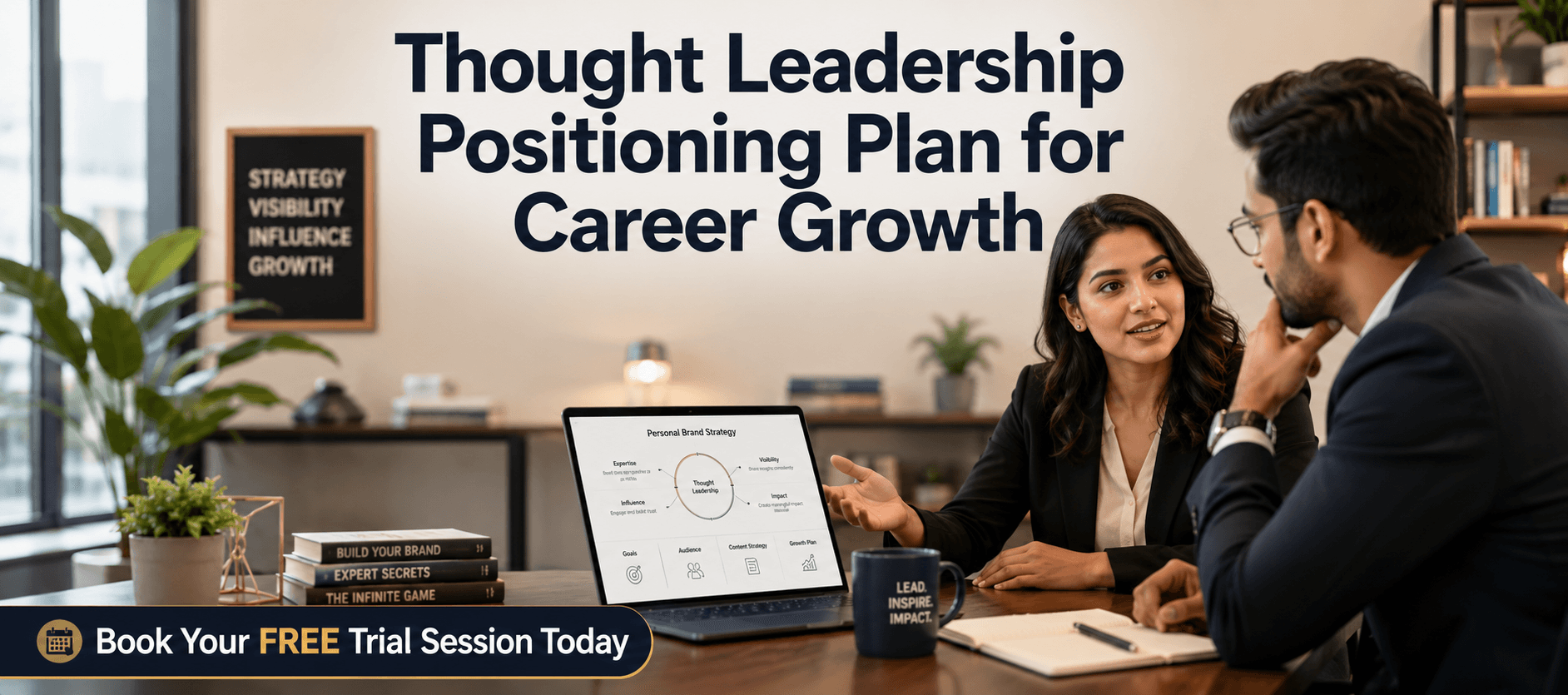
Who Is This Blog For?
- Working professionals who want to build visibility and credibility in their field
- Mid-career professionals aiming for leadership roles or industry recognition
- Consultants and specialists looking to attract clients and opportunities
- Career changers repositioning themselves in a new domain
- Professionals struggling with inconsistent personal branding or low visibility
Why This Topic Matters Today?
The modern professional landscape rewards visibility as much as capability. Opportunities increasingly flow to individuals who are not just skilled—but known for their skills.
Many professionals face common challenges:
- Unclear professional identity across platforms
- Inconsistent messaging that confuses their audience
- Lack of a structured content or visibility strategy
- Hesitation or imposter syndrome when sharing expertise
In a world where hiring managers, collaborators, and clients search online before making decisions, your positioning determines whether you are discovered—or ignored. Thought leadership bridges this gap by making your expertise visible, understandable, and trusted.
Core Concept or Framework Explained
At the heart of this guide is a structured 6-step thought-leadership positioning framework. It moves you from self-awareness to sustained visibility in a logical, actionable sequence.
The framework includes:
- Clarifying your expertise core
- Defining a clear positioning statement
- Mapping your target audience
- Choosing the right visibility channels
- Building a consistent content strategy
- Measuring and evolving your positioning
This is not about self-promotion. It is about strategic communication—helping the right people understand what you do, the problems you solve, and why they should trust you.
How This Blog and Guidebook Help You?
By applying this framework, you will:
- Gain clarity on your unique professional strengths
- Build a focused and credible positioning statement
- Identify the right audience and platforms for visibility
- Create content that reflects your expertise and builds authority
- Develop consistency in communication and engagement
- Track progress and refine your strategy over time
The outcome is a professional presence that attracts opportunities instead of chasing them.
Step-by-Step Breakdown
Step 1: Clarify Your Expertise Core
Your journey begins with understanding what you truly know deeply. This is not just about job roles—it is about insights, experiences, and perspectives you have developed over time.
The guide uses a three-lens model:
- Deep Knowledge: Topics, tools, or domains you understand better than peers
- Hard-Won Experience: Complex problems you have solved repeatedly
- Unique Perspective: Views or beliefs that differ from conventional thinking
For example, a professional who has handled cross-functional conflicts for years holds insights that cannot be learned from textbooks. Identifying this expertise is the foundation of your positioning.
Step 2: Define Your Positioning Statement
Your positioning statement clearly defines:
- Who you help
- What problem you solve
- What outcome you deliver
- How you uniquely do it
A strong positioning statement is specific and focused. It does not try to appeal to everyone. Instead, it attracts the right audience by being precise and credible.
For instance, helping “mid-career professionals transition into leadership roles using real-world frameworks” is far more powerful than a generic statement about helping people succeed.
Step 3: Map Your Target Audience
Effective thought leadership starts with understanding your audience deeply. Without this, content becomes random and ineffective.
You need to define:
- Their role, industry, and career stage
- Their top goals and biggest challenges
- Their fears and decision-making concerns
- Platforms and content formats they prefer
- Questions they are actively seeking answers to
The more specific your audience profile, the more relevant and impactful your communication becomes.
Step 4: Choose Your Visibility Channels
You do not need to be everywhere. In fact, trying to maintain presence across multiple platforms often leads to burnout and inconsistency.
Instead, focus on one primary and one secondary channel based on:
- Where your audience spends time
- Your natural communication style
- Your ability to maintain consistency
Examples include:
- LinkedIn for professional visibility and networking
- Email newsletters for deeper engagement
- Speaking or podcasts for verbal communicators
- Long-form writing for analytical thinkers
Consistency on the right platform builds credibility faster than scattered efforts across many.
Step 5: Build Your Content Strategy
A strong content strategy is built on content pillars—core themes that reflect your expertise and audience needs.
Each piece of content should align with one of these pillars. This creates:
- Consistency in messaging
- Depth in expertise
- Recognition over time
Additionally, high-impact content follows a clear structure:
- A compelling hook that grabs attention
- Context that establishes relevance
- Insight that showcases expertise
- Evidence that builds credibility
- A call to action that drives engagement
This structure ensures your content is not just seen—but remembered and shared.
Step 6: Measure, Learn, and Evolve
Thought leadership is not a one-time effort. It is an evolving strategy that requires tracking and refinement.
Key metrics to monitor include:
- Engagement rates and audience interaction
- Follower or subscriber growth
- Profile views and connection quality
- Direct messages and opportunities generated
Over time, these leading indicators translate into real outcomes such as job offers, speaking invitations, and consulting opportunities.
Common Mistakes or Pitfalls to Avoid
- Positioning too broadly, making your message generic and forgettable
- Copying other thought leaders instead of developing your own voice
- Posting inconsistently, which reduces audience trust and engagement
- Ignoring audience interaction and engagement opportunities
- Waiting for perfection instead of starting and improving over time
Avoiding these mistakes ensures steady progress and credibility.
How Should You Use This Guidebook Effectively?
To get the best results from this guide:
- Start with a full read to understand the framework
- Complete all worksheets honestly and thoroughly
- Apply each step directly to your professional profiles and content
- Dedicate 2–3 focused hours for initial implementation
- Revisit and refine your positioning every quarter
This structured approach helps you move from planning to execution efficiently.
Key Takeaways
- Thought leadership is about visibility, not self-promotion
- Specific positioning attracts the right opportunities
- Your existing experience is your biggest advantage
- Consistency matters more than intensity
- Focus on one channel before expanding
- Track progress using meaningful metrics
- Start before you feel fully ready
Your Next Step: Accelerate Your Career with PlanetSpark
Creating an impact-driven resume is not just about landing your next job—it’s about owning your professional story and presenting it with clarity, confidence, and credibility. When your resume clearly communicates value, results, and impact, opportunities follow naturally.
At PlanetSpark, we are committed to empowering working professionals with practical, outcome-focused resources that drive real career growth. From resume building and workplace communication to leadership presence and professional writing, our programs are designed to help you succeed in today’s fast-evolving job market.
Visit https://www.planetspark.in/resources to explore:
- Career and resume-building guides
- Workplace communication and professional writing resources
- Skill-development tools curated for working professionals
Want a deeper, hands-on experience?
You can also book a free trial session to learn more about PlanetSpark’s Working Professional Courses, designed to accelerate your career through personalised coaching, real-world practice, and expert guidance.
Your career deserves more than generic advice.
It deserves clarity, confidence, and measurable impact.
Personalized Communication Roadmaps
Record a video to get a AI generated personalized communication reports