
Management Resume Structure Roadmap for Professionals
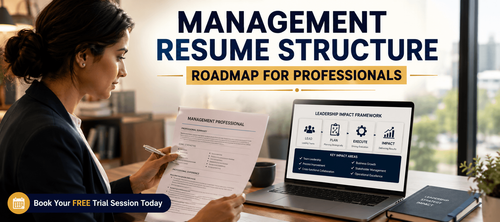

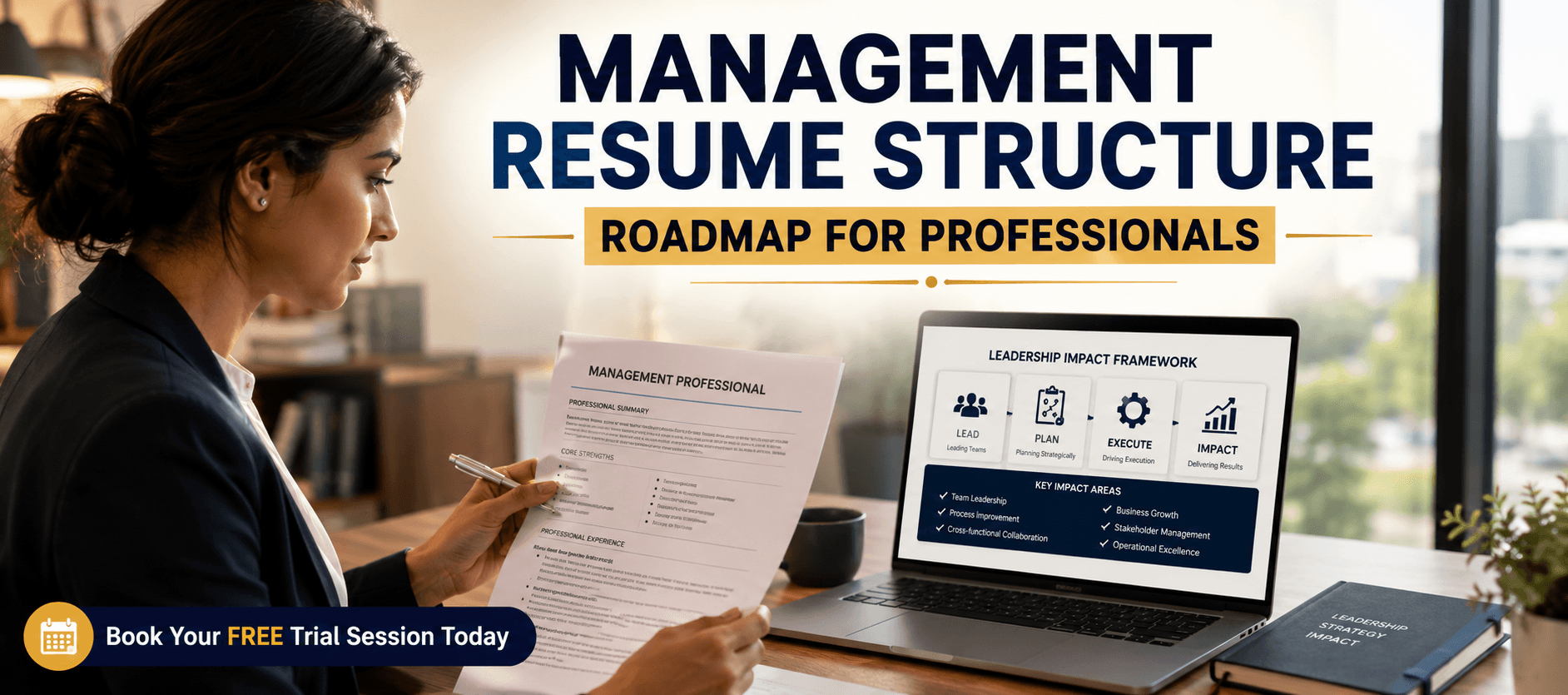
Build a Management-Ready Resume That Showcases Leadership, Impact, and Results
Many professionals hit a frustrating plateau in their careers when transitioning into management roles. Despite having strong experience, they struggle to get shortlisted. The reason is rarely a lack of capability—it’s a lack of positioning.
Recruiters scanning for leadership roles are not looking for task execution. They are looking for ownership, decision-making, and measurable business impact. Yet most resumes continue to read like individual contributor profiles, failing to reflect leadership potential.
This is exactly where a structured, impact-driven approach to resume building becomes critical. This guide helps you reposition your experience, highlight leadership signals, and create a resume that speaks the language of management—clearly, confidently, and effectively.
Download these resources and apply them alongside your daily work for improved clarity, productivity, and professional growth. You can also book a free trial to gain expert guidance and enhance your communication, problem-solving, and decision-making skills. The materials are designed in a clear, structured format to help professionals learn efficiently and implement insights with confidence.
Who Is This Blog For?
- Working professionals with 0–15 years of experience aiming to move into management roles
- Individual contributors preparing for their first leadership position
- Mid-career professionals targeting promotions or senior roles
- Career switchers transitioning into managerial responsibilities
- Consultants and specialists repositioning themselves as strategic leaders
Why This Topic Matters Today?
The hiring landscape has evolved significantly. Management hiring is no longer based solely on experience—it is based on demonstrated leadership impact.
Hiring managers today are scanning for:
- Evidence of team leadership and stakeholder influence
- Ownership of outcomes rather than task completion
- Measurable business results and strategic thinking
The challenge is that most professionals continue to present their experience in a contributor format. This disconnect leads to missed opportunities. A management-ready resume bridges that gap by aligning your experience with what employers actually value.
Core Concept or Framework Explained
At the heart of building a management resume is a shift in perspective—from execution to impact, and from individual contribution to leadership influence.
The guide introduces a structured 6-step resume restructuring framework that helps professionals systematically transform their resumes:
- Audit your current resume to identify gaps
- Define your leadership identity and narrative
- Rebuild your professional summary for positioning
- Reframe experience into leadership achievements
- Restructure skills and education strategically
- Tailor, format, and final-check for role alignment
Alongside this, the STAR-L framework plays a critical role in crafting achievement statements:
- Situation: Context or challenge
- Task: Responsibility owned
- Action: Steps taken
- Result: Measurable outcome
- Leadership signal: What it demonstrates about your leadership ability
This dual-framework approach ensures your resume is not just well-written—but strategically aligned with management expectations.
How This Blog and Guidebook Help You?
By applying the frameworks in this guide, you will be able to:
- Reposition your experience from contributor to leader
- Identify and highlight leadership moments—even without a formal title
- Write achievement-driven bullet points with measurable impact
- Build a strong leadership narrative across your resume
- Align your resume with management-level hiring expectations
The outcome is a resume that communicates authority, clarity, and value—within seconds of being read.
Step-by-Step Breakdown
Step 1: Audit Your Current Resume
Before rewriting, you need clarity on where you stand.
Review your resume with a hiring manager’s mindset and assess:
- Are you using leadership verbs like led, built, or transformed?
- Do your bullet points include measurable outcomes?
- Have you mentioned team size, scope, or stakeholder influence?
- Does your summary position you for management roles?
Most resumes fail at this stage because they focus on responsibilities instead of outcomes. Identifying these gaps gives you a clear starting point for improvement.
Step 2: Define Your Leadership Identity
A strong management resume is built around a clear leadership narrative.
You need to define what kind of leader you are:
- People builder focused on team development
- Process architect improving efficiency and systems
- Strategic operator driving business outcomes
- Technical leader guiding domain expertise
Once defined, create a positioning statement that anchors your resume. This ensures consistency across all sections and prevents a scattered, unfocused narrative.
Step 3: Rebuild Your Professional Summary
Your professional summary is the most critical section of your resume. It sets the tone for everything that follows.
A strong summary should include:
- Leadership identity and years of experience
- Core management strength
- A quantified achievement
- Target role or career direction
Instead of vague statements, your summary should clearly communicate your value proposition as a leader.
Step 4: Reframe Your Experience Section
This is where the transformation truly happens.
Replace task-based bullet points with leadership-driven achievements. Each bullet should:
- Start with a strong action verb
- Show what you did and how you did it
- Include team size, scope, or scale
- End with a measurable result
For example, instead of saying you supported a team, show how you led initiatives, influenced outcomes, or improved performance.
Even without a formal management title, you can highlight leadership through:
- Mentoring colleagues
- Leading projects
- Driving cross-functional collaboration
- Taking ownership beyond your role
Step 5: Restructure Skills and Education
Your skills section should reflect leadership readiness, not just technical ability.
Organise it into three tiers:
- Leadership competencies such as team management and strategic planning
- Domain expertise relevant to your function
- Tools and technologies as supporting elements
For education, highlight certifications and leadership programmes that strengthen your management profile. This reinforces your readiness for higher responsibility roles.
Step 6: Tailor, Format, and Final-Check
A generic resume will not perform well for management roles.
To maximise impact:
- Align your resume with the job description
- Mirror key leadership keywords and priorities
- Highlight relevant achievements for each role
Ensure your formatting is clean and professional:
- 1–2 pages maximum
- Clear section hierarchy
- No unnecessary design elements
- ATS-friendly structure
This final step ensures your resume is not just strong—but competitive.
Common Mistakes or Pitfalls to Avoid
- Using titles that reflect past roles instead of target leadership roles
- Listing responsibilities instead of measurable achievements
- Ignoring informal leadership experience
- Failing to include numbers or scale
- Using the same resume for every application
- Skipping or weakening the professional summary
Each of these mistakes reduces your chances of being perceived as a leadership candidate.
How Should You Use This Guidebook Effectively?
To get the best results, follow a structured approach:
- Read the guide once to understand the full framework
- Work through each step sequentially
- Complete worksheets to identify leadership examples
- Allocate 2–4 focused hours for implementation
- Review and refine your resume before applying
For faster results, follow a 7-day plan:
- Day 1: Audit your resume
- Day 2: Define leadership identity
- Day 3: Rewrite summary
- Day 4: Reframe experience
- Day 5: Update skills and education
- Day 6: Apply checklist and refine
- Day 7: Evaluate and begin applying
This approach ensures consistent progress and a high-quality final output.
Key Takeaways
- Management resumes focus on impact, not tasks
- Leadership identity must be clear and consistent
- Quantified achievements are essential for credibility
- Strong action verbs signal ownership and authority
- Tailoring your resume increases interview chances
- Even informal leadership experience should be highlighted
Your Next Step: Accelerate Your Career with PlanetSpark
Creating an impact-driven resume is not just about landing your next job—it’s about owning your professional story and presenting it with clarity, confidence, and credibility. When your resume clearly communicates value, results, and impact, opportunities follow naturally.
At PlanetSpark, we are committed to empowering working professionals with practical, outcome-focused resources that drive real career growth. From resume building and workplace communication to leadership presence and professional writing, our programs are designed to help you succeed in today’s fast-evolving job market.
Visit https://www.planetspark.in/resources to explore:
- Career and resume-building guides
- Workplace communication and professional writing resources
- Skill-development tools curated for working professionals
Want a deeper, hands-on experience?
You can also book a free trial session to learn more about PlanetSpark’s Working Professional Courses, designed to accelerate your career through personalised coaching, real-world practice, and expert guidance.
Your career deserves more than generic advice.
It deserves clarity, confidence, and measurable impact.
Personalized Communication Roadmaps
Record a video to get a AI generated personalized communication reports