
How Professionals Measure Skills with a Capability Scoring Tool


Professional Capability Scoring Tool: A Practical Guide to Assess, Improve, and Accelerate Your Career Growth
Many professionals spend years working hard, gaining experience, and moving from one role to another—yet when it comes to promotions, career switches, or leadership opportunities, they struggle to demonstrate real capability. The problem is not effort. It is lack of clarity.
Without a structured way to assess your skills, career growth becomes reactive rather than intentional. You rely on feedback cycles, guesswork, or external validation instead of owning your development.
This is exactly where a structured capability scoring system changes everything. By giving you a clear, evidence-based snapshot of where you stand today, it allows you to identify gaps, prioritise growth, and take focused action that drives measurable career progress.
Book your free trial session today with Planetspark.
Download for more details or PDF file.
Who Is This Blog For?
This blog and the underlying scoring
tool are designed for:
- Working professionals with 0–15 years of experience seeking structured career growth
- Mid-career professionals preparing for promotions or leadership roles
- Career changers who want clarity on transferable skills and gaps
- Consultants and specialists building a strong professional positioning
- Professionals who feel “stuck” despite working hard
- Individuals who want a data-driven approach to self-improvement
Why This Topic Matters Today?
The modern workplace rewards clarity, capability, and impact—not just effort. Yet most professionals operate without a clear understanding of their strengths and weaknesses.
Many common challenges include:
- An unclear picture of current capability levels
- Difficulty articulating strengths in interviews or reviews
- Lack of prioritisation in skill development
- Reactive career decisions instead of proactive planning
In today’s competitive environment, professionals who can measure and communicate their capabilities have a significant advantage. A structured scoring system eliminates guesswork and replaces it with actionable insight.
Core Concept or Framework Explained
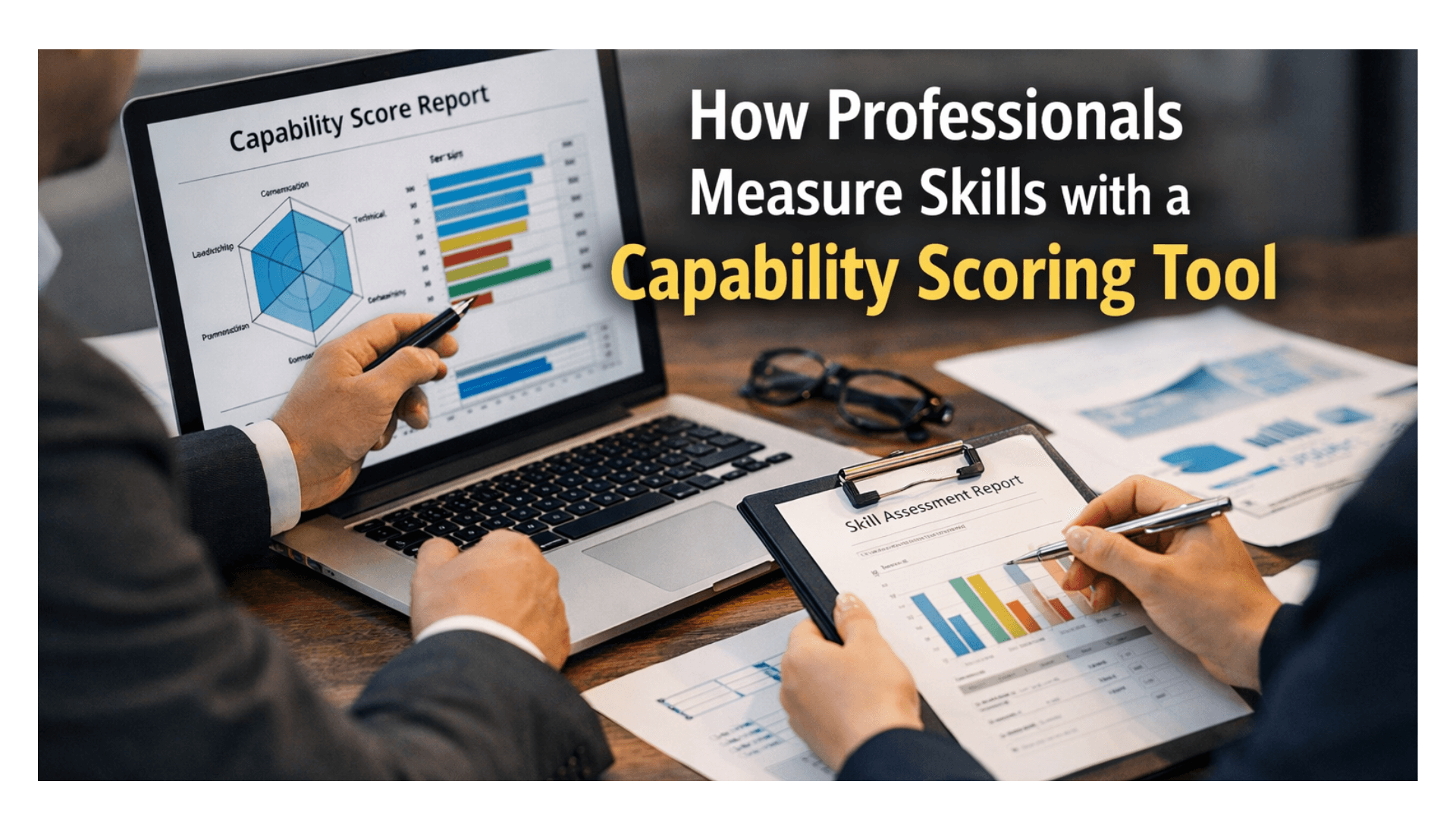
At the heart of this guide is the Professional Capability Scoring Tool—a structured framework designed to evaluate your professional readiness across five critical domains.
These five domains collectively define high-impact professionals:
- Technical and Functional Expertise
Your depth of knowledge, tools, and domain-specific skills that make you credible in your role
- Communication and Influence
Your ability to articulate ideas, persuade stakeholders, and adapt communication across contexts
- Strategic Thinking
Your capacity to connect the bigger picture, make decisions under uncertainty, and understand business impact
- Execution and Delivery
Your ability to deliver results consistently through planning, accountability, and resilience
- Leadership and Self-Management
Your emotional intelligence, initiative, and ability to lead yourself and others
Each domain is scored on a scale from 1 to 5:
- 1 indicates emerging capability
- 3 reflects consistent competence
- 5 represents expert-level performance recognised by others
This framework transforms vague self-assessment into structured, evidence-based evaluation.
How This Blog and Guidebook Help You?
This blog and tool help you move from uncertainty to clarity by enabling you to:
- Measure your professional capability with precision
- Identify high-impact development areas
- Build a focused and realistic growth plan
- Communicate your strengths with confidence
- Take ownership of your career trajectory
Instead of improving everything at once, you learn to focus on what truly matters—accelerating results.
Step-by-Step Breakdown
Step 1: Understand the Five Capability Domains
Before scoring yourself, you need clarity on what each domain represents. These domains are interconnected and together provide a 360-degree view of your professional readiness.
For example, someone strong in technical expertise but weak in communication may struggle to gain visibility. Similarly, strong execution without strategic thinking can limit leadership potential.
Understanding this balance is the first step toward meaningful growth.
Step 2: Run Your Capability Audit
The core of the process is a structured self-assessment. For each sub-skill within the five domains, assign a score between 1 and 5 based on real evidence from the past 12 months.
Key sub-skills include:
- Technical knowledge and tool proficiency
- Written and verbal communication
- Stakeholder management
- Business awareness and decision-making
- Project management and accountability
- Emotional intelligence and leadership behaviours
The most important rule is honesty. If you cannot recall a specific example, your score should reflect that.
Step 3: Interpret Your Scores and Identify Patterns
Once scoring is complete, the real insight comes from analysing patterns—not individual numbers.
Most professionals fall into one of three profiles:
- Deep Specialist
Strong technical expertise but weaker communication or strategic skills
Risk: High capability but low visibility
- Versatile Generalist
Balanced scores across domains without standout strength
Risk: Seen as reliable but not exceptional
- Emerging Leader
Strong execution and leadership traits but gaps in technical or strategic depth
Risk: Lacks credibility for senior roles
Each profile is not a limitation but a direction for focused development.
Step 4: Identify Priority Gaps Using the Development Matrix
Not all skill gaps are equally important. The Development Priority Matrix helps you decide where to focus.
For each low-scoring skill, evaluate:
- How critical it is to your 12-month career goal
- How quickly you can improve it
This helps you categorise gaps into:
- Priority 1: Urgent and high-impact
- Priority 2: Important but not immediate
Focusing on one or two Priority 1 gaps creates momentum and measurable improvement.
Step 5: Conduct Reflection and Gap Analysis
Structured reflection transforms insights into clarity.
Key reflection exercises include:
- Identifying your top strengths and how you will use them
- Writing a clear “Priority Gap Statement”
- Reviewing past situations where your weakest skill was tested
- Comparing your self-perception with how others might rate you
This step ensures your development plan is grounded in reality, not assumptions.
Step 6: Avoid Scoring Mistakes That Derail Growth
Many professionals unknowingly undermine their progress by making avoidable errors:
- Scoring based on potential instead of evidence
- Confusing effort with actual capability
- Ignoring context differences between roles
- Treating all gaps as equally important
- Treating the exercise as a one-time activity
Correcting these mistakes ensures your plan leads to real improvement.
Step 7 : Build Your 30-Day Development Sprint
Insight without action does not create results. The tool translates your findings into a focused 30-day plan.
The sprint follows a simple structure:
- Week 1: Build awareness through learning and observation
- Week 2: Practice the skill in real work scenarios
- Week 3: Seek feedback from colleagues or managers
- Week 4: Apply feedback and reassess your capability
The goal is not perfection but measurable progress—even a 0.5 improvement in score indicates real growth.
Step 8: Validate Your Self-Assessment with a Honesty Check
Before finalising your plan, use a self-check to ensure accuracy.
Ask yourself:
- Can I provide evidence for my high scores?
- Would peers agree with my assessment?
- Am I evaluating outcomes rather than effort?
- Are my priorities aligned with career goals?
Honest answers make the difference between a useful plan and a superficial one.
Step 9: Create a Continuous Growth Cycle
This tool is not a one-time exercise. Its true value comes from repetition.
A recommended cycle includes:
- Monthly action through focused sprints
- Quarterly reflection and recalibration
- Full reassessment every six months
Tracking progress over time builds confidence and measurable career momentum.
Common Mistakes or Pitfalls to Avoid
Even with a structured tool, professionals often fall into common traps:
- Overestimating capabilities without evidence
- Trying to improve too many skills at once
- Ignoring feedback from others
- Focusing on comfortable skills instead of critical gaps
- Failing to revisit and update their assessment
Avoiding these mistakes ensures your efforts translate into visible career growth.
How Should You Use This Guidebook Effectively?
To maximise the impact of this tool, follow a structured workflow:
- Complete the full scorecard in one focused session
- Use real examples from the past year for scoring
- Identify only one or two Priority 1 gaps
- Build and execute a 30-day sprint plan
- Seek feedback actively during the process
- Reassess progress at the end of the cycle
A focused investment of 2–3 hours can create clarity that influences your career for months.
Key Takeaways
- Professional capability can be measured and improved systematically
- The five-domain framework provides a complete view of your strengths and gaps
- Honest, evidence-based scoring is critical for meaningful progress
- Not all skill gaps deserve equal attention
- Focused 30-day sprints drive real improvement
- Continuous reassessment creates long-term career acceleration
- Deliberate professionals grow faster than reactive ones
Your Next Step: Accelerate Your Career with PlanetSpark
Creating an impact-driven resume is not just about landing your next job—it’s about owning your professional story and presenting it with clarity, confidence, and credibility. When your resume clearly communicates value, results, and impact, opportunities follow naturally.
At PlanetSpark, we are committed to empowering working professionals with practical, outcome-focused resources that drive real career growth. From resume building and workplace communication to leadership presence and professional writing, our programs are designed to help you succeed in today’s fast-evolving job market.
Visit https://www.planetspark.in/resources to explore:
- Career and resume-building guides
- Workplace communication and professional writing resources
- Skill-development tools curated for working professionals
Want a deeper, hands-on experience?
You can also book a free trial session to learn more about PlanetSpark’s Working Professional Courses, designed to accelerate your career through personalised coaching, real-world practice, and expert guidance.
Your career deserves more than generic advice.
It deserves clarity, confidence, and measurable impact.
Start building that advantage today—with PlanetSpark.
Personalized Communication Roadmaps
Record a video to get a AI generated personalized communication reports