
Career Milestone Storytelling Framework for Professionals
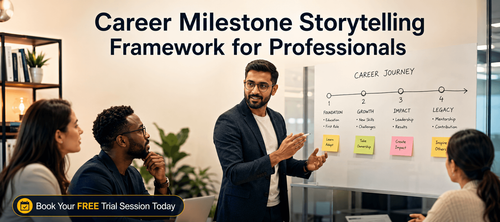

Creating Powerful Career Stories with the SPARK Framework: A Practical Guide to Stand Out in Interviews and Beyond
You have the experience. You have delivered results, solved problems, and grown professionally. Yet, when it matters most—during interviews, networking conversations, or performance reviews—many professionals struggle to communicate their value effectively.
The problem is not lack of achievement. It is lack of structured storytelling. In today’s competitive job market, the ability to clearly articulate your career journey can be the difference between being overlooked and being selected.
This is where professional storytelling becomes a career-defining skill. This blog transforms a powerful guidebook into a practical, step-by-step approach to help you craft compelling career stories that are memorable, credible, and action-driven.
Download these resources and apply them alongside your daily work for improved clarity, productivity, and professional growth. You can also book a free trial to gain expert guidance and enhance your communication, problem-solving, and decision-making skills. The materials are designed in a clear, structured format to help professionals learn efficiently and implement insights with confidence.
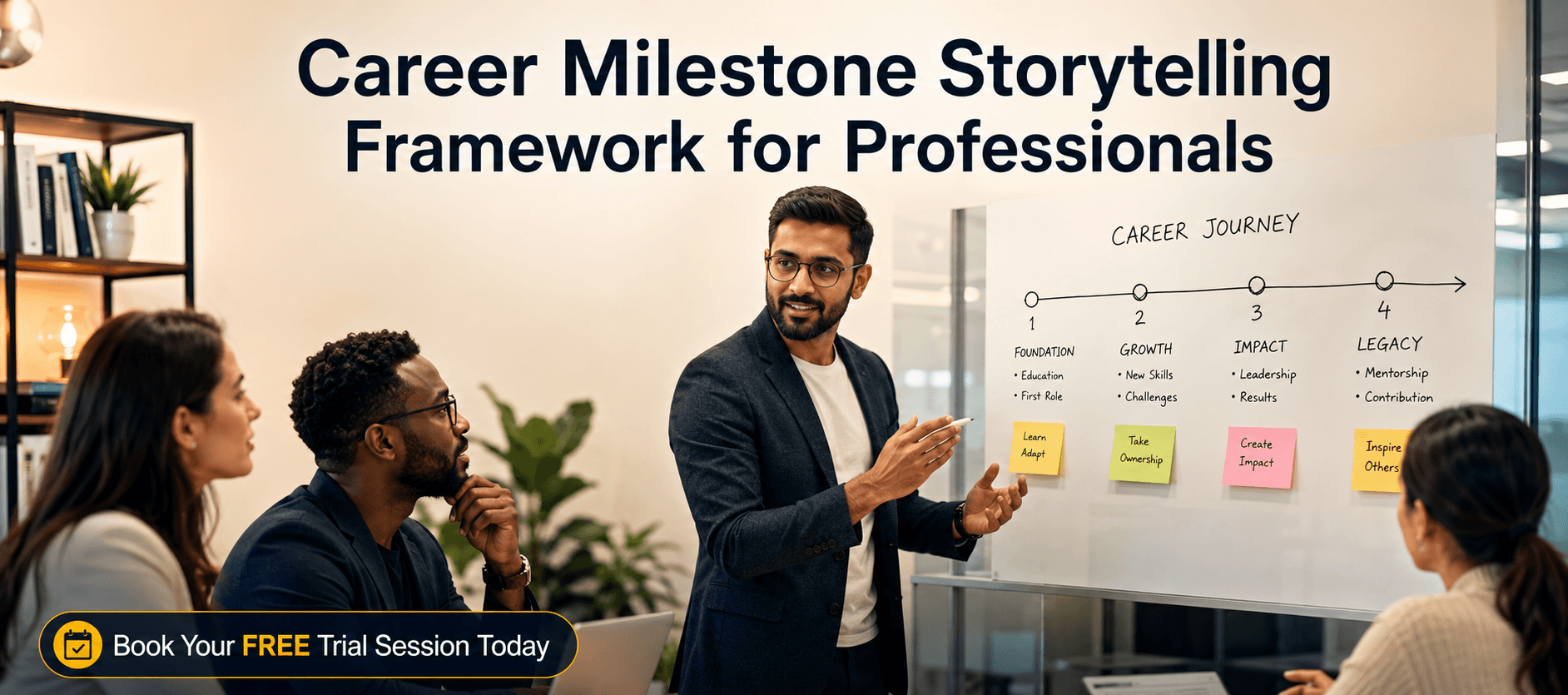
Who Is This Blog For?
- Working professionals who struggle to articulate their achievements clearly
- Job seekers preparing for interviews and networking opportunities
- Mid-career professionals aiming for promotions or leadership roles
- Career changers who need to reposition their experience effectively
- Consultants and specialists building a strong personal brand
Why This Topic Matters Today?
Modern hiring and career progression depend heavily on communication clarity. Recruiters, hiring managers, and leaders are not just evaluating what you have done—they are assessing how well you can explain it.
Many professionals face three critical gaps:
- Relevance gap where experiences are shared without explaining their importance
- Evidence gap where claims lack measurable proof
- Arc gap where stories lack structure and narrative flow
Without addressing these gaps, even strong candidates appear average. Structured storytelling solves this by turning experiences into persuasive, outcome-driven narratives.
Core Concept or Framework Explained
At the heart of professional storytelling is the SPARK framework—a structured model designed to make your stories clear, impactful, and memorable.
- Situation: Set the context briefly
- Problem: Highlight the challenge or stakes
- Action: Explain what you specifically did
- Result: Share measurable outcomes
- Knowledge: Reflect on what you learned and how it shapes your future
The inclusion of Knowledge is what makes SPARK powerful. It transforms a past experience into a forward-looking narrative, signalling growth, self-awareness, and leadership potential.
Instead of listing tasks, SPARK helps you present experiences as meaningful career milestones that demonstrate value.
How This Blog and Guidebook Help You?
This blog and the underlying guidebook enable you to:
- Build a strong repository of career stories
- Convert raw experiences into structured narratives
- Communicate impact with clarity and confidence
- Adapt your stories for different professional contexts
- Strengthen your personal brand across interviews and digital platforms
The result is a professional identity that is not only clear but also compelling and credible.
Step-by-Step Breakdown
Step 1: Mine Your Career Milestones
Most professionals underestimate their experience because they do not actively document it. The first step is to build a Story Bank—a collection of meaningful career moments.
Focus on identifying:
- Leadership or influence moments
- Problems you solved or improved
- First-time challenges you handled
- Projects you initiated or transformed
- Situations where you created measurable change
Use reflective prompts to uncover hidden achievements. Aim to document at least 8 to 12 milestones to ensure you always have relevant stories ready.
Step 2: Shape Your Story Using SPARK
Once you have raw material, the next step is to structure it.
Start by writing the full story using all five SPARK elements. Then refine it by:
- Removing irrelevant details
- Highlighting specific outcomes
- Adding measurable or qualitative impact
- Crafting a strong Knowledge closing
A well-structured story should be concise, engaging, and deliverable within 60 to 120 seconds.
Step 3: Match Your Story to the Moment
A common mistake is using the same story everywhere. Effective professionals tailor their stories based on context.
Different scenarios require different emphasis:
- Job interviews focus on results and measurable impact
- Performance reviews highlight business value and growth
- Networking conversations prioritise engagement and memorability
- LinkedIn content emphasises insight and perspective
Your story remains the same, but its delivery changes based on audience expectations.
Step 4: Build Your Professional Identity Narrative
Beyond individual stories, every professional needs a cohesive narrative that answers “Tell me about yourself.”
This narrative includes:
- The Spark that shaped your career direction
- Key milestones showing progression
- Your current focus and expertise
- Your forward vision and career goals
Instead of listing roles chronologically, this approach creates a clear and purposeful story that connects your past, present, and future.
Step 5: Use Storytelling for Career Transitions
Career transitions require a different storytelling approach. Instead of focusing on what you lack, highlight transferable skills.
Build explicit bridges such as:
- What you did in your previous role
- The underlying skill behind that work
- How that skill directly applies to the new role
This reframing positions you as a strong candidate with relevant capabilities rather than a risky career changer.
Step 6: Develop Leadership Stories
For professionals targeting senior roles, storytelling must reflect influence, not just execution.
Strong leadership stories demonstrate:
- Decision-making under uncertainty
- Team development and people impact
- Change management and transformation
- Culture building and long-term influence
These stories show that you operate at a strategic level, making them critical for promotions and leadership opportunities.
Step 7: Optimise Your Digital Storytelling
Your online presence often creates the first impression. Your LinkedIn profile, bio, and written content must reflect your story clearly.
Focus on:
- Writing a value-driven headline
- Crafting a compelling About section with a narrative arc
- Using structured achievement-based bullet points in experience sections
- Including clear outcomes and insights
Strong digital storytelling ensures credibility even before a conversation begins.
Common Mistakes or Pitfalls to Avoid
- Starting too early instead of focusing on relevant context
- Using “we” instead of clearly stating your contribution
- Skipping the stakes and failing to create engagement
- Using vague results without measurable outcomes
- Ending stories without a Knowledge takeaway
- Using the same story in every situation
- Underplaying your impact due to modesty
- Over-rehearsing until the story sounds unnatural
Avoiding these mistakes significantly improves how your story is received.
How Should You Use This Guidebook Effectively?
To maximise results, follow a structured approach:
- Read the full guide to understand the framework
- Build your Story Bank with at least 8 to 12 milestones
- Convert top milestones into SPARK stories
- Practice delivery aloud for clarity and timing
- Apply stories in real conversations and refine them
- Update your LinkedIn and professional profiles
A recommended approach is to spread this work across 30 days with focused weekly goals, ensuring steady progress without overwhelm.
Key Takeaways
- Your story is a powerful career asset that must be developed intentionally
- Use the SPARK framework to structure every professional story
- Specific results and measurable outcomes build credibility
- Always tailor your story to the audience and context
- Career transitions should highlight transferable skills, not gaps
- Leadership stories must show influence and strategic thinking
- Practice ensures your story sounds natural and confident
Your Next Step: Accelerate Your Career with PlanetSpark
Creating an impact-driven resume is not just about landing your next job—it’s about owning your professional story and presenting it with clarity, confidence, and credibility. When your resume clearly communicates value, results, and impact, opportunities follow naturally.
At PlanetSpark, we are committed to empowering working professionals with practical, outcome-focused resources that drive real career growth. From resume building and workplace communication to leadership presence and professional writing, our programs are designed to help you succeed in today’s fast-evolving job market.
Visit https://www.planetspark.in/resources to explore:
- Career and resume-building guides
- Workplace communication and professional writing resources
- Skill-development tools curated for working professionals
Want a deeper, hands-on experience?
You can also book a free trial session to learn more about PlanetSpark’s Working Professional Courses, designed to accelerate your career through personalised coaching, real-world practice, and expert guidance.
Your career deserves more than generic advice.
It deserves clarity, confidence, and measurable impact.
Personalized Communication Roadmaps
Record a video to get a AI generated personalized communication reports