
How Students Can Document Achievements for Career Growth
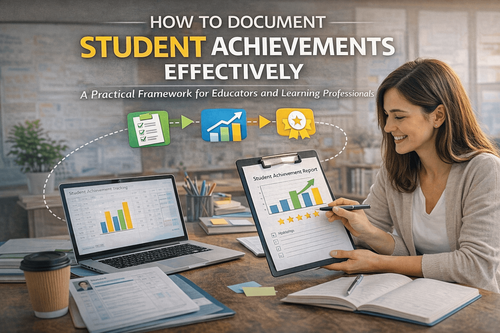

How to Document Student Achievements Effectively: A Practical Framework for Educators and Learning Professionals
Every educator, academic coach, or learning professional has experienced this moment: a student makes noticeable progress, a parent asks for proof of improvement, or an institution requests evidence of learning outcomes—and suddenly you realise your documentation is scattered across memory, incomplete notes, and outdated spreadsheets.
This is the documentation gap.
Without a structured system to capture student progress, even meaningful achievements become difficult to prove or communicate. In education and coaching environments where results matter, this gap can cost professionals credibility, time, and influence.
Effective student achievement documentation is not administrative busywork. When done correctly, it becomes one of the most powerful tools in a professional educator’s toolkit. It allows you to track growth patterns, identify learning gaps early, celebrate milestones, and communicate student progress with clarity and confidence.
The Student Achievement Documentation Worksheet was designed specifically to solve this problem by providing a structured system that helps educators record performance, skill development, and growth over time.
Who Is This Blog For?
This guide is designed for professionals responsible for tracking, analysing, and communicating student progress.
- Teachers managing large classrooms or cohorts
- Academic coaches conducting one-on-one sessions
- Learning and development professionals
- Curriculum designers and consultants
- Education managers overseeing instructional teams
- Tutors who need clear evidence of student progress
If your role involves demonstrating student impact to parents, institutions, or stakeholders, this framework can significantly improve the clarity and effectiveness of your documentation.
Why This Topic Matters Today?
Education is increasingly outcome-driven. Parents expect transparency about their child’s progress, institutions demand measurable learning outcomes, and educators themselves need reliable records to improve their teaching strategies.
However, many professionals struggle with documentation because:
- Achievement records are inconsistent or incomplete
- Progress tracking relies too heavily on memory
- Data is captured without a structured framework
- Valuable insights are lost between reporting cycles
This creates a situation where real student progress exists but cannot be clearly demonstrated.
Structured documentation solves this challenge by turning everyday observations and session notes into a coherent growth narrative supported by both qualitative and quantitative evidence.
Core Concept or Framework Explained
Before documenting student progress, it is important to understand what achievement actually means.
According to the worksheet framework, achievement is not a single metric such as a test score. Instead, it is a multi-dimensional picture made up of three key layers.
Layer 1: Performance Data
This includes measurable outcomes such as test scores, assignment grades, and assessment results. These metrics are easy to collect but only tell part of the story.
Examples include:
- Quiz scores
- Assignment completion rates
- Benchmark test results
Layer 2: Skill Markers
Skill markers represent qualitative indicators of deeper learning. These include observable behaviours that demonstrate competency development.
Examples include:
- Communication clarity
- Critical thinking ability
- Collaboration skills
- Self-regulation during tasks
Layer 3: Growth Indicators
Growth indicators capture the difference between where a student started and where they are now. This “baseline-to-current” comparison often provides the most compelling evidence of progress.
Examples include:
- Improvement in assessment scores
- Increased confidence in class participation
- Faster problem-solving ability
- Consistent application of new learning strategies
When educators combine all three layers—performance data, skill markers, and growth indicators—the result is a far more persuasive and meaningful record of student development.
How This Blog and Guidebook Help You?
The worksheet provides a step-by-step documentation system that simplifies how educators capture and communicate student achievements.
By applying this framework, professionals can:
- Establish clear learning baselines
- Track progress consistently across sessions
- Capture milestone achievements
- Conduct structured progress reviews
- Communicate results effectively to stakeholders
The system transforms documentation from a tedious reporting task into a strategic professional tool.
Step-by-Step Breakdown
Step 1: Establish a Clear Baseline
Every meaningful documentation process begins with understanding where the student starts.
Without a baseline, it becomes impossible to measure genuine progress.
A strong baseline includes both quantitative and qualitative information collected during the first few sessions. This may include:
- Initial performance scores
- Observations about learning style
- Key strengths and weaknesses
- Target outcomes for improvement
The worksheet includes a structured baseline template that records information such as the student’s starting score, learning behaviour observations, and a SMART goal for future performance.
This baseline becomes the anchor point for measuring all future growth.
Step 2: Build an Ongoing Tracking System
Once the baseline is established, the next step is to maintain consistent records after each learning session.
Many documentation systems fail because they are too complicated or time-consuming.
To address this issue, the worksheet introduces a simple but effective method called the 4-Point Session Log.
This log captures four key elements after every session:
What We Covered
Document the specific topic, skill, or task addressed during the session.
What the Student Demonstrated
Record observable evidence of understanding or skill development.
What Still Needs Work
Identify the remaining gap or challenge that the student must address.
Next Step or Follow-Up Action
Define the next action or learning objective for the upcoming session.
Each entry takes only a few minutes but builds a valuable record of student progress over time.
Step 3: Capture Milestone Achievements
While session logs track routine progress, milestone documentation captures breakthrough moments in a student’s learning journey.
Milestones may include:
- First independent mastery of a skill
- Significant improvement in assessment scores
- Completion of a major project
- Positive mindset or behavioural change
- Recognition from teachers or peers
Milestone documentation includes several key components:
- Description of the achievement
- Evidence supporting the achievement
- Context explaining what led to the milestone
- The student’s reaction or response
- The next milestone target
These milestone records form the backbone of a compelling student progress narrative.
Step 4: Conduct Structured Progress Reviews
Individual session logs and milestone entries are useful, but their full value emerges when they are synthesised into structured progress reviews.
Progress reviews typically occur every four to six weeks and involve analysing trends across multiple records.
During a review, educators examine questions such as:
- What trends appear in performance data?
- Which skills have improved significantly?
- What teaching methods contributed most to progress?
- Where are additional interventions required?
This analysis allows educators to adjust their strategies and set new targets based on evidence rather than intuition.
Step 5: Communicate Achievement to Stakeholders
Documentation is only valuable if it can be communicated effectively.
Different stakeholders require different types of progress reports.
Parents
Parents need reassurance, context, and actionable recommendations. Reports should highlight the student’s growth story supported by a few key data points.
Institutions
Institutional reports focus more heavily on measurable outcomes and alignment with learning standards.
Students
Students themselves benefit from clear feedback that connects their effort with their results and motivates further improvement.
The worksheet includes a communication template that helps educators translate documentation into clear narratives explaining progress and next steps.
Common Mistakes or Pitfalls to Avoid
Even experienced educators make common documentation mistakes.
One of the most frequent errors is documenting progress only when reports are required. Sporadic documentation creates gaps that make it difficult to track long-term trends.
Another mistake is capturing only numerical scores without qualitative observations. Numbers alone rarely tell the full story of learning progress.
Vague notes such as “student improving” also reduce the usefulness of documentation. Records should use precise, evidence-based language.
Finally, failing to establish a baseline prevents educators from demonstrating measurable growth.
Avoiding these mistakes significantly strengthens the credibility and usefulness of student progress records.
How Should You Use This Guidebook Effectively?
To implement this documentation framework successfully, educators should integrate it directly into their daily workflow.
Start by completing a baseline documentation sheet within the first few sessions with a new student.
Then maintain a consistent habit of recording session logs immediately after each interaction.
Milestones should be documented as they occur, and progress reviews should be conducted every four to six weeks.
By following this cycle—baseline, session logs, milestones, review, and communication—educators create a comprehensive record of student development.
Key Takeaways
- Student achievement documentation strengthens professional credibility and communication
- Achievement includes performance data, skill markers, and growth indicators
- Establishing a baseline is essential for measuring meaningful progress
- The 4-Point Session Log provides a simple method for consistent documentation
- Milestone records capture significant breakthroughs in learning
- Structured progress reviews help identify patterns and improve teaching strategies
- Tailored communication ensures that parents, institutions, and students understand progress clearly
Your Next Step: Accelerate Your Career with PlanetSpark
Creating an impact-driven resume is not just about landing your next job—it’s about owning your professional story and presenting it with clarity, confidence, and credibility. When your resume clearly communicates value, results, and impact, opportunities follow naturally.
At PlanetSpark, we are committed to empowering working professionals with practical, outcome-focused resources that drive real career growth. From resume building and workplace communication to leadership presence and professional writing, our programs are designed to help you succeed in today’s fast-evolving job market.
Visit https://www.planetspark.in/resources to explore:
- Career and resume-building guides
- Workplace communication and professional writing resources
- Skill-development tools curated for working professionals
Want a deeper, hands-on experience?
You can also book a free trial session to learn more about PlanetSpark’s Working Professional Courses, designed to accelerate your career through personalised coaching, real-world practice, and expert guidance.
Your career deserves more than generic advice.
It deserves clarity, confidence, and measurable impact.
Personalized Communication Roadmaps
Record a video to get a AI generated personalized communication reports