
How to Align Your Cover Letter With Any Job Description
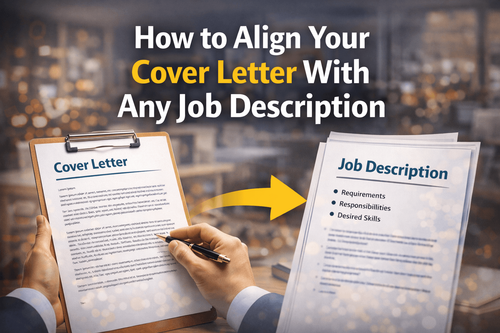

How to Write a High-Impact Cover Letter Aligned with Job Descriptions
You spend hours perfecting your resume,
yet your applications still go unanswered. Sound familiar? The problem often isn’t your experience—it’s how you communicate relevance. Most professionals write cover letters that talk about themselves, not what the employer actually needs.
Hiring managers are not looking for generic enthusiasm. They are scanning for alignment—clear evidence that you understand their challenges and can solve them. If your cover letter doesn’t instantly connect your experience to their job description, it gets ignored.
This is where a targeted, alignment-driven cover letter changes everything. Instead of repeating your resume, it positions you as the solution to a specific business problem. This guide breaks down a proven, step-by-step framework to help you decode job descriptions, mirror employer language, and craft compelling cover letters that get interviews.
Who Is This Blog For?
This blog and guidebook are designed for:
- Working professionals aiming to improve interview conversion rates
- Job seekers tired of sending applications with no response
- Career switchers who need to reposition their experience effectively
- Mid-level professionals targeting promotions or strategic roles
- Individuals re-entering the workforce after a break
- Consultants and specialists building a strong professional narrative
Why This Topic Matters Today
The hiring landscape has evolved. Recruiters are overwhelmed with applications and rely on quick scanning, ATS filters, and relevance signals to shortlist candidates.
A generic cover letter no longer works because:
- It fails to address the employer’s specific needs
- It does not reflect the language of the job description
- It lacks clear proof of relevance and impact
Today, hiring managers are asking one critical question: “Does this candidate understand our problem and can they solve it?”
An aligned cover letter answers that question immediately. By mirroring the job description and presenting targeted evidence, you dramatically increase your chances of standing out in a competitive market.
Core Concept or Framework Explained
At the heart of a high-impact cover letter is alignment—not just showcasing your experience, but connecting it directly to what the employer is looking for.
The guide introduces two powerful frameworks:
The Alignment Mindset
Instead of writing about your career broadly, you focus on:
- The employer’s needs
- The role’s priorities
- The business problem behind the job posting
The PAR-JD Framework
This framework transforms your experience into compelling, relevant statements:
- Problem: The challenge or context you faced
- Action: What you did to address it
- Result: The measurable outcome
- JD Link: How it connects to the job description
Together, these frameworks ensure every sentence in your cover letter is purposeful, relevant, and persuasive.
How This Blog and Guidebook Help You
By applying the insights from this guide, you will be able to:
- Decode job descriptions like a hiring manager
- Identify hidden priorities and expectations
- Translate your experience into employer-relevant language
- Write structured, easy-to-scan cover letters
- Build confidence in presenting your professional value
The outcome is simple: fewer generic applications, higher response rates, and better-quality interview opportunities.
Step-by-Step Breakdown
Step 1: Decode the Job Description Before Writing
The biggest mistake professionals make is jumping straight into writing. Instead, start by analysing the job description in depth.
Use a three-pass approach:
- First read for overall understanding
- Second read to identify key action verbs like lead, manage, optimise, build
- Third read to categorise requirements into must-haves, nice-to-haves, and cultural signals
This process helps you uncover what the employer truly values, including:
- Skills they prioritise
- Work environment expectations
- Performance indicators for success
By the end of this step, you should clearly understand what the role demands and how your experience fits.
Step 2: Identify the Employer’s Core Problem
Every job exists for a reason. Your task is to identify that reason.
Ask yourself:
- Why is this role being hired now?
- What challenge is the company trying to solve?
- What outcome are they expecting from the candidate?
Once identified, position yourself as the solution.
Instead of starting with a generic statement, your opening should:
- Highlight the employer’s problem
- Show how your experience directly addresses it
This immediately signals relevance and captures attention.
Step 3: Mirror the Language Strategically
One of the most powerful techniques in cover letter writing is language alignment.
When you use the same terminology as the job description:
- You increase your chances of passing ATS filters
- You build instant credibility with the recruiter
For example:
- Instead of saying “worked with different teams,” say “led cross-functional collaboration”
- Instead of “handled projects,” say “delivered multi-phase projects under tight timelines”
The key is to adapt—not copy—the employer’s language while keeping your narrative authentic.
Step 4: Structure Your Cover Letter for Maximum Impact
A strong cover letter follows a clear, four-part structure:
Hook Paragraph
- Introduce the role
- Highlight the employer’s core problem
- Present your key proof point
Evidence Paragraph
- Share 2–3 relevant, quantified achievements
- Align them with the job description requirements
Culture Fit Paragraph
- Demonstrate understanding of the company’s values or mission
- Show why you are genuinely interested
Confident Closing
- Clearly state your intent for the next step
- Maintain a professional and confident tone
This structure ensures your message is clear, concise, and easy to evaluate quickly.
Step 5: Build Evidence Using the PAR-JD Method
Before writing your letter, create a bank of achievement statements using the PAR-JD approach.
For example:
- Problem: Inefficient reporting system
- Action: Redesigned workflow using new tools
- Result: Reduced turnaround time significantly
- JD Link: Matches requirement for process improvement
This preparation makes writing faster and ensures every statement adds value.
Step 6: Run the Alignment Audit Before Submission
Before sending your cover letter, evaluate it across three dimensions:
Content Alignment
- Does it address key job requirements?
- Are achievements relevant and specific?
Language Alignment
- Have you used key phrases from the job description?
- Is the tone professional and industry-appropriate?
Tone Alignment
- Does it match the company’s culture?
- Is it confident without sounding exaggerated?
A quick review can significantly improve your chances of success.
Common Mistakes or Pitfalls to Avoid
Even strong candidates make these avoidable mistakes:
- Sending the same cover letter to multiple companies
- Repeating the resume instead of adding context
- Using vague or generic language
- Ignoring company culture and tone
- Writing weak or passive closing statements
- Highlighting gaps without reframing them positively
Avoiding these errors ensures your application stands out for the right reasons.
How Should You Use This Guidebook Effectively?
To get the best results from this guide:
- Start by analysing one job description thoroughly
- Follow each step sequentially for your first application
- Build a reusable bank of aligned achievement statements
- Spend 20–30 minutes tailoring each cover letter
- Review and refine using the alignment audit checklist
With practice, this process becomes faster and more intuitive, allowing you to apply confidently to multiple roles.
Key Takeaways / Summary
- Alignment matters more than generic experience
- Always decode the job description before writing
- Identify the employer’s core problem first
- Mirror language strategically for credibility and ATS success
- Use structured frameworks like PAR-JD for strong statements
- Follow a clear four-paragraph format
- Audit your cover letter before submission
- Tailor every application for maximum impact
Your Next Step: Accelerate Your Career with PlanetSpark
Creating an impact-driven resume is not just about landing your next job—it’s about owning your professional story and presenting it with clarity, confidence, and credibility. When your resume clearly communicates value, results, and impact, opportunities follow naturally.
At PlanetSpark, we are committed to empowering working professionals with practical, outcome-focused resources that drive real career growth. From resume building and workplace communication to leadership presence and professional writing, our programs are designed to help you succeed in today’s fast-evolving job market.
Visit https://www.planetspark.in/resources to explore:
- Career and resume-building guides
- Workplace communication and professional writing resources
- Skill-development tools curated for working professionals
Want a deeper, hands-on experience?
You can also book a free trial session to learn more about PlanetSpark’s Working Professional Courses, designed to accelerate your career through personalised coaching, real-world practice, and expert guidance.
Your career deserves more than generic advice.
It deserves clarity, confidence, and measurable impact.
Start building that advantage today—with PlanetSpark.
Personalized Communication Roadmaps
Record a video to get a AI generated personalized communication reports