
How to Audit Your Thinking Process: A Practical Guide for Professionals


Strengthen Your Decision-Making by Evaluating Your Thinking Process
Most professionals focus on improving outcomes—better decisions, faster execution, stronger results. But very few take the time to evaluate the one thing that drives all of these outcomes: their thinking process.
If your thinking is unclear, biased, or inconsistent, your decisions will reflect the same flaws. Over time, this leads to inefficiencies, repeated mistakes, and missed opportunities. The challenge is not just solving problems—it’s ensuring that your thinking process is structured, logical, and effective.
This is where a Thinking Process Audit Worksheet becomes a powerful tool. It helps you systematically examine how you think, identify gaps, and refine your cognitive approach for better decision-making and problem-solving.
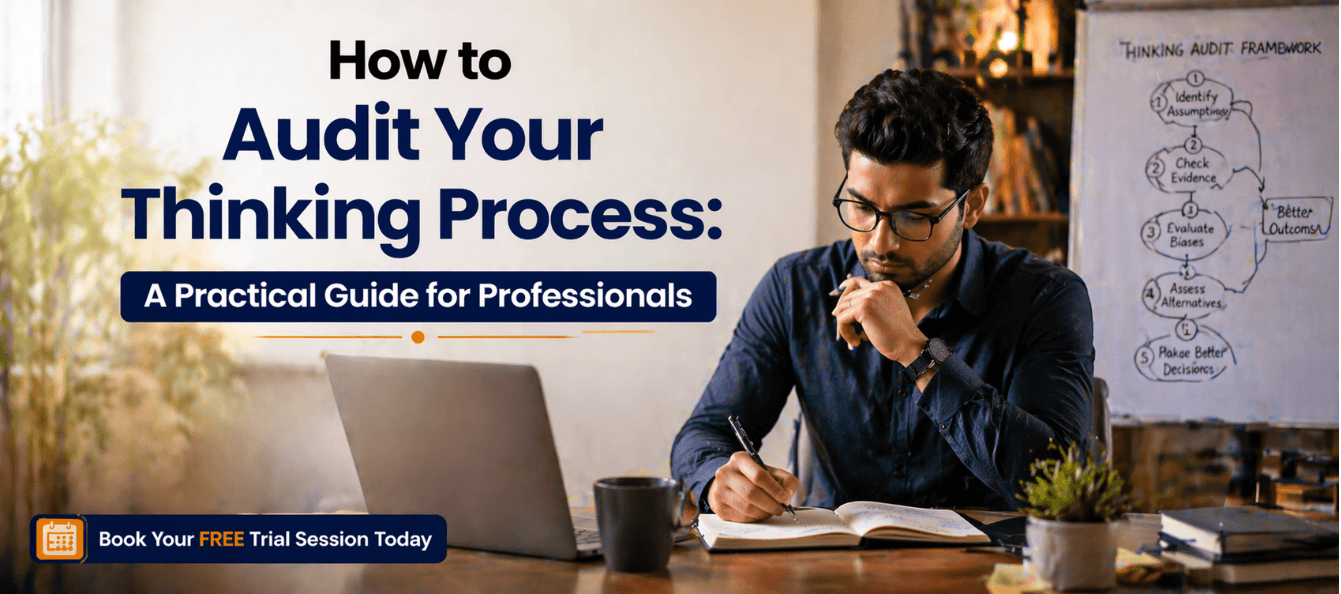
Download these resources and apply them alongside your daily work for improved clarity, productivity, and professional growth. You can also book a free trial to gain expert guidance and enhance your communication, problem-solving, and decision-making skills. The materials are designed in a clear, structured format to help professionals learn efficiently and implement insights with confidence.
Who Is This Blog For?
- Working professionals aiming to improve clarity and structured thinking
- Managers and leaders responsible for complex decision-making
- Consultants and analysts handling data-driven problem-solving
- Entrepreneurs navigating uncertainty and strategic choices
- Early-career professionals building strong cognitive foundations
Why This Topic Matters Today?
In today’s fast-paced and information-heavy work environment, professionals often make decisions under pressure. This leads to challenges such as:
- Unstructured thinking causing confusion and delays
- Overreliance on intuition without validation
- Difficulty breaking down complex problems
- Inconsistent reasoning across similar situations
- Lack of awareness of thinking gaps and inefficiencies
Without auditing your thinking process, these issues remain hidden. A structured audit helps uncover weaknesses and improve decision quality over time.
Core Concept or Framework Explained
The Thinking Process Audit Worksheet is based on the principle of metacognition—thinking about your thinking. It encourages professionals to step back and evaluate how they approach problems and decisions.
The framework focuses on key aspects of thinking such as:
- Clarity in defining problems
- Logical structuring of thoughts
- Use of data and evidence
- Identification of assumptions
- Consistency in reasoning
- Awareness of biases
For example, instead of simply solving a problem, the worksheet prompts you to ask:
- Did I clearly define the problem before acting?
- Did I consider multiple perspectives?
- Was my reasoning based on evidence or assumptions?
This structured evaluation improves both awareness and performance.
How This Blog and Guidebook Help You?
This guidebook provides a systematic approach to refining your thinking process.
By using the worksheet, you can:
- Identify gaps in your reasoning and decision-making
- Improve clarity and logical structuring
- Reduce errors caused by assumptions and biases
- Build a consistent approach to problem-solving
- Enhance overall professional effectiveness
Over time, this leads to stronger, more reliable decision-making.
Step-by-Step Breakdown
Step 1: Define the Situation or Problem
Start by clearly describing the situation you are analyzing.
Include:
- What is the problem or decision?
- What is the context?
- What is at stake?
Clarity ensures a focused audit.
Step 2: Evaluate Problem Definition
Assess whether the problem was defined accurately.
Ask:
- Was the problem clearly articulated?
- Were key details included?
- Was the scope appropriate?
This ensures that your thinking starts on the right foundation.
Step 3: Analyze Thought Structure
Examine how you organized your thinking.
Consider:
- Did you break the problem into smaller parts?
- Was your approach logical and sequential?
- Did you follow a structured framework?
This step highlights strengths and gaps in your reasoning.
Step 4: Review Use of Evidence
Evaluate the quality of information used.
Ask:
- Did you rely on data and facts?
- Were multiple sources considered?
- Did you validate your information?
Strong evidence leads to better decisions.
Step 5: Identify Assumptions and Biases
Uncover hidden influences on your thinking.
Document:
- Assumptions you made
- Potential cognitive biases
- Areas where judgment may have been subjective
This improves objectivity.
Step 6: Assess Decision Quality
Evaluate the outcome of your thinking.
Consider:
- Was the decision effective?
- Were risks properly evaluated?
- Did the outcome align with expectations?
This connects thinking to results.
Step 7: Identify Improvements
Based on your audit, define areas for improvement.
- What should you do differently next time?
- Which habits need to change?
- What frameworks can you apply?
This ensures continuous growth.
Common Mistakes or Pitfalls to Avoid
While using the worksheet, professionals often make these mistakes:
- Skipping the audit due to time constraints
- Being superficial in evaluation
- Ignoring biases and assumptions
- Focusing only on outcomes, not the thinking process
- Not documenting insights
- Failing to apply improvements
Avoiding these pitfalls ensures meaningful results.
How Should You Use This Guidebook Effectively?
To maximize the value of the Thinking Process Audit Worksheet, integrate it into your routine.
Recommended approach:
- Use it after important decisions or problem-solving activities
- Spend 15 to 25 minutes on each audit
- Be honest and objective in your evaluation
- Document insights for future reference
- Review past audits to track improvement
Consistency builds stronger thinking habits.
Key Takeaways
- Your thinking process directly impacts decision quality
- Auditing your thinking improves clarity and structure
- Identifying assumptions reduces errors
- Evidence-based reasoning enhances outcomes
- Consistency leads to better performance
- Reflection drives continuous improvement
- Strong thinking is a competitive professional advantage
Your Next Step: Accelerate Your Career with PlanetSpark
Creating an impact-driven resume is not just about landing your next job—it’s about owning your professional story and presenting it with clarity, confidence, and credibility. When your resume clearly communicates value, results, and impact, opportunities follow naturally.
At PlanetSpark, we are committed to empowering working professionals with practical, outcome-focused resources that drive real career growth. From resume building and workplace communication to leadership presence and professional writing, our programs are designed to help you succeed in today’s fast-evolving job market.
Visit https://www.planetspark.in/resources to explore:
- Career and resume-building guides
- Workplace communication and professional writing resources
- Skill-development tools curated for working professionals
Want a deeper, hands-on experience?
You can also book a free trial session to learn more about PlanetSpark’s Working Professional Courses, designed to accelerate your career through personalised coaching, real-world practice, and expert guidance.
Your career deserves more than generic advice.
It deserves clarity, confidence, and measurable impact.
Start building that advantage today—with PlanetSpark.
Personalized Communication Roadmaps
Record a video to get a AI generated personalized communication reports