
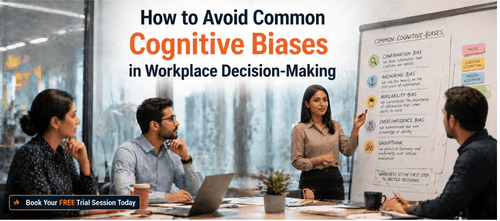
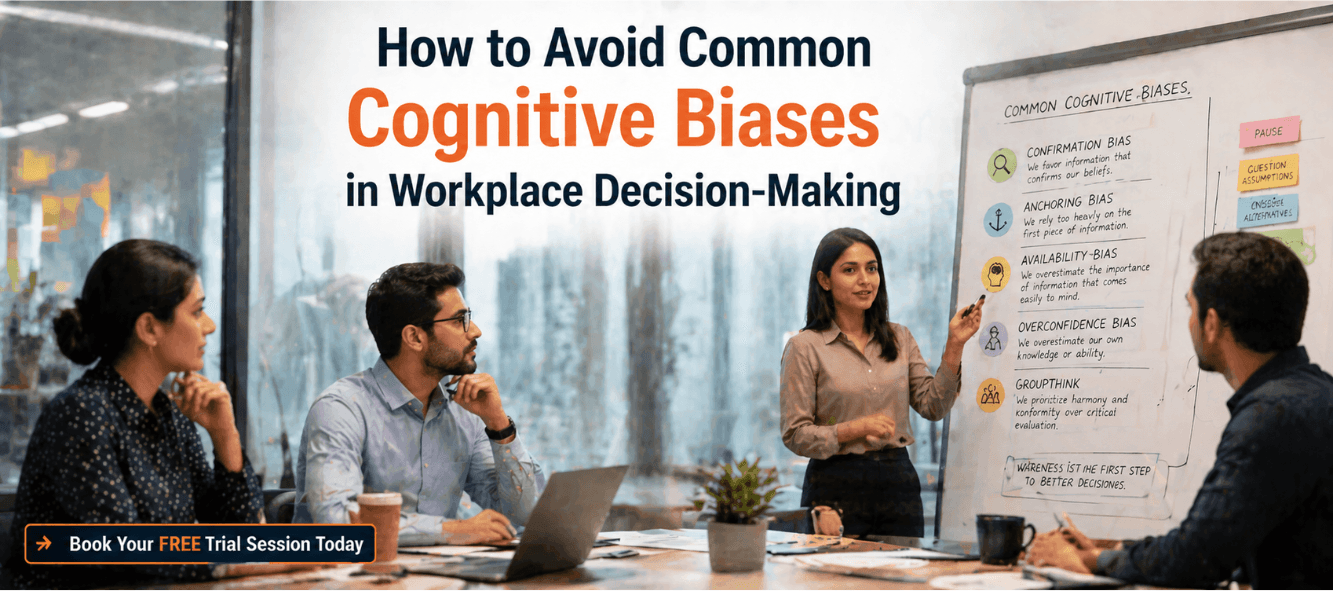
How to Avoid Common Cognitive Biases in Workplace Decision-Making

Think Smarter at Work: A Practical Guide to Overcoming Cognitive Biases in Decision-Making
Every day at work, you are expected to make decisions that are fast, accurate, and impactful. Whether you are shortlisting candidates, evaluating business strategies, responding to client challenges, or planning your next career move, your decisions shape not only outcomes—but also how others perceive your judgment and leadership potential.
Yet, despite having access to data, experience, and logical reasoning, many professionals still make decisions they later question. You may have hired someone who looked perfect on paper but underperformed. You might have continued investing in a project long after warning signs appeared. Or perhaps you agreed with a team decision simply because everyone else seemed confident—even when you had doubts.
These situations are more common than most professionals realise. The issue is not a lack of intelligence or effort. It is the presence of cognitive biases—subtle mental shortcuts your brain uses to make quick decisions. While these shortcuts can save time, they often lead to systematic errors in judgment, especially in complex and high-stakes workplace environments.
What makes cognitive biases particularly dangerous is that they operate beneath your awareness. They influence how you interpret information, whom you trust, what risks you take, and how you evaluate success and failure. Over time, these small distortions can compound into major professional setbacks—missed opportunities, flawed strategies, and weakened credibility.
In today’s competitive and fast-evolving work environment, relying solely on instinct is no longer enough. Professionals who consistently succeed are not just hardworking—they are intentional about how they think. They question assumptions, challenge their own perspectives, and use structured approaches to make better decisions.
This is exactly where a practical, structured guide to overcoming cognitive biases becomes invaluable. Instead of leaving your decisions to chance, you gain the ability to recognise thinking traps in real time, apply proven techniques to counter them, and build systems that improve your judgment consistently. The result is not just better decisions—but stronger confidence, clearer communication, and more predictable career growth.
Download these resources and apply them alongside your daily work for improved clarity, productivity, and professional growth. You can also book a free trial to gain expert guidance and enhance your communication, problem-solving, and decision-making skills. The materials are designed in a clear, structured format to help professionals learn efficiently and implement insights with confidence.
Who Is This Blog For?
- Working professionals involved in daily decision-making
- Managers and leaders responsible for hiring, strategy, and team outcomes
- Job seekers evaluating opportunities and career moves
- Entrepreneurs and consultants handling high-stakes decisions
- Professionals aiming to improve critical thinking and problem-solving skills
Why This Topic Matters Today?
In today’s fast-paced and competitive work environment, decision quality directly influences success. However, most professionals rely on mental shortcuts that can lead to flawed outcomes without realising it.
Cognitive biases affect:
- Hiring and talent evaluation processes
- Strategic planning and forecasting accuracy
- Team collaboration and group decision-making
- Personal career decisions and growth strategies
The problem is not that these biases exist—they are part of how the human brain works. The real issue is that most professionals lack the awareness and tools to manage them effectively.
Those who learn to recognise and counter these biases gain a strong professional advantage. They make better decisions, build credibility, and avoid costly mistakes.
Core Concept or Framework Explained
The guide is built on a powerful, practical framework that helps professionals improve decision-making at three levels.
Awareness: Recognising the Bias
The first step is identifying the most common cognitive biases that affect workplace decisions. The guide focuses on eight high-impact biases:
- Confirmation Bias
- Anchoring Bias
- Sunk Cost Fallacy
- Halo Effect
- Groupthink
- Fundamental Attribution Error
- Availability Bias
- Overconfidence Bias
Each bias has clear triggers and warning signs, helping you recognise when it is influencing your thinking.
Interruption: Acting in Real Time
Awareness alone is not enough. You must interrupt bias before it shapes your decision.
The guide introduces a simple four-step loop:
- Pause
- Name
- Challenge
- Decide
This process creates a moment of reflection, allowing you to shift from automatic thinking to deliberate reasoning.
System Design: Building Better Decision Processes
The most advanced level is creating systems that reduce bias consistently.
These include:
- Decision journals to track reasoning and outcomes
- Pre-decision checklists to ensure objectivity
- Structured evaluation frameworks
- External reviews to challenge assumptions
These systems ensure that better decisions become a habit, not a coincidence.
How This Blog and Guidebook Help You?
This blog translates the guide into actionable insights you can apply immediately.
You gain:
- Clear understanding of how cognitive biases impact your work
- Practical techniques to improve decision-making in real time
- Structured frameworks to enhance clarity and consistency
- Tools to strengthen both individual and team decisions
The outcome is improved judgment, stronger professional credibility, and better career results.
Step-by-Step Breakdown
Step 1: Identify Your Bias Patterns
Start by observing your thinking in real situations.
Ask yourself:
- Do I favour information that confirms my beliefs?
- Do first impressions influence my decisions too heavily?
- Do I hesitate to abandon failing projects?
Recognising these patterns is the first step toward improvement.
Step 2: Use a Self-Diagnosis Approach
Evaluate how frequently each bias affects you.
Best practices:
- Reflect after important decisions
- Be honest about your tendencies
- Focus on the biases that impact you the most
This targeted approach makes improvement more effective.
Step 3: Apply the Pause–Name–Challenge–Decide Loop
Before making key decisions:
- Pause to create thinking space
- Name the possible bias
- Challenge your assumptions
- Decide based on evidence
This simple habit can significantly improve decision quality.
Step 4: Use Bias-Specific Techniques
Each bias requires a tailored solution.
Examples:
- Challenge your beliefs by considering opposing viewpoints
- Set your own benchmarks before discussions
- Re-evaluate decisions without considering past investments
- Use structured criteria instead of relying on impressions
- Conduct pre-mortem analysis to anticipate risks
These techniques are practical and easy to apply.
Step 5: Build Decision Systems
Consistency comes from systems, not effort alone.
Implement:
- Decision journals to track patterns
- Checklists before major decisions
- Structured evaluation frameworks
- External feedback mechanisms
These systems reduce the impact of bias over time.
Step 6: Use a Pre-Decision Checklist
Before finalising a decision, ask:
- Have I considered opposing evidence?
- Am I influenced by early information?
- Am I continuing due to past investments?
- Have I evaluated options objectively?
- Have I considered diverse perspectives?
This ensures more balanced and rational decisions.
Step 7: Review and Learn from Outcomes
Track and analyse your decisions regularly.
Approach:
- Compare expected vs actual outcomes
- Identify recurring thinking patterns
- Adjust your approach based on insights
This continuous feedback loop improves long-term decision-making.
Step 8: Improve Group Decision-Making
Bias is amplified in team settings.
To improve outcomes:
- Encourage diverse opinions
- Assign a devil’s advocate role
- Avoid rushing to consensus
- Use structured evaluation criteria
This leads to more thoughtful and balanced decisions.
Step 9: Apply Bias Awareness to Career Decisions
Bias also affects your personal career choices.
Examples:
- Staying in comfortable roles for too long
- Overestimating readiness for new challenges
- Misinterpreting feedback
Awareness helps you make more informed career moves.
Step 10: Follow a Structured Action Plan
A consistent approach ensures real progress:
- Week 1: Identify key biases
- Week 2: Apply one technique consistently
- Week 3: Introduce team-level tools
- Week 4: Review and refine
This creates lasting behavioural change.
Common Mistakes or Pitfalls to Avoid
Even with awareness, professionals often make avoidable mistakes.
Common pitfalls include:
- Relying only on willpower
- Assuming more data removes bias
- Trying to fix all biases at once
- Ignoring external perspectives
- Not reviewing past decisions
Better alternatives:
- Build structured processes
- Focus on high-impact biases
- Seek diverse input
- Track outcomes consistently
How Should You Use This Guidebook Effectively?
To maximise impact, treat this guide as an ongoing tool.
Recommended workflow:
- Read once for awareness
- Use before major decisions
- Apply one technique at a time
- Maintain a decision journal
- Review progress regularly
Time investment:
- 5–10 minutes per decision
- 20 minutes monthly for reflection
Consistency is key to long-term improvement.
Key Takeaways
- Cognitive biases affect every professional decision
- Awareness is the first step, but systems drive real change
- The Pause–Name–Challenge–Decide loop improves clarity
- Each bias requires a specific solution
- Decision journals and checklists build consistency
- Group decisions need structured processes
- Regular reflection strengthens judgment over time
- Small improvements compound into significant career growth
Your Next Step: Accelerate Your Career with PlanetSpark
Creating an impact-driven resume is not just about landing your next job—it’s about owning your professional story and presenting it with clarity, confidence, and credibility. When your resume clearly communicates value, results, and impact, opportunities follow naturally.
At PlanetSpark, we are committed to empowering working professionals with practical, outcome-focused resources that drive real career growth. From resume building and workplace communication to leadership presence and professional writing, our programs are designed to help you succeed in today’s fast-evolving job market.
Visit https://www.planetspark.in/resources to explore:
- Career and resume-building guides
- Workplace communication and professional writing resources
- Skill-development tools curated for working professionals
Want a deeper, hands-on experience?
You can also book a free trial session to learn more about PlanetSpark’s Working Professional Courses, designed to accelerate your career through personalised coaching, real-world practice, and expert guidance.
Your career deserves more than generic advice.
It deserves clarity, confidence, and measurable impact.
Start building that advantage today—with PlanetSpark.
Personalized Communication Roadmaps
Record a video to get a AI generated personalized communication reports