
How to Maintain Structure and Flexibility in Personal Life Systems

How to Balance Structure and Flexibility in Your Life Systems for Professional Success
In today’s fast-paced professional world, it’s easy to feel like you’re stuck in a productivity paradox: on one hand, you have the need for strict structure, routines, and discipline; on the other, you crave the freedom to adapt and respond to life's unpredictable demands. Many professionals swing between the two extremes—either over-scheduling their time until they feel stifled, or letting go of any structure altogether and feeling like they’re always catching up.
The real issue isn't about choosing one over the other. It’s about finding the right balance. Structured systems offer stability, while flexibility allows for growth and adaptation. Professionals who succeed in today's fast-paced world master the art of balancing both.
This guide will walk you through how to create systems that provide the benefits of structure without the suffocation of rigidity. It will help you build flexible frameworks that support your career, mental well-being, and personal life without sacrificing one for the other.
Download these resources and apply them alongside your daily work for improved clarity, productivity, and professional growth. You can also book a free trial to gain expert guidance and enhance your communication, problem-solving, and decision-making skills. The materials are designed in a clear, structured format to help professionals learn efficiently and implement insights with confidence.
Who Is This Blog For?
Job seekers preparing for interviews and networking opportunities
Career switchers exploring new industries or roles
Working professionals aiming to build stronger connections
Freelancers and consultants managing client communication
Managers and leaders focused on professional relationship-building.
Why This Topic Matters Today?
In a world where efficiency and work-life balance are often at odds, finding a way to be both productive and adaptable is crucial. The tension between structure and flexibility is felt by nearly every working professional today. A rigid system that doesn’t allow for flexibility leads to burnout, while an overly flexible approach can result in unproductive weeks.
Professionals who balance structure with flexibility not only improve their productivity but also increase their long-term job satisfaction. As today’s job market continues to shift, the ability to handle disruption, maintain energy, and continue progressing with consistency is more important than ever.
Core Concept or Framework Explained
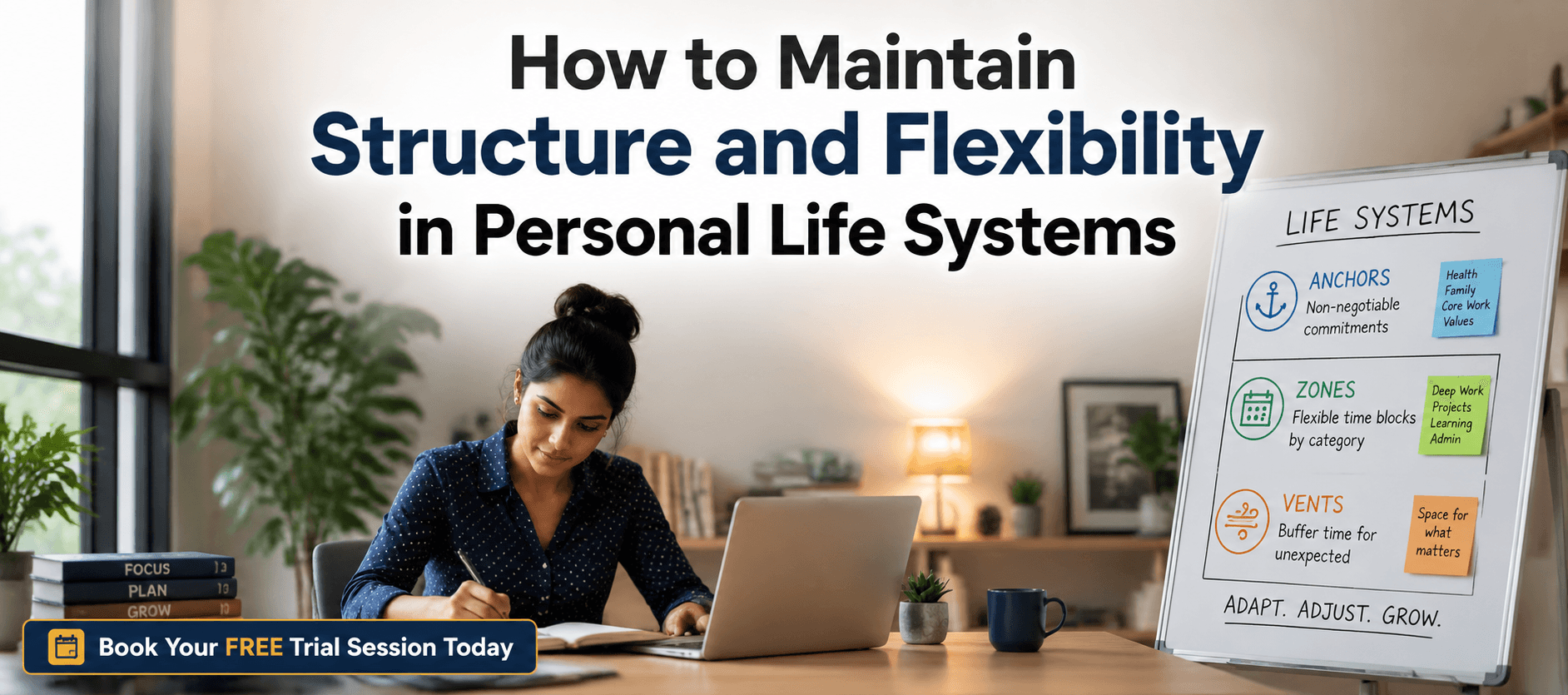
The solution to balancing structure and flexibility lies in the Lattice Model, a framework designed to create robust systems that support both predictable and adaptable components of your professional and personal life. The model is based on three key components:
Anchors: These are the fixed points in your week—your non-negotiable commitments. They provide the stability you need to thrive.
Zones: These are flexible time blocks dedicated to specific categories of work, not individual tasks, allowing for adaptability.
Vents: Often overlooked, Vents are empty time slots in your schedule that absorb overflow and help you manage unexpected disruptions.
The Lattice Model helps you design a life system that works with your natural rhythm, while ensuring you’re not overwhelmed by either over-scheduling or under-planning.
How This Blog and Guidebook Help You?
This blog breaks down the Lattice Model and offers practical steps for its implementation. By following these strategies, you’ll:
Design a flexible framework that holds you accountable without draining your energy
Cultivate a routine that adapts to the ever-changing demands of life
Improve your professional productivity and personal satisfaction by protecting your time effectively.
Step-by-Step Breakdown
Step 1: Identify Your Non-Negotiable Anchors
Begin by identifying the five to seven activities that are non-negotiable. These could include important work deliverables, health habits, or family commitments. These Anchors are the foundation of your system, ensuring that crucial activities are prioritized.
Step 2: Design Your Zones
Zones categorize your time into broad categories, not specific tasks. For example, designate specific blocks of time for strategic planning, deep work, or administrative tasks. These Zones ensure that you can focus on the right activities without getting bogged down by a rigid schedule.
Step 3: Build In Your Vents
Vents are intentionally empty time slots that help you absorb unexpected disruptions. By setting aside 20-25% of your time for Vents, you create space for flexibility, allowing you to handle whatever life throws at you without disrupting your productivity.
Step 4: Build Your Weekly Rhythm
The Pulse Review is a crucial part of your system. It’s a 20-30 minute weekly ritual to assess your system's effectiveness and adjust as needed. This regular check-in ensures that your Lattice remains responsive to your changing needs.
Step 5: Calibrate for Your Season
Understand that your system must evolve with your career and life stages. During intense work periods, you may tighten your system, focusing more on Deep Work Zones. In recovery seasons, you’ll loosen your structure to allow more time for rest and rejuvenation. By adjusting your system quarterly, you keep it aligned with your current demands.
Common Mistakes or Pitfalls to Avoid
Over-Anchoring: Avoid treating every task as a non-negotiable. Keep your Anchors limited to those that truly matter.
Zone Creep: Ensure that your Zones remain focused on specific categories of work. A Zone should never become a catch-all.
Skipping the Pulse Review: Make your weekly review a non-negotiable. It’s the cornerstone of maintaining a functional system.
No Vents: Vents are essential. If your schedule is too rigid, you will eventually burn out.
Season Blindness: Regularly assess which “season” you are in, and reconfigure your system to match it.
How Should You Use This Guidebook Effectively?
Step 1: Identify your Anchors using the worksheet provided.
Step 2: Design your Zones by categorizing your work into clear windows of time.
Step 3: Allocate at least 20% of your time as Vents.
Step 4: Schedule your weekly Pulse Review to assess your system’s performance.
Step 5: Recalibrate your system based on your current season (Sprint, Growth, Connection, or Recovery).
This guide is meant to be an ongoing tool. Revisit it regularly to ensure that your system evolves with you.
Key Takeaways:
A balanced life system integrates structure and flexibility, not one or the other.
Anchors, Zones, and Vents form the foundation of your system.
Vents are essential for system resilience and flexibility.
Regular Pulse Reviews ensure that your system stays effective and adaptable.
Recalibrate your system quarterly to keep it in alignment with your life’s seasons.
Your Next Step: Accelerate Your Career with PlanetSpark
Creating an impact-driven resume is not just about landing your next job—it’s about owning your professional story and presenting it with clarity, confidence, and credibility. When your resume clearly communicates value, results, and impact, opportunities follow naturally.
At PlanetSpark, we are committed to empowering working professionals with practical, outcome-focused resources that drive real career growth. From resume building and workplace communication to leadership presence and professional writing, our programs are designed to help you succeed in today’s fast-evolving job market.
Visit https://www.planetspark.in/resources
to explore:
Career and resume-building guides
Workplace communication and professional writing resources
Skill-development tools curated for working professionals.
Want a deeper, hands-on experience?
You can also book a free trial session to learn more about PlanetSpark’s Working Professional Courses, designed to accelerate your career through personalised coaching, real-world practice, and expert guidance.
Your career deserves more than generic advice.
It deserves clarity, confidence, and measurable impact.
Start building that advantage today—with PlanetSpark.
Personalized Communication Roadmaps
Record a video to get a AI generated personalized communication reports