
How to Build a High-Impact Job Pipeline While Working
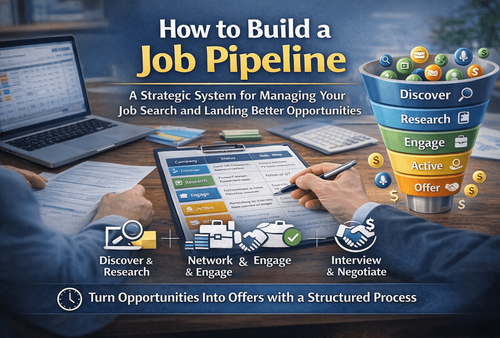

How to Build a Job Pipeline: A Strategic System for Managing Your Job Search and Landing Better Opportunities
Most professionals approach job searching in a reactive way. They browse job boards occasionally, apply to a few interesting roles, and hope something works out. When weeks pass without responses, frustration grows and confidence drops.
The truth is that the problem is rarely the candidate. The problem is the system.
A successful job search does not rely on luck or random applications. It relies on structure, momentum, and a continuous flow of opportunities. Instead of treating job hunting as a one-time activity, professionals should manage it like a pipeline.
A job pipeline is a structured system where opportunities move through different stages — from discovery and research to networking, interviews, and offers. This approach, inspired by sales pipeline management, ensures that professionals always have multiple opportunities progressing simultaneously rather than depending on a single application.
The guide How to Build a Job Pipeline provides a practical framework to help professionals build, manage, and convert opportunities into offers using a structured and disciplined approach.
Who Is This Blog For?
This guide is designed for professionals who want a strategic approach to their job search instead of relying on random applications.
- Working professionals exploring new career opportunities while managing full-time jobs
- Early to mid-career professionals looking to grow into leadership roles
- Career switchers transitioning into new industries or functions
- Managers and consultants seeking better roles or strategic career moves
- Professionals who want to build multiple opportunities rather than depend on a single job application
Why This Topic Matters Today?
The modern job market is competitive, fast-moving, and often unpredictable. Many roles receive hundreds of applications within hours of being posted.
Relying solely on job boards significantly reduces your chances of success. Instead, professionals need a structured system that consistently generates opportunities.
The job pipeline framework introduces a five-stage system that ensures professionals maintain a healthy flow of opportunities:
- Discover opportunities
- Research companies and roles
- Engage through networking and applications
- Participate in interviews
- Evaluate and negotiate offers
As illustrated in the pipeline diagram on page 3 of the guide, opportunities should be spread across all stages rather than concentrated in one place. This balance prevents desperation and ensures continuous momentum throughout the job search.
When managed properly, a pipeline transforms job searching from a stressful guessing game into a controlled and measurable process.
Core Concept or Framework Explained
The central concept of the guide is the job pipeline framework.
A job pipeline is a structured flow of opportunities that move through different engagement stages. Each stage requires a different type of activity and level of effort.
The five stages include:
Discover
Identifying potential companies and job roles aligned with your target.
Research
Understanding the company, role requirements, team structure, and industry context.
Engage
Building relationships, networking, and submitting targeted applications.
Active
Participating in interviews and assessment processes.
Offer
Evaluating and negotiating job offers before making a decision.
The diagram on page 3 visually represents these five stages as a sequential pipeline system, showing how opportunities progress from awareness to decision. :contentReference[oaicite:2]{index=2}
This framework ensures that professionals maintain opportunities at multiple stages simultaneously rather than waiting for one application to succeed.
How This Blog and Guidebook Help You?
Following the job pipeline approach offers several advantages for professionals.
Instead of feeling stuck or overwhelmed, professionals gain a structured system that produces consistent progress.
Key benefits include:
- Better visibility into all opportunities being pursued
- Improved networking and referral opportunities
- Higher interview conversion rates due to targeted applications
- Reduced stress because multiple opportunities exist simultaneously
- Greater negotiation leverage when offers arrive
Professionals who run a disciplined pipeline shift from hoping for opportunities to actively creating them.
Step-by-Step Breakdown
Step 1: Define Your Target Role
Every effective pipeline begins with clarity.
Before identifying companies or applying for jobs, professionals must clearly define the role they are targeting. Vague goals such as “something in tech” or “a marketing job” lead to scattered applications and wasted effort.
The guide introduces a Target Definition Framework with three layers of clarity:
Role Clarity
The function, title, and level you want to pursue.
Sector Clarity
Industries, company types, and cultural environments that align with your interests.
Constraint Clarity
Location preferences, compensation expectations, work model, and timeline.
Professionals are encouraged to create a one-sentence target statement that summarizes these elements. This statement acts as a compass guiding every decision in the job search.
Step 2: Build a Target Company List
Once your role target is clear, the next step is identifying companies where that role exists.
Instead of randomly applying to job postings, professionals should create a structured list of 30 to 50 target companies. This list becomes the foundation of the job pipeline.
Sources for identifying companies include:
- LinkedIn job listings and job boards
- Industry awards and high-growth company lists
- Companies where professional connections already work
- News about startups receiving funding or expanding operations
Each company should be tracked with details such as industry, company size, reason for targeting, and potential internal contacts.
This structured company list ensures professionals focus on quality opportunities rather than volume.
Step 3: Research Before You Reach Out
Research significantly increases the success rate of outreach and applications.
Before contacting a company or applying for a role, professionals should spend 30 to 45 minutes gathering insights about the organization.
Important research areas include:
Company-level insights
Understanding the company’s business model, growth trajectory, competitors, and culture.
Role-level insights
Understanding the expectations, team structure, leadership, and success metrics for the position.
Professionals should document their findings in a one-page company brief that can be reused when preparing for interviews or networking conversations.
This preparation ensures that every interaction is relevant and informed.
Step 4: Activate Your Network
Networking is one of the most powerful job search channels.
According to the guide, employee referrals account for approximately 30 to 50 percent of hires at many organizations, yet only a small portion of candidates pursue this channel effectively.
The networking strategy in the guide uses three circles of relationships.
Inner Circle
People who know your work well and can provide referrals or introductions.
Middle Circle
Professional acquaintances and former colleagues who can provide insights and connections.
Outer Circle
New connections in your target companies who can provide informational interviews and insights.
By strategically activating these circles, professionals dramatically increase their chances of reaching decision-makers inside companies.
Step 5: Apply With Precision
Applications should be the result of research and networking rather than the starting point.
High-quality applications follow several principles:
- Mirror the language used in the job description
- Highlight quantified achievements and measurable impact
- Include a personalized cover note explaining why the company is relevant
- Use referrals whenever possible before submitting the application
When these strategies are applied, callback rates can increase dramatically compared to traditional job board applications.
Step 6: Manage Your Pipeline Weekly
Building a pipeline is only the beginning. Maintaining it requires consistent review and follow-up.
The guide recommends conducting a weekly pipeline review lasting approximately 60 to 90 minutes.
During this session, professionals should:
- Review the status of every opportunity
- Send follow-up messages to recruiters or contacts
- Move opportunities to the next stage when appropriate
- Add new companies or contacts to the pipeline
This weekly rhythm keeps opportunities progressing and ensures the pipeline never runs dry.
Common Mistakes or Pitfalls to Avoid
Several mistakes can undermine even the most promising job search pipeline.
Common pitfalls include:
- Treating job boards as the primary job search channel
- Sending the same generic resume to every role
- Failing to follow up with recruiters or contacts
- Activating your network only when desperate for a job
- Treating every company equally without prioritizing key targets
Avoiding these mistakes ensures that your pipeline remains focused, efficient, and productive.
How Should You Use This Guidebook Effectively?
This guide works best when used as an operational system rather than a one-time read.
Recommended workflow:
- Read the guide completely to understand the pipeline framework
- Create your target role statement and company list
- Build a simple spreadsheet to track opportunities
- Schedule a weekly pipeline review session
- Continuously add new companies and contacts to the system
Professionals who follow this process consistently develop a pipeline that generates steady career opportunities.
Key Takeaways
- A job pipeline transforms job searching from random applications into a structured system
- Maintaining opportunities across multiple stages reduces stress and increases leverage
- Clear career targets help professionals focus on the right opportunities
- Networking and referrals significantly increase interview conversion rates
- Research and preparation improve the quality of outreach and applications
- Weekly pipeline reviews keep opportunities moving forward
- Consistency and discipline are the foundation of a successful job search system
Your Next Step: Accelerate Your Career with PlanetSpark
Creating an impact-driven resume is not just about landing your next job—it’s about owning your professional story and presenting it with clarity, confidence, and credibility. When your resume clearly communicates value, results, and impact, opportunities follow naturally.
At PlanetSpark, we are committed to empowering working professionals with practical, outcome-focused resources that drive real career growth. From resume building and workplace communication to leadership presence and professional writing, our programs are designed to help you succeed in today’s fast-evolving job market.
Visit https://www.planetspark.in/resources to explore:
- Career and resume-building guides
- Workplace communication and professional writing resources
- Skill-development tools curated for working professionals
Want a deeper, hands-on experience?
You can also book a free trial session to learn more about PlanetSpark’s Working Professional Courses, designed to accelerate your career through personalised coaching, real-world practice, and expert guidance.
Your career deserves more than generic advice.
It deserves clarity, confidence, and measurable impact.
Personalized Communication Roadmaps
Record a video to get a AI generated personalized communication reports