
How to Build a Personal Brand Story for Career Growth
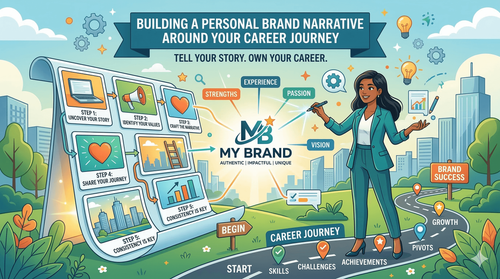

How to Build a Powerful Personal Brand Narrative That Clearly Communicates Your Career Value
Many professionals have impressive career experiences. They have solved complex problems, navigated career pivots, led teams, and adapted to evolving industries. Yet when asked a simple question such as “Tell me about yourself,” they often struggle to respond clearly.
Instead of presenting a confident story, they list job titles, describe scattered experiences, or undersell their achievements. The issue is rarely a lack of accomplishments. The real problem is a lack of narrative.
A personal brand narrative connects your past experiences, present expertise, and future direction into a clear professional story. It helps others quickly understand who you are, what you stand for, and the value you bring.
When your story is clear, your career becomes easier for others to understand and support. Recruiters recognize your strengths faster. Clients trust your expertise sooner. Colleagues remember your impact longer.
This guide explores how professionals can transform their career history into a compelling personal brand narrative using a structured framework. The goal is simple: turn scattered experiences into a memorable, confident professional story that accelerates career growth.
Who Is This Blog For?
This blog is designed for professionals who want to communicate their career story with clarity and confidence.
- Early and mid-career professionals who want stronger personal branding
- Professionals preparing for interviews, networking conversations, or career pivots
- Managers and specialists seeking clearer professional positioning
- Consultants or freelancers presenting their expertise to potential clients
- Professionals updating their LinkedIn profiles or personal bios
- Anyone who struggles to explain their career journey clearly
Why This Topic Matters Today?
Modern careers are rarely linear. Professionals often move across roles, industries, and responsibilities while building their expertise. While this diversity creates valuable experience, it can also make career stories difficult to explain.
Many professionals experience common challenges when describing their career journey:
- Listing job titles without explaining the deeper meaning behind them
- Struggling to explain career pivots or industry changes
- LinkedIn profiles that present facts but not a coherent story
- Missed opportunities because others cannot quickly understand their value
- Feeling unprepared when asked to introduce themselves professionally
A personal brand narrative solves these challenges by creating a clear professional storyline. Instead of presenting disconnected experiences, professionals communicate a story that shows:
- What motivates their work
- What unique value they bring
- Where their career direction is heading
According to the PlanetSpark guidebook, a strong narrative connects three key elements: audience relevance, evidence from real career experiences, and a clear professional storyline about who you were, who you are today, and where you are going next. :contentReference[oaicite:0]{index=0}
When these elements align, your career story becomes memorable, credible, and persuasive.
Core Concept or Framework Explained
The guidebook introduces a six-step framework designed to transform raw career experiences into a powerful personal brand narrative. Each step builds on the previous one, helping professionals move from reflection to clear positioning. :contentReference[oaicite:1]{index=1}
The six steps include:
- Excavate your story
- Find the throughline
- Define your positioning
- Craft your core narrative
- Adapt the story to different contexts
- Activate and sustain the narrative
This framework ensures that professionals do not simply describe their past but instead shape a coherent story that explains their career purpose and impact.
At the end of the process, professionals develop more than a list of achievements. They create a narrative that communicates:
- Their professional identity
- The problems they are uniquely suited to solve
- The direction their career is moving toward
This narrative becomes the foundation for interviews, networking conversations, LinkedIn profiles, personal websites, and professional bios.
How This Blog and Guidebook Help You?
This guide helps professionals move from confusion to clarity when explaining their career journey.
By following the framework, you can:
- Identify meaningful career moments that shaped your professional growth
- Discover patterns and themes in your career experiences
- Clarify your professional positioning
- Create a structured narrative that communicates your value
- Adapt your story for different professional contexts
- Consistently present your professional brand across platforms
Instead of struggling to summarize your career during interviews or networking conversations, you will have a ready-to-use narrative that clearly communicates who you are and what you bring.
Step-by-Step Breakdown
Step 1: Excavate Your Story
Every strong narrative begins with raw material. Many professionals skip this step and jump directly into writing a summary of their career.
However, a compelling story requires deeper reflection.
This step involves exploring meaningful moments in your career such as:
- Projects that energized you
- Challenges that pushed you to grow
- Career pivots or major decisions
- Skills or strengths colleagues consistently recognize
- Moments when you realized what work truly matters to you
Rather than focusing only on job titles or responsibilities, this stage uncovers the experiences that shaped your professional identity.
By collecting these moments, you build the foundation for a narrative that reflects not only what you have done but also why it matters.
Step 2: Find the Throughline
A throughline is the theme that connects different chapters of your career. Without it, your career history appears as a disconnected sequence of roles.
With a throughline, your career becomes a coherent story.
The guidebook identifies three common types of throughlines:
Problem Throughline
Some professionals are consistently drawn to solving the same category of problems, such as fixing inefficient systems or improving communication.
Impact Throughline
Others are defined by the type of impact they create, such as building trust with stakeholders or transforming complex challenges into actionable strategies.
Values Throughline
In some careers, a core value drives professional decisions, such as ownership, innovation, or access to opportunity.
To discover your throughline, reflect on questions like:
- What challenge appears repeatedly across my roles?
- What strengths do colleagues consistently recognize?
- What problem do I feel most motivated to solve?
The answers often reveal the consistent thread running through your career.
Step 3: Define Your Brand Positioning
Once you understand your career theme, the next step is defining how you want to be perceived professionally.
Brand positioning is the intersection of three factors:
- Your unique strengths
- Your audience’s needs
- Your differentiating advantage
When these elements align, you create a clear professional identity that others can easily recognize.
The guidebook provides a positioning template:
I help [specific audience] achieve [specific outcome] by leveraging [unique strength]. Unlike others, I bring [differentiating factor].
This positioning statement clarifies your professional value in a concise and memorable way.
Step 4: Craft Your Core Narrative
Once your career moments, throughline, and positioning are clear, you can craft your core narrative.
The guidebook recommends a storytelling structure commonly used in compelling narratives:
Context
Briefly explain where your professional journey began and what shaped your early interests.
Complication
Describe the challenge, realization, or turning point that changed your direction.
Pivot
Explain the deliberate decision you made in response to that challenge.
Payoff
Describe where you are now and how your journey uniquely equips you to create value.
This structure transforms career history into a story that feels intentional and meaningful rather than random or fragmented.
Step 5: Adapt the Story for Different Contexts
Your core narrative becomes the foundation for multiple professional formats.
Different situations require different versions of the same story, including:
30-second introduction
Used for networking conversations and quick professional introductions.
2-minute interview answer
Used when responding to “Tell me about yourself” in interviews or meetings.
LinkedIn About section
A slightly longer version that explains your career story in a conversational tone.
Professional bio
A short third-person summary used for conferences, proposals, or speaking engagements.
The key principle is consistency. While the format changes, the core message and positioning remain the same.
Step 6: Activate and Sustain Your Narrative
A personal brand narrative becomes valuable only when it is actively used.
Professionals can activate their narrative through several practical actions:
- Updating LinkedIn headlines and profile descriptions
- Practicing their introduction out loud
- Sharing insights or content related to their expertise
- Incorporating their narrative into presentations or networking conversations
- Reviewing and refining the narrative periodically
Because careers evolve over time, your narrative should evolve as well. Regular reflection ensures that your story continues to represent who you are becoming professionally.
Common Mistakes or Pitfalls to Avoid
Even motivated professionals often weaken their career narrative by making common mistakes.
Chronological storytelling
Simply listing jobs in order does not create a compelling story.
Apologizing for career pivots
Career changes can demonstrate growth and adaptability when framed correctly.
Generic positioning
Phrases such as “passionate professional” or “results-driven leader” provide little clarity.
Audience-blind storytelling
A narrative should highlight the elements most relevant to the listener.
Ignoring soft skills
Communication, collaboration, and leadership capabilities often differentiate professionals more than technical skills.
Lack of forward momentum
A strong narrative ends by pointing toward what you want to build next.
Never updating the story
Your narrative should evolve as your career progresses.
Avoiding these pitfalls ensures that your story communicates confidence, clarity, and purpose.
How Should You Use This Guidebook Effectively?
This guide works best when treated as an interactive process rather than a quick read.
Start by working through the reflection exercises that help you identify career moments, strengths, and values.
Next, draft your throughline and positioning statement. These elements form the backbone of your narrative.
Then write a full narrative draft using the context, complication, pivot, and payoff structure.
After drafting your core story, create shorter versions for different professional contexts such as networking introductions, LinkedIn summaries, and interview answers.
Finally, practice telling your story out loud and refine it over time. Consistent use helps the narrative become natural and authentic.
The guidebook notes that professionals can complete the full framework in a focused two-hour session or spread the process over several weeks for deeper reflection. :contentReference[oaicite:2]{index=2}
Either approach works as long as you actively complete the exercises and apply the insights.
Key Takeaways
- A personal brand narrative connects your past experiences, present expertise, and future direction
- Many professionals struggle not because they lack achievements but because they lack a clear story
- The six-step framework helps transform career experiences into a coherent professional narrative
- Discovering your throughline reveals the theme that connects different career chapters
- Strong positioning clarifies the specific audience you serve and the value you create
- Storytelling structures such as context, complication, pivot, and payoff make narratives memorable
- Adapting your narrative for multiple formats ensures consistency across platforms
- Regularly revisiting your narrative keeps it aligned with your evolving career goals
Your Next Step: Accelerate Your Career with PlanetSpark
Creating an impact-driven resume is not just about landing your next job—it’s about owning your professional story and presenting it with clarity, confidence, and credibility. When your resume clearly communicates value, results, and impact, opportunities follow naturally.
At PlanetSpark, we are committed to empowering working professionals with practical, outcome-focused resources that drive real career growth. From resume building and workplace communication to leadership presence and professional writing, our programs are designed to help you succeed in today’s fast-evolving job market.
Visit https://www.planetspark.in/resources to explore:
- Career and resume-building guides
- Workplace communication and professional writing resources
- Skill-development tools curated for working professionals
Want a deeper, hands-on experience?
You can also book a free trial session to learn more about PlanetSpark’s Working Professional Courses, designed to accelerate your career through personalised coaching, real-world practice, and expert guidance.
Your career deserves more than generic advice.
It deserves clarity, confidence, and measurable impact.
Personalized Communication Roadmaps
Record a video to get a AI generated personalized communication reports