
How to Build a Personal Productivity System for Professionals
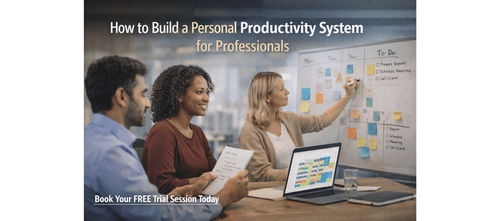

A Practical Framework for Designing a Personal Productivity System to Take Control of Your Time, Improve Focus, and Drive Career Growth
In today’s fast-paced professional environment, most people don’t struggle because they lack talent or ambition—they struggle because they lack a system. Days get consumed by meetings, emails, and constant context-switching, leaving little room for meaningful, high-impact work. The result is a cycle of busyness without real progress.
Many professionals rely on memory, reactive habits, and scattered tools to manage their responsibilities. Over time, this leads to missed priorities, mental fatigue, and the persistent feeling of being overwhelmed. Despite working hard, they find themselves stuck—unable to focus on what truly matters.
This is exactly where a personal productivity system becomes a game-changer. Instead of relying on willpower alone, you build a structured, repeatable approach to capture tasks, prioritise effectively, and execute with clarity. The guidebook “Designing a Personal Productivity System for Professionals” provides a practical, step-by-step framework to help you regain control of your time and consistently deliver high-value work.
Download these resources and apply them alongside your daily work for improved clarity, productivity, and professional growth. You can also book a free trial to gain expert guidance and enhance your communication, problem-solving, and decision-making skills. The materials are designed in a clear, structured format to help professionals learn efficiently and implement insights with confidence.
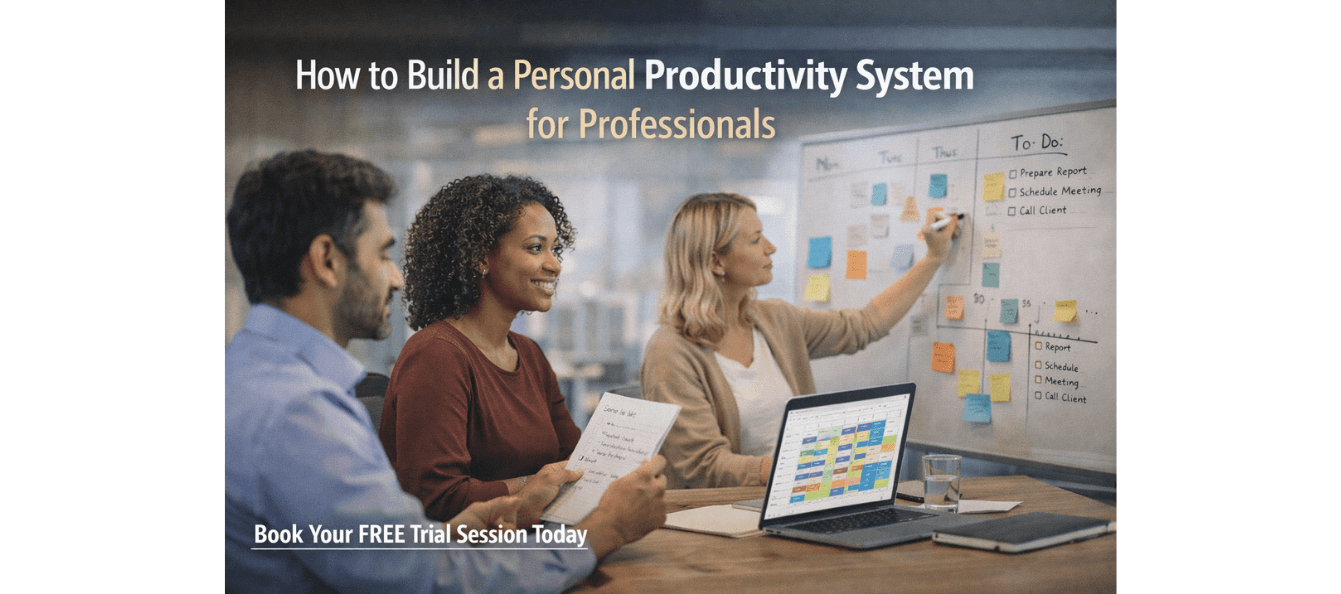
Who Is This Blog For?
- Working professionals struggling with time management and overwhelm
- Managers balancing team responsibilities and individual deliverables
- Consultants handling multiple projects simultaneously
- Career switchers adapting to new roles and expectations
- Freelancers aiming to improve focus, consistency, and output
Why This Topic Matters Today?
Modern work environments are more complex than ever. Professionals are expected to juggle multiple responsibilities, collaborate across teams, and deliver results under tight deadlines. However, most have never been taught how to manage their time, attention, and energy effectively.
The guide highlights a critical issue: most professionals spend less than 90 minutes per day on Deep Work—tasks that truly drive value. Instead, their time is consumed by shallow work such as emails, meetings, and administrative tasks.
This creates a gap between effort and impact.
Today’s career growth depends on:
- The ability to prioritise high-value work consistently
- Managing increasing workloads without burnout
- Maintaining clarity and focus in a distraction-heavy environment
A personal productivity system is no longer optional—it is a foundational career skill.
Core Concept or Framework Explained
At the heart of the guidebook is a simple yet powerful framework built on four pillars:
Capture
All tasks, ideas, and commitments are collected in a trusted system instead of relying on memory.
Clarify
Each captured item is processed to determine its relevance and next action.
Organise
Tasks are structured into projects, contexts, and priorities for easy execution.
Execute
Focused work is carried out with minimal friction and maximum clarity.
These four components form the backbone of a complete productivity system. When implemented correctly, they reduce cognitive load, improve decision-making, and create consistent momentum in your work.
How This Blog and Guidebook Help You?
This blog and the underlying guidebook provide you with:
- A clear, structured approach to managing work and priorities
- Practical frameworks to reduce overwhelm and improve focus
- Step-by-step guidance to build a system tailored to your role
- Tools and habits that ensure long-term consistency
The outcome is greater control over your time, improved productivity, and the ability to focus on work that truly matters.
Step-by-Step Breakdown
Step 1: Audit Your Current Reality
Before building a better system, you must understand your current one.
Start with a weekly time audit:
- Track your time in 30-minute blocks
- Categorise work into Deep Work, Shallow Work, Meetings, and Recovery
Then identify friction points:
- Tasks you keep postponing
- Areas where work falls through the cracks
- Times when you feel most productive
This step builds awareness and highlights what needs to change.
Step 2: Define Your Productivity North Star
Without direction, productivity becomes busyness.
To define your North Star:
- Identify your professional roles
- Determine which roles create the most impact
- Write a 2–3 sentence statement describing your ideal outcomes
This becomes your decision-making filter for how you spend time.
Step 3: Build Your Capture System
Your brain is for thinking, not storing tasks.
Create a capture system with:
- One digital inbox (task manager or notes app)
- One physical capture method (notebook)
- Optional situational tools (voice notes)
Key rule:
- Capture everything immediately
Consistency matters more than the tool you choose.
Step 4: Clarify and Organise with Weekly Review
The Weekly Review is the most critical habit in your system.
During a 45–60 minute session:
- Process all captured items
- Review active projects
- Plan priorities for the next week
For each task, ask:
- Is this actionable?
- What is the next step?
- Where does it belong?
This keeps your system clean and actionable.
Step 5: Structure Your Day for Deep Work
Your daily schedule determines your output.
Use a simple structure:
- Morning: 90–120 minutes of Deep Work
- Midday: Meetings and collaboration
- Afternoon: Focused work sprint
- End of day: 15-minute shutdown routine
Prioritise your most important work before reactive tasks.
Step 6: Build Sustainable Habits
A system only works if it is maintained.
Focus on:
- Habit stacking (attach new habits to existing routines)
- Environment design (make tools easily accessible)
- Immediate rewards (track progress and celebrate completion)
Also, review your system monthly to refine and improve it.
Common Mistakes or Pitfalls to Avoid
Many productivity systems fail due to predictable mistakes:
- Constantly switching tools or frameworks without consistency
- Overcomplicating systems with unnecessary features
- Skipping the Weekly Review
- Ignoring energy levels while scheduling tasks
- Capturing tasks without clarifying them
- Spending more time organising than executing
A better approach is to:
- Keep your system simple
- Focus on consistency over perfection
- Regularly review and refine your process
How Should You Use This Guidebook Effectively?
To get maximum value:
- Read the guidebook fully once to understand the system
- Implement one step at a time over a week
- Use worksheets to apply concepts in real time
- Schedule weekly reviews consistently
Suggested time investment:
- Daily planning: 5–10 minutes
- Weekly review: 45–60 minutes
- Monthly reflection: 1–2 hours
Treat your productivity system as a long-term practice, not a one-time setup.
Key Takeaways
- Productivity systems reduce overwhelm and improve clarity
- Deep Work is essential for meaningful career progress
- A capture system prevents mental overload
- Weekly reviews keep your system functional and relevant
- Daily structure ensures consistent execution
- Sustainable habits make productivity automatic
- Continuous improvement keeps your system effective
Your Next Step: Accelerate Your Career with PlanetSpark
Creating an impact-driven resume is not just about landing your next job—it’s about owning your professional story and presenting it with clarity, confidence, and credibility. When your resume clearly communicates value, results, and impact, opportunities follow naturally.
At PlanetSpark, we are committed to empowering working professionals with practical, outcome-focused resources that drive real career growth. From resume building and workplace communication to leadership presence and professional writing, our programs are designed to help you succeed in today’s fast-evolving job market.
Visit https://www.planetspark.in/resources to explore:
- Career and resume-building guides
- Workplace communication and professional writing resources
- Skill-development tools curated for working professionals
Want a deeper, hands-on experience?
You can also book a free trial session to learn more about PlanetSpark’s Working Professional Courses, designed to accelerate your career through personalised coaching, real-world practice, and expert guidance.
Your career deserves more than generic advice.
It deserves clarity, confidence, and measurable impact.
Start building that advantage today—with PlanetSpark.
Personalized Communication Roadmaps
Record a video to get a AI generated personalized communication reports