
How to Build a Personal Transition Portfolio to Showcase Your Career Capability
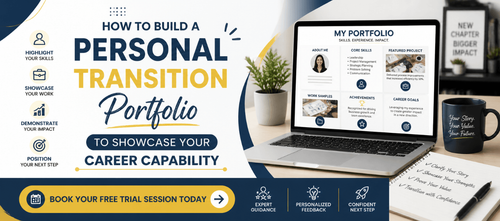

Accelerate Career Change and Build a Personal Transition Portfolio to Showcase Capability
Making a career transition is no longer just about updating your resume or attending a few networking events. Working professionals today face a deeper challenge: proving capability in a field where they may not yet have formal experience. Whether you are shifting industries, roles, or career paths entirely, the biggest barrier is credibility. Hiring managers, clients, and stakeholders want evidence—not just intent.
This is where most professionals get stuck. They invest time in learning new skills but struggle to demonstrate them in a way that builds trust and opens opportunities. Traditional credentials alone are no longer enough in a fast-evolving job market that prioritises outcomes, adaptability, and real-world application.
A personal transition portfolio solves this problem. It provides structured, tangible proof of your capabilities, helping you bridge the gap between where you are and where you want to be. Instead of saying “I can do this,” you show it—through projects, experiments, and documented results.
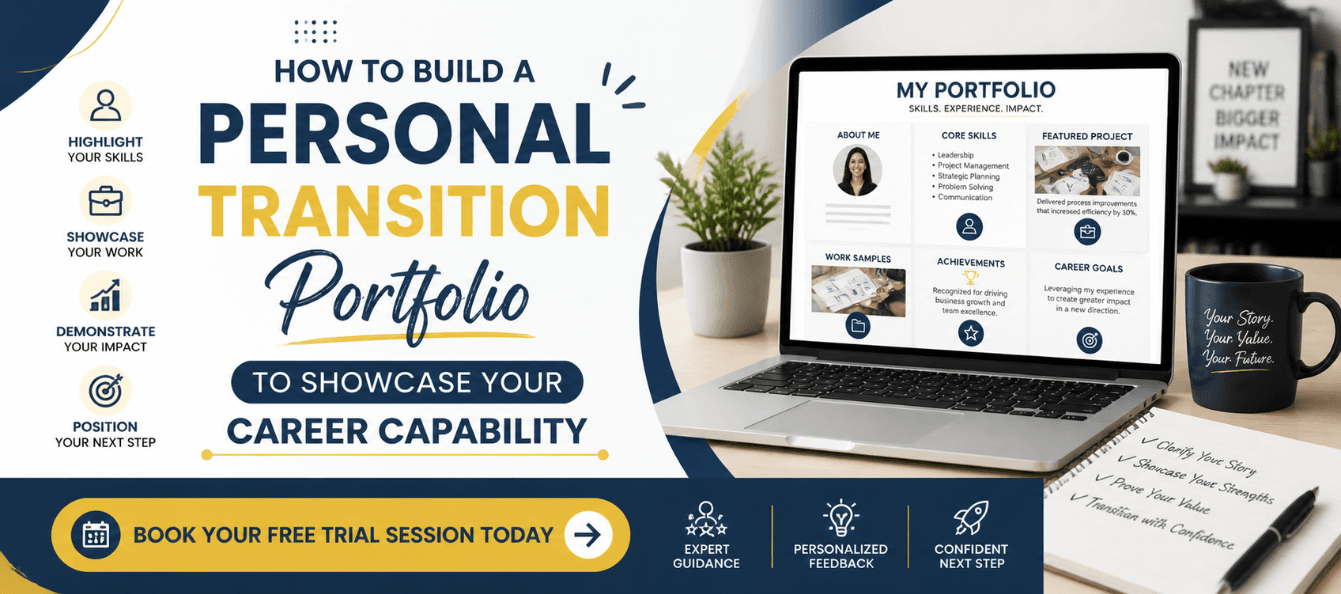
Download these resources and apply them alongside your daily work for improved clarity, productivity, and professional growth. You can also book a free trial to gain expert guidance and enhance your communication, problem-solving, and decision-making skills. The materials are designed in a clear, structured format to help professionals learn efficiently and implement insights with confidence.
Who Is This Blog For?
- Professionals planning a career transition into a new industry or role
- Mid-career individuals seeking to reposition their experience for better opportunities
- Job seekers struggling to demonstrate practical skills beyond their resume
- Freelancers or consultants building credibility in a new domain
- Managers and leaders exploring parallel career paths or second careers
Why This Topic Matters Today?
The modern job market has shifted from qualification-based hiring to capability-based evaluation. Employers increasingly prioritise demonstrable skills, real-world problem-solving, and measurable outcomes over degrees or job titles.
This creates a major challenge for career switchers. Even if you acquire new skills through courses or self-learning, you may still face questions such as:
- Where have you applied these skills?
- Can you show real examples of your work?
- What results have you delivered?
Without clear answers, your transition stalls.
At the same time, opportunities are expanding. Remote work, freelance platforms, and project-based roles allow professionals to experiment, build, and showcase their abilities independently. The gap is not access to opportunity—it is the ability to structure and present your work effectively.
A personal transition portfolio addresses this gap by turning learning into visible proof and intention into credibility.
Core Concept or Framework Explained
A personal transition portfolio is not just a collection of work samples. It is a strategic, structured system designed to demonstrate your readiness for a new role or career path.
The core idea revolves around three pillars:
Proof of Capability
Instead of relying on claims, you provide evidence through projects, case studies, and practical outputs. Each element of your portfolio answers one key question: Can you actually do the work?
Narrative Alignment
Your portfolio is not random. It tells a cohesive story about your transition—why you are shifting, what skills you bring, and how your past experience connects to your future direction.
Progressive Validation
A strong portfolio evolves over time. It includes small experiments, iterative improvements, and increasing levels of complexity, showing continuous growth and commitment.
For example, someone transitioning from marketing to product management might include:
- A product teardown analysis
- A mock product roadmap
- A user research case study
- A feature prioritisation framework
Each piece builds credibility and demonstrates applied thinking, not just theoretical knowledge.
How This Blog and Guidebook Help You?
This guide helps you move from passive learning to active demonstration. Instead of accumulating information, you start building assets that directly support your career transition.
By following this approach, you will:
- Translate your learning into visible, structured outputs
- Build credibility even without formal experience in the new field
- Create a compelling narrative that aligns your past and future roles
- Stand out in competitive job markets through proof-based positioning
- Gain confidence by working on real or simulated projects
Ultimately, the goal is simple: reduce the gap between your current identity and your target role.
Step-by-Step Breakdown
Step 1: Define Your Target Role Clearly
Before building your portfolio, you need clarity on where you are heading. A vague goal leads to a scattered portfolio.
Ask yourself:
- What specific role am I targeting?
- What skills and competencies are required?
- What kind of work outputs define success in this role?
For example, targeting “data analyst” is too broad. Instead, define it as “business-focused data analyst working on customer insights.” This clarity shapes the type of projects you include.
Step 2: Identify Core Skill Areas
Break down your target role into key skill clusters. These will guide your portfolio content.
For instance:
- Technical skills
- Analytical thinking
- Communication and presentation
- Problem-solving
Each portfolio piece should map to at least one of these areas. This ensures coverage and balance.
Step 3: Design Portfolio Projects Strategically
Your portfolio should not be random—it should be intentional. Choose projects that demonstrate relevant skills and mimic real-world scenarios.
Types of projects you can include:
- Self-initiated projects based on real-world problems
- Simulated case studies
- Freelance or volunteer work
- Internal projects from your current role (reframed appropriately)
For example, if you are transitioning into UX design, you might redesign an existing app, document your process, and present usability improvements.
Step 4: Focus on Process, Not Just Output
Many professionals make the mistake of showcasing only final results. However, employers value thinking and approach just as much as outcomes.
Each project should include:
- Problem statement
- Approach and methodology
- Tools and frameworks used
- Key decisions and trade-offs
- Final outcome and learnings
This demonstrates depth and structured thinking, which are critical for most professional roles.
Step 5: Document Your Work Effectively
Presentation matters. Even strong work can lose impact if it is poorly documented.
Ensure that:
- Each project is clearly structured
- Language is concise and professional
- Visuals or examples are used where relevant
- Key insights are highlighted
Think of each project as a mini case study rather than a simple task.
Step 6: Connect Past Experience to New Skills
Your transition portfolio should not ignore your past—it should leverage it.
Identify transferable skills such as:
- Stakeholder management
- Problem-solving
- Leadership
- Communication
Then show how these apply to your new domain.
For example, a sales professional transitioning into marketing can highlight customer understanding and persuasion skills.
Step 7: Build a Cohesive Narrative
Your portfolio should tell a story, not feel like a collection of unrelated work.
Create a clear narrative:
- Why you are transitioning
- What you have done to prepare
- How your portfolio reflects your readiness
This narrative can be presented through an introduction section or summary.
Step 8: Continuously Improve and Expand
Your portfolio is not a one-time effort. It should evolve as you gain more experience and clarity.
Regularly:
- Add new projects
- Refine existing ones
- Remove weaker work
- Update based on feedback
This keeps your portfolio relevant and aligned with your goals.
Common Mistakes or Pitfalls to Avoid
- Creating a portfolio without a clear target role
- Including too many low-quality or irrelevant projects
- Focusing only on outputs without explaining the process
- Ignoring transferable skills from past experience
- Using overly technical or unclear language
- Failing to update the portfolio regularly
These mistakes reduce the effectiveness of your portfolio and weaken your positioning.
How Should You Use This Guidebook Effectively?
To get the most value from this guide:
- Allocate dedicated time each week to work on your portfolio
- Start with one or two high-quality projects instead of trying to build everything at once
- Treat each project as a real-world assignment with clear goals and outcomes
- Seek feedback from peers, mentors, or industry professionals
- Iterate based on feedback and improve continuously
A practical workflow could look like this:
- Week 1: Define target role and skill areas
- Week 2–3: Build first project
- Week 4: Document and refine
- Ongoing: Add new projects and improve existing ones
Consistency matters more than speed. Even a small but well-structured portfolio can create significant impact.
Key Takeaways
- A personal transition portfolio helps you prove capability, not just claim it
- It bridges the gap between learning and real-world application
- Strong portfolios focus on both process and outcomes
- Strategic project selection is critical for relevance and impact
- Your past experience should support, not compete with, your transition
- Continuous improvement keeps your portfolio aligned with evolving goals
- A well-crafted portfolio significantly increases credibility and opportunity access
Your Next Step: Accelerate Your Career with PlanetSpark
Creating an impact-driven resume is not just about landing your next job—it’s about owning your professional story and presenting it with clarity, confidence, and credibility. When your resume clearly communicates value, results, and impact, opportunities follow naturally.
At PlanetSpark, we are committed to empowering working professionals with practical, outcome-focused resources that drive real career growth. From resume building and workplace communication to leadership presence and professional writing, our programs are designed to help you succeed in today’s fast-evolving job market.
Visit https://www.planetspark.in/resources to explore:
- Career and resume-building guides
- Workplace communication and professional writing resources
- Skill-development tools curated for working professionals
Want a deeper, hands-on experience?
You can also book a free trial session to learn more about PlanetSpark’s Working Professional Courses, designed to accelerate your career through personalised coaching, real-world practice, and expert guidance.
Your career deserves more than generic advice.
It deserves clarity, confidence, and measurable impact.
Start building that advantage today—with PlanetSpark.
Personalized Communication Roadmaps
Record a video to get a AI generated personalized communication reports