
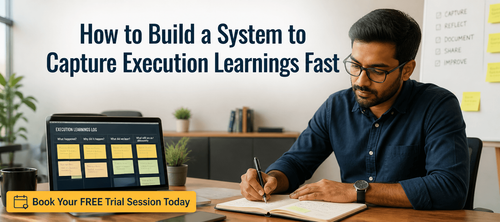
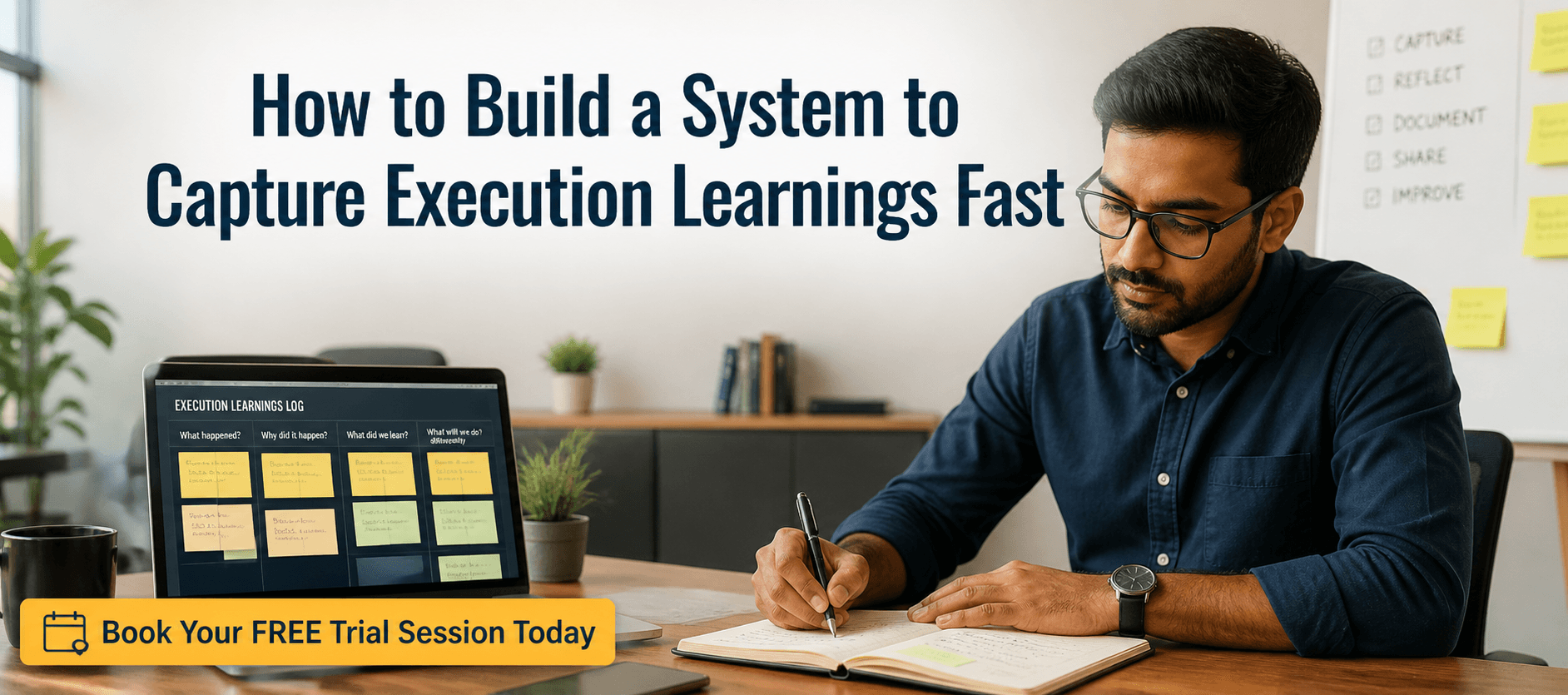
How to Build a System to Capture Execution Learnings Fast

Capturing Execution Insights From Every Project and Reuse for Faster Career Growth
Most professionals gain experience every day—through projects, meetings, negotiations, presentations, and decision-making. Yet despite years of work, many people feel like they are constantly solving the same problems again and again. Lessons from previous projects fade quickly, mistakes get repeated in new situations, and valuable insights disappear once a project ends.
The reality is that experience alone does not automatically translate into professional growth. Without a deliberate process for capturing and organising what you learn, your knowledge remains scattered and difficult to reuse. Over time, this leads to a frustrating pattern where you work harder but do not necessarily become more effective.
This is where a structured execution learning system becomes powerful. By consistently capturing what worked, what failed, and why, you can transform everyday work experiences into reusable insights. Instead of allowing lessons to disappear after a project ends, you create a growing repository of practical knowledge that can guide future decisions. Over time, this system helps you recognise patterns faster, avoid repeating mistakes, and approach new challenges with greater clarity and confidence.
When applied consistently, this approach turns everyday work into a continuous learning loop. Each project, conversation, and decision becomes a source of insight that strengthens your professional judgement. Instead of relying on memory alone, you build a reliable framework that supports better execution and more thoughtful problem-solving.
Download these resources and apply them alongside your daily work for improved clarity, productivity, and professional growth. You can also book a free trial to gain expert guidance and enhance your communication, problem-solving, and decision-making skills. The materials are designed in a clear, structured format to help professionals learn efficiently, apply insights faster, and steadily build stronger professional capabilities.
Who Is This Blog For?
- Working professionals managing projects, clients, or teams
- Managers and team leaders responsible for decision-making
- Consultants and freelancers handling multiple engagements
- Professionals preparing for promotions or leadership roles
- Anyone who wants to convert daily experience into long-term career advantage
Why This Topic Matters Today?
Modern professional environments move fast. Projects overlap, deadlines are tight, and teams often jump quickly from one task to the next. In this pace, reflection is usually the first habit to disappear.
Many professionals accumulate large amounts of experience—client meetings, product launches, team conflicts, strategic decisions—but very few convert those experiences into structured learning. As a result:
- Valuable insights fade quickly after projects end
- Professionals repeat mistakes in new contexts
- Teams solve the same problems repeatedly
- Expertise remains undocumented and underutilised
Research suggests that people forget up to 70 percent of new information within 24 hours without deliberate recall. That means the insight from a difficult client call or a successful negotiation can vanish before it is ever documented.
A structured execution learning system solves this problem by turning experience into a searchable and reusable knowledge library. Instead of relying on memory alone, professionals can draw from documented lessons when facing similar challenges in the future.
Core Concept or Framework Explained
At the heart of the guidebook is a simple but powerful three-phase framework designed to convert everyday work experiences into long-term professional intelligence.
The framework consists of three stages:
- Capture
- Distil
- Retrieve and Reuse
Each phase closes a learning loop and ensures that insights from one project influence the next.
Capture
The first phase focuses on documenting what happened immediately after a meaningful professional moment. This might include a client meeting, product launch, team discussion, or negotiation.
The key objective is speed. Professionals should capture insights within 24 hours before details fade.
Distil
Raw notes alone are not enough. In the second phase, you extract the underlying lesson from your experience.
Instead of describing what happened in one specific situation, you identify a reusable principle that can apply across future scenarios.
Retrieve and Reuse
The final phase transforms your knowledge library into a practical decision-making tool.
Before starting a new project or entering an important meeting, you review relevant past insights to guide your actions. This habit turns past experience into proactive preparation.
Together, these three phases create a continuous learning loop that compounds professional growth over time.
How This Blog and Guidebook Help You?
This blog and the accompanying guidebook provide a practical system for turning everyday work into structured learning.
Key benefits include:
- A clear method to capture lessons from real work situations
- A structured approach for converting experiences into actionable insights
- A searchable personal knowledge archive
- A repeatable habit that strengthens professional decision-making
Over time, professionals who use this system develop stronger pattern recognition, faster problem-solving abilities, and greater confidence in unfamiliar situations.
Step-by-Step Breakdown
Step 1: Capture Learning Moments Quickly
The biggest threat to learning is delay. Insights fade quickly if they are not recorded soon after the experience.
The capture phase focuses on answering four simple questions within 24 hours of an execution moment.
Question 1: What Was the Situation?
Briefly describe the context and objective.
Example: Leading a discovery call with a potential consulting client to scope a three-month project.
Question 2: What Did I Do?
Document the specific actions you took.
Example: Sent a pre-read brief before the call and used open-ended questions during the discussion.
Question 3: What Was the Result?
Describe both measurable outcomes and softer results such as trust or team alignment.
Example: The client signed the engagement and appreciated the structured preparation.
Question 4: What Would I Change?
Even successful outcomes contain opportunities for improvement.
Example: Confirm all stakeholders before the call to avoid missing decision-makers.
This four-question method ensures that learning is captured quickly without requiring long writing sessions.
Step 2: Distil the Reusable Insight
Raw captures become truly valuable only when they are converted into reusable principles.
The distillation phase focuses on abstraction—turning a specific event into a broader lesson that can guide future actions.
The guidebook recommends using a simple sentence formula:
When a certain situation occurs, taking a specific action tends to produce a particular result, especially under certain conditions.
For example:
When scoping a consulting engagement, sending a structured pre-read 48 hours before the discovery call tends to reduce meeting time and increase client confidence.
This structure forces clarity and makes the insight portable across contexts.
Step 3: Tag and Organise Your Learning Library
To make insights searchable, each entry should include tags that reflect the context of the lesson.
Examples include:
- client-management
- leadership
- project-scoping
- negotiation
- communication
Tagging allows professionals to retrieve relevant insights quickly when similar situations arise.
Step 4: Retrieve Insights Before Execution
Many professionals reflect only after problems occur. High performers reflect before starting important work.
Before beginning a project or meeting, ask yourself:
- Have I faced something similar before?
- What worked or failed last time?
- What signals should I watch for?
Reviewing previous insights for just a few minutes can significantly improve preparation and decision-making.
Step 5: Maintain a Weekly Learning Tracker
Consistency is essential for the system to work.
A weekly tracker helps professionals capture and distil insights regularly. Typical tracker fields include:
- Key execution moment of the week
- What worked
- What did not work
- Root cause analysis
- Distilled insight
- Tags for retrieval
- Reuse potential rating
Running this tracker weekly builds a habit of continuous learning.
Step 6: Conduct Quarterly Reviews
Every few months, review your highest-value insights and synthesise them into a short document describing your professional operating principles.
This document can become extremely valuable for:
- Performance reviews
- Job interviews
- Client onboarding conversations
Over time, your library becomes a personal operating manual describing how you work best.
Common Mistakes or Pitfalls to Avoid
Many professionals attempt to build learning systems but abandon them due to avoidable mistakes.
Common pitfalls include:
- Capturing too many entries and overwhelming the system
- Writing long notes that are difficult to review later
- Skipping the distillation step entirely
- Never retrieving insights before new projects
- Recording only successes while ignoring failures
A better approach is to focus on quality over quantity. One clear, reusable insight is far more valuable than dozens of unstructured notes.
Consistency matters more than perfection.
How Should You Use This Guidebook Effectively?
To implement the system efficiently, start with a simple setup process.
Initial setup should take about 30 to 45 minutes and includes:
- Choosing a capture tool such as Notion, Google Docs, or a notebook
- Creating a learning library folder or database
- Setting up 8 to 10 tags relevant to your role
- Creating a weekly tracker template
- Scheduling a recurring 15-minute learning review each week
Once the system is established, the ongoing time investment is minimal.
Recommended workflow:
- Capture insights within 24 hours of key events
- Distil insights during a weekly review session
- Retrieve insights before major tasks or decisions
- Conduct deeper reviews every quarter
This small but consistent habit gradually transforms everyday work experience into a powerful professional knowledge engine.
Key Takeaways
- Experience alone does not guarantee professional growth
- Capturing insights quickly prevents valuable lessons from fading
- Distilling experiences into principles makes them reusable
- Tagging insights creates a searchable personal knowledge library
- Reviewing past lessons before new tasks improves decision-making
- Quality insights are more valuable than large quantities of raw notes
- Consistent weekly reflection builds a powerful long-term learning system
Your Next Step: Accelerate Your Career with PlanetSpark
Creating an impact-driven resume is not just about landing your next job—it’s about owning your professional story and presenting it with clarity, confidence, and credibility. When your resume clearly communicates value, results, and impact, opportunities follow naturally.
At PlanetSpark, we are committed to empowering working professionals with practical, outcome-focused resources that drive real career growth. From resume building and workplace communication to leadership presence and professional writing, our programs are designed to help you succeed in today’s fast-evolving job market.
Visit https://www.planetspark.in/resources to explore:
- Career and resume-building guides
- Workplace communication and professional writing resources
- Skill-development tools curated for working professionals
Want a deeper, hands-on experience?
You can also book a free trial session to learn more about PlanetSpark’s Working Professional Courses, designed to accelerate your career through personalised coaching, real-world practice, and expert guidance.
Your career deserves more than generic advice.
It deserves clarity, confidence, and measurable impact.
Start building that advantage today—with PlanetSpark.
Personalized Communication Roadmaps
Record a video to get a AI generated personalized communication reports