
How to Build Career Clarity: Checklist for Working Professionals
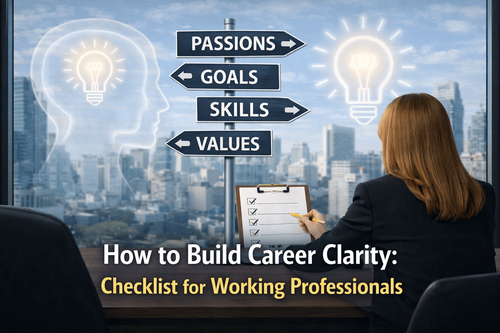

A Structured Methodology for Developing a Persuasive Professional Story to Enable Sustained Career Progression
You may have years of experience,
strong skills, and a solid track record—but if you cannot clearly explain your career story, you risk being overlooked. In high-stakes moments like interviews, networking conversations, or leadership discussions, many professionals struggle not because they lack capability, but because they lack clarity.
When your career narrative is unclear, opportunities slip through the cracks. Recruiters lose interest, hiring managers feel uncertain, and your value becomes invisible.
This is where a structured, intentional career narrative becomes your biggest advantage. This guide transforms a practical checklist into a powerful framework to help you articulate your story with clarity, confidence, and strategic direction.
Who Is This Blog For?
This blog and guidebook are designed for:
- Working professionals aiming to communicate their value more effectively
- Mid-career individuals preparing for leadership roles or promotions
- Career switchers navigating pivots across industries or functions
- Job seekers struggling to explain their experience clearly in interviews
- Consultants, freelancers, and specialists building a strong personal brand
Why This Topic Matters Today?
In today’s competitive job market, clarity is currency. Hiring decisions are often made quickly, and professionals are evaluated not just on what they’ve done, but on how clearly they communicate their impact and direction.
A fragmented or inconsistent career story creates doubt. When your LinkedIn profile, CV, and verbal pitch tell different stories, it weakens your credibility.
On the other hand, a strong, consistent narrative answers three critical questions every decision-maker is asking:
- Why you
- Why now
- Why this role
Without a clear answer, even highly skilled professionals risk being overlooked—not because they lack ability, but because their value isn’t immediately understood.
Core Concept or Framework Explained
At the heart of this guide is a simple but powerful idea: your career is not a list of roles—it is a story with direction and intent.
The most effective career narratives follow a structured arc: Context, Challenge, Contribution, and Direction.
- Context explains where you started and what shaped your foundation
- Challenge highlights the transitions, pivots, or problems you navigated
- Contribution showcases what you built, solved, or delivered
- Direction connects your past to your future goals
This framework transforms scattered experiences into a cohesive story. Instead of sounding like a timeline of jobs, your narrative becomes a strategic explanation of your growth, value, and ambition.
How This Blog and Guidebook Help You?
This blog and guidebook help you move from confusion to clarity by enabling you to:
- Audit your existing career narrative across platforms
- Identify your core strengths, values, and impact stories
- Build a compelling and structured career story
- Ensure consistency across LinkedIn, CV, and conversations
- Handle difficult career moments with confidence and clarity
The outcome is a professional identity that is clear, memorable, and aligned with your future goals.
Step-by-Step Breakdown
Step 1: Audit Your Current Narrative
Before improving your story, you must understand what story you are currently telling. Many professionals unknowingly present inconsistent or unclear narratives across different platforms.
Start with a self-audit using practical tests:
- Mirror Test: Compare your LinkedIn and CV. Do they tell the same story
- Stranger Test: Reflect on how you introduce yourself. Is it consistent
- Google Test: Search your name. Does your digital presence support your direction
- Keywords Test: Identify five words that define your professional identity and check if they appear consistently
This step reveals gaps between your intended and perceived professional identity.
Step 2: Identify Your Narrative Building Blocks
A strong career narrative is built on four core elements:
- Experiences: What you have done
- Strengths: What you do exceptionally well
- Values: What drives your decisions
- Impact: The measurable difference you have created
To bring these elements to life, identify your peak moments—situations where you delivered meaningful results or felt most effective.
This process helps you move from disconnected bullet points to a cohesive and intentional story.
Step 3: Craft Your Core Career Story
Your core story should be concise, engaging, and structured. It typically takes 90 seconds to 3 minutes to deliver and should follow the narrative arc: Context, Challenge, Contribution, Direction.
A strong story:
- Starts with confidence, not hesitation
- Maintains a clear thread across roles and experiences
- Is tailored to the audience
- Ends with forward-looking intent
This is the foundation of how you present yourself in interviews, networking conversations, and professional interactions.
Step 4: Ensure Narrative Consistency Across Platforms
Even a strong story loses impact if it is not consistently communicated.
Review all your professional touchpoints:
- LinkedIn headline and summary
- CV headline and profile
- Email bio or signature
- Verbal pitches
Each platform should reflect the same core narrative, adapted for format and context. Consistency builds trust and reinforces your professional identity.
Step 5: Handle Difficult Career Moments Strategically
Every career includes challenging phases such as gaps, pivots, or roles that did not work out. These are not weaknesses—they are opportunities to demonstrate growth.
The key is framing:
- Be honest but concise
- Focus on learning and outcomes
- Connect past experiences to your current direction
For example, instead of apologising for a gap, explain what you learned and how it shapes your current approach. This reframing builds credibility and confidence.
Step 6: Build and Use Your Narrative Templates
To make your narrative practical and repeatable, use structured templates for different scenarios:
- 30-second pitch for quick introductions
- LinkedIn headline for online positioning
- Career pivot explanation for transitions
- Interview response for “Tell me about yourself”
Create a personal “Narrative Bank” where these templates are stored and updated regularly. This allows you to adapt quickly without starting from scratch.
Step 7: Evaluate and Strengthen Your Narrative
Regular self-assessment ensures continuous improvement. Evaluate your narrative across key dimensions:
- Clarity: Can you explain your story quickly and clearly
- Consistency: Does the same message appear across platforms
- Confidence: Do you present your story without hesitation
- Calibration: Can you adapt your story to different audiences
- Compelling nature: Does your story spark interest
Tracking these areas helps you identify gaps and focus your improvement efforts.
Common Mistakes or Pitfalls to Avoid
Many professionals weaken their narrative by making avoidable mistakes:
- Presenting different versions of their story in different contexts
- Relying only on job titles instead of explaining value
- Starting with apologies or underplaying their experience
- Over-explaining difficult career moments
- Failing to connect past experience with future goals
Avoiding these pitfalls makes your narrative sharper, more credible, and more impactful.
How Should You Use This Guidebook Effectively?
To get maximum value from this guidebook, follow a structured approach:
- Read it once completely to understand the framework
- Work through each module step by step
- Use reflection prompts to draft your narrative
- Allocate 20 minutes for quick updates or a few hours for deep work
- Revisit regularly before interviews, applications, or networking events
Consistency and repetition are key to mastering your career narrative.
Key Takeaways
- Your career is a story, not a list of job titles
- A clear narrative answers why you, why now, and why this role
- Use the Context, Challenge, Contribution, Direction framework
- Build your story using experiences, strengths, values, and impact
- Maintain consistency across all professional platforms
- Reframe difficult career moments as growth opportunities
- Create a Narrative Bank to adapt quickly for different situations
Your Next Step: Accelerate Your Career with PlanetSpark
Creating an impact-driven resume is not just about landing your next job—it’s about owning your professional story and presenting it with clarity, confidence, and credibility. When your resume clearly communicates value, results, and impact, opportunities follow naturally.
At PlanetSpark, we are committed to empowering working professionals with practical, outcome-focused resources that drive real career growth. From resume building and workplace communication to leadership presence and professional writing, our programs are designed to help you succeed in today’s fast-evolving job market.
Visit https://www.planetspark.in/resources to explore:
- Career and resume-building guides
- Workplace communication and professional writing resources
- Skill-development tools curated for working professionals
Want a deeper, hands-on experience?
You can also book a free trial session to learn more about PlanetSpark’s Working Professional Courses, designed to accelerate your career through personalised coaching, real-world practice, and expert guidance.
Your career deserves more than generic advice.
It deserves clarity, confidence, and measurable impact.
Start building that advantage today—with PlanetSpark.
Personalized Communication Roadmaps
Record a video to get a AI generated personalized communication reports