
How to Build Momentum and Overcome Slow Phases in Your Career Transition

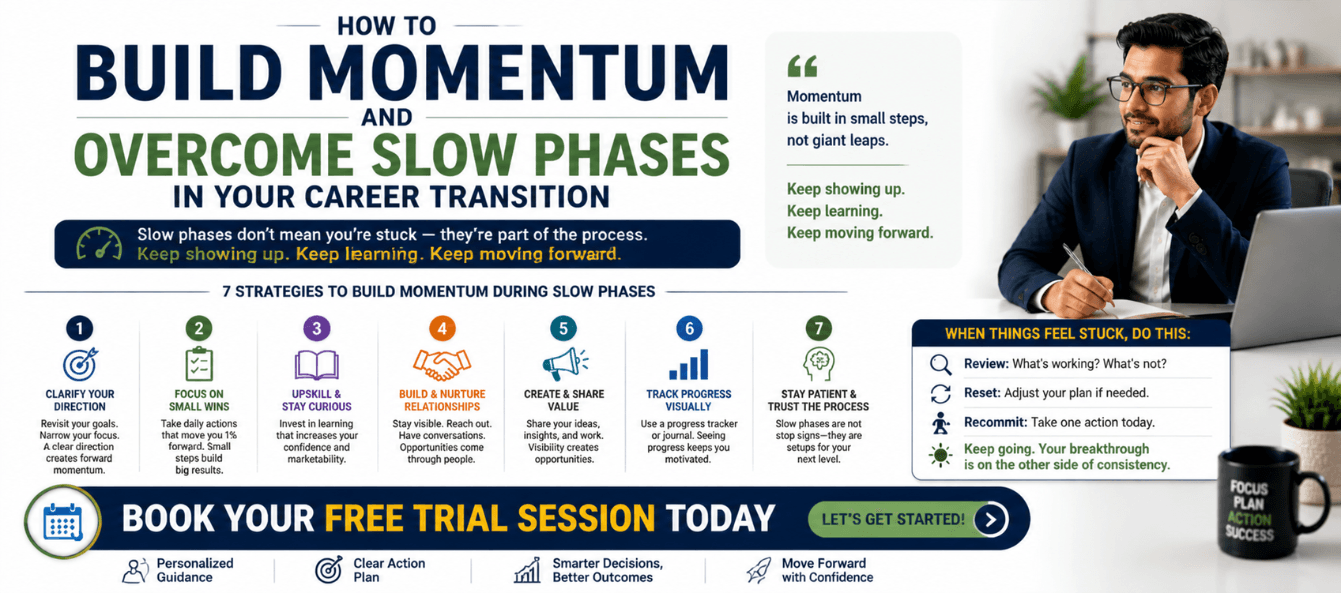
How to Stay Consistent Toward Your Next Role and Build Momentum During Slow Career Transition Phases
Career transitions rarely follow a straight, predictable path. You may start with enthusiasm—learning new skills, updating your resume, and applying for roles—but then hit a phase where progress slows down. Responses become inconsistent, interviews are delayed, and results feel far away.
This slow phase is where most professionals lose momentum. Doubt creeps in, motivation drops, and efforts become irregular. The lack of visible progress often leads to frustration, making it tempting to pause or abandon the transition altogether.
However, slow phases are not signs of failure—they are a natural part of the transition process. The key difference between those who succeed and those who don’t lies in how they navigate this period. Building momentum during slow phases requires a structured approach, consistent effort, and the ability to generate progress even when results are not immediate.
This guide provides a practical system to help you stay productive, focused, and confident during slow career transition phases, ensuring that you continue moving forward until opportunities align.
Download these resources and apply them alongside your daily work for improved clarity, productivity, and professional growth. You can also book a free trial to gain expert guidance and enhance your communication, problem-solving, and decision-making skills. The materials are designed in a clear, structured format to help professionals learn efficiently and implement insights with confidence.
Who Is This Blog For?
- Working professionals experiencing slow progress in their career transition
- Job seekers facing low response rates or delayed hiring processes
- Individuals balancing current jobs while preparing for a new role
- Mid-career professionals feeling stuck despite consistent effort
- Professionals who want to maintain motivation and consistency during uncertainty
Why This Topic Matters Today?
In today’s competitive job market, delays and slow responses are common. Hiring cycles are longer, competition is higher, and decision-making processes are more complex.
Common challenges during slow phases include:
- Reduced motivation due to lack of immediate results
- Inconsistent effort and loss of routine
- Overthinking and self-doubt
- Difficulty measuring progress
- Abandoning strategies too early
Without a system to maintain momentum, professionals risk losing valuable time and falling behind. Understanding how to stay consistent during slow phases is critical for long-term success.
Core Concept or Framework Explained
Building momentum during slow career transition phases involves creating a system that generates progress regardless of external outcomes.
Instead of relying solely on results like job offers or interview calls, you focus on controllable actions and internal metrics.
The framework includes:
- Action consistency: Maintaining daily or weekly efforts
- Micro-progress tracking: Measuring small wins and incremental improvements
- Skill reinforcement: Continuously improving relevant capabilities
- Feedback integration: Using insights to refine your approach
- Momentum loops: Creating cycles of action, feedback, and improvement
For example, even if you are not receiving interview calls, you can still improve your resume, expand your network, and build projects. These actions create forward movement, which eventually leads to results.
How This Blog and Guidebook Help You?
This blog translates the concept of momentum-building into actionable strategies. By applying this approach, you will:
- Maintain consistency even during slow periods
- Reduce frustration and self-doubt
- Create measurable progress through small wins
- Improve your readiness for opportunities
- Increase your chances of success when opportunities arise
Instead of waiting for results, you will actively create progress.
Step-by-Step Breakdown
Shift Focus from Outcomes to Actions
Start by redefining what success looks like during slow phases.
Instead of focusing only on:
- Job offers
- Interview calls
Focus on:
- Number of applications submitted
- Quality of networking conversations
- Skills learned or improved
This shift helps you stay motivated and productive.
Create a Weekly Action Plan
Design a structured plan to maintain consistency.
Include:
- Applying to targeted roles
- Reaching out to industry professionals
- Learning or practicing new skills
- Updating your resume or portfolio
Example:
Set a goal of 10 applications, 3 networking conversations, and 5 hours of skill-building per week.
Track Micro-Wins Consistently
Small wins build momentum.
Examples of micro-wins:
- Receiving a response from a recruiter
- Completing a project or certification
- Improving your resume based on feedback
- Expanding your professional network
Tracking these wins reinforces progress and boosts confidence.
Strengthen Your Skill Set
Use slow phases as an opportunity to improve your capabilities.
Focus on:
- Learning tools and technologies relevant to your target role
- Practicing real-world scenarios
- Building projects to demonstrate your skills
This ensures you are better prepared when opportunities arise.
Expand and Nurture Your Network
Networking is a powerful way to create opportunities.
Actions include:
- Connecting with professionals in your target field
- Scheduling informational interviews
- Engaging with industry content
- Following up with contacts regularly
Consistent networking increases your visibility and access to opportunities.
Review and Refine Your Strategy
Regularly evaluate what’s working and what’s not.
Ask:
- Are my applications aligned with my target role?
- Is my resume effectively showcasing my skills?
- Am I targeting the right companies?
Make adjustments based on your findings.
Maintain a Consistent Routine
Consistency is key to building momentum.
Tips:
- Set fixed time slots for transition-related activities
- Avoid long gaps between efforts
- Treat your transition like a structured project
Routine reduces reliance on motivation and ensures steady progress.
Build a Positive Feedback Loop
Create a cycle where actions lead to small wins, which reinforce further action.
Example:
- Apply for roles → Receive feedback → Improve resume → Get better responses → Stay motivated
This loop sustains momentum over time.
Common Mistakes or Pitfalls to Avoid
- Stopping efforts due to lack of immediate results
- Measuring success only through external outcomes
- Overloading yourself and burning out
- Ignoring feedback and repeating the same approach
- Comparing your progress with others
These mistakes disrupt momentum and delay success.
How Should You Use This Guidebook Effectively?
To maximise the benefits of this guidebook, follow a disciplined approach:
- Dedicate specific hours each week to transition activities
- Maintain a tracker for actions, feedback, and progress
- Focus on consistency rather than perfection
- Review your progress weekly and adjust your plan
- Stay patient and trust the process
Momentum builds over time through consistent effort.
Key Takeaways
- Slow phases are a natural part of career transitions
- Focus on controllable actions instead of external outcomes
- Track micro-wins to maintain motivation
- Continuously improve your skills and strategy
- Build and nurture your professional network
- Maintain consistency through structured routines
- Create feedback loops to sustain momentum
Your Next Step: Accelerate Your Career with PlanetSpark
Creating an impact-driven resume is not just about landing your next job—it’s about owning your professional story and presenting it with clarity, confidence, and credibility. When your resume clearly communicates value, results, and impact, opportunities follow naturally.
At PlanetSpark, we are committed to empowering working professionals with practical, outcome-focused resources that drive real career growth. From resume building and workplace communication to leadership presence and professional writing, our programs are designed to help you succeed in today’s fast-evolving job market.
Visit https://www.planetspark.in/resources to explore:
- Career and resume-building guides
- Workplace communication and professional writing resources
- Skill-development tools curated for working professionals
Want a deeper, hands-on experience?
You can also book a free trial session to learn more about PlanetSpark’s Working Professional Courses, designed to accelerate your career through personalised coaching, real-world practice, and expert guidance.
Your career deserves more than generic advice.
It deserves clarity, confidence, and measurable impact.
Start building that advantage today—with PlanetSpark.
Personalized Communication Roadmaps
Record a video to get a AI generated personalized communication reports