
How to Build Resilience After Making Wrong Career Decisions

Building Judgment Resilience After Making Wrong Decisions, A Guide for Professionals
Every professional, regardless of experience, will make wrong decisions. You might misread a situation, back the wrong strategy, trust the wrong person, or act too early or too late. These missteps are not failures of character; they are unavoidable aspects of working in complex, information-incomplete environments where the rules change, stakeholders evolve, and the cost of inaction is just as real as the cost of a bad call.
The real challenge lies not in avoiding wrong decisions, but in how you respond to them. Do you spiral into self-doubt and second-guessing? Do you avoid making decisions altogether to protect yourself from being wrong again? Or do you use that experience to strengthen your judgment and confidence?
Building judgment resilience is the key to overcoming mistakes and turning poor decisions into valuable lessons. It’s about learning how to recover quickly, adjust your thinking, and make decisions with greater confidence moving forward.
Download these resources and apply them alongside your daily work for improved clarity, productivity, and professional growth. You can also book a free trial to gain expert guidance and refine your decision-making resilience. The materials are designed in a clear, structured format to help professionals learn efficiently and implement insights with confidence.
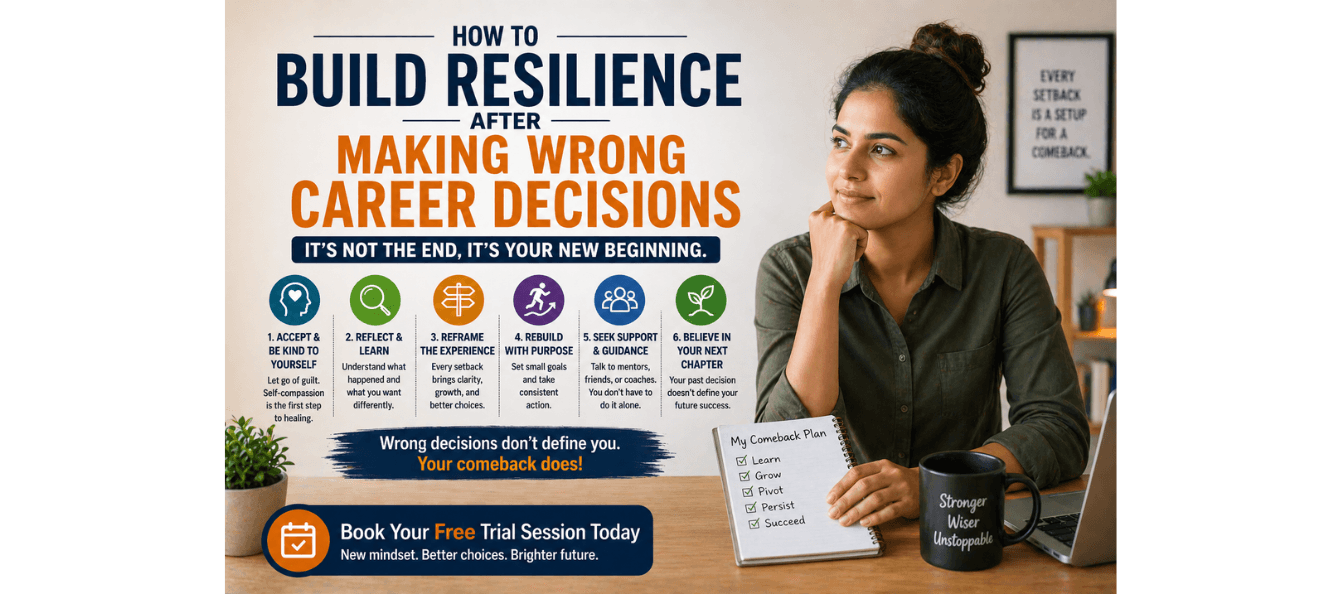
Who Is This Blog For?
This blog is for professionals who want to build resilience after making wrong decisions and improve their decision-making abilities. It’s especially useful for:
- Managers and leaders who need to recover from past mistakes and build stronger judgment
- Consultants and advisors who regularly face high-stakes decisions and need to maintain confidence
- Mid-career professionals struggling to rebuild confidence after setbacks
- Anyone who wants to transform decision failures into career-defining wisdom
Why This Topic Matters Today?
In today’s fast-paced, high-pressure work environments, the ability to bounce back from wrong decisions is crucial. Professionals who fail to recover from a bad decision quickly risk losing their credibility and confidence, which can impact their performance and future decisions.
On the other hand, professionals who practice judgment resilience use mistakes as stepping stones to greater wisdom. They understand that decision-making isn’t just about getting things right all the time—it’s about processing errors constructively and recalibrating their approach for better outcomes.
Building judgment resilience empowers professionals to make decisions faster, with more confidence, and without the fear of failure holding them back.
Core Concept or Framework Explained
The Judgment Resilience Process is structured into five distinct phases, designed to help you recover from a wrong decision and rebuild your decision-making confidence. These phases provide a structured, actionable approach to learning from mistakes and ensuring that past errors don’t dictate future actions.
1. Stabilize: The first step is to create emotional distance from the wrong decision, giving you time to process the situation without reacting impulsively.
2. Diagnose: Analyze the decision using a structured framework to identify what went wrong and what factors contributed to the mistake.
3. Extract: Convert the failure into transferable learning that can be applied to future decisions.
4. Recalibrate: Adjust your mental models and decision-making processes to prevent repeating the same mistake.
5. Re-engage: Make your next decision with deliberate confidence, applying your updated judgment to future situations.
These phases are flexible, meaning you can enter the process at any stage depending on where you are in your recovery. For instance, if the decision is recent and emotions are still high, start with Phase 1 (Stabilize). If you’ve already processed the situation but feel uncertain about your judgment, proceed to Phases 4 and 5 to rebuild confidence.
How This Blog and Guidebook Help You?
This guide provides actionable strategies and frameworks to help you build judgment resilience after making a wrong decision. The benefits include:
- Emotional Stabilization: Learn how to prevent emotional reactions from clouding your judgment and decision-making.
- Structured Analysis: The Judgment Audit framework helps you diagnose the root causes of your wrong decision and separate process failures from bad luck.
- Actionable Principles: Extract lessons from your decisions and convert them into principles you can apply to future decisions.
- Recalibration: Learn how to adjust your mental models and decision-making habits without over-correcting or becoming overly cautious.
By following this process, you can turn any wrong decision into a valuable learning experience and enhance your decision-making abilities going forward.
Step-by-Step Breakdown
Phase 1: Stabilize — Stop the Emotional Bleed
The first phase of judgment resilience is to stabilize your emotional state before taking any further action. In the immediate aftermath of a wrong decision, it’s easy to let frustration, embarrassment, or fear cloud your judgment. The key to stabilizing is to:
- Take 24 to 72 hours to feel the discomfort without acting on it.
- Inform stakeholders of next steps but resist the impulse to make major decisions immediately.
- Speak to a trusted person (not to vent, but to gain perspective).
- Separate your decision from your identity—avoid using negative language like “stupid” or “always.”
Phase 2: Diagnose — The Judgment Audit
Once your emotional state has stabilized, it’s time to diagnose what went wrong. The Judgment Audit framework helps you separate the contributing factors to the wrong decision:
- Information Quality: Was the information you acted on accurate, complete, and timely?
- Process Quality: How did you reason through the decision? Did you consult the right people and consider alternatives?
- Bias Presence: Were cognitive biases (e.g., confirmation bias, overconfidence) influencing your reasoning?
- Outcome Luck: Was the negative outcome a result of factors beyond your control?
This phase helps you identify exactly what went wrong, so you can address the specific elements of your decision-making process that need improvement.
Phase 3: Extract — Converting Mistakes Into Transferable Learning
It’s crucial not to simply dwell on your mistakes. Instead, extract the lessons from them to improve your decision-making in the future. Here’s how:
- Identify what assumptions were wrong: What beliefs or predictions failed?
- Recognize missed signals: What early indicators did you overlook?
- Define what you would do differently: Be specific about the changes you would make in hindsight.
- Create a principle: Convert the lesson into a reusable rule that can guide your future decisions.
Example principle: "When I feel pressure to decide quickly, I will always take an extra 24 hours to gather more input."
Phase 4: Recalibrate — Updating Your Mental Models
Recalibration is about adjusting your judgment, not abandoning it altogether. To recalibrate effectively:
- Review your decision habits using the Recalibration Matrix.
- Identify which habits or approaches need to change and which should stay.
- Avoid over-correcting—target only the elements that need improvement.
Recalibration helps you refine your decision-making without overcompensating or becoming too cautious.
Phase 5: Re-engage — Make Your Next Decision With Deliberate Confidence
The final phase is about applying your recalibrated judgment to make your next decision. Here’s how:
- Pick a low-stakes decision: Practice making decisions with your updated approach.
- Apply your updated process: Use the new principles and insights you’ve gained to guide your decision.
- Review and acknowledge: After making the decision, honestly review how you did and what you’ve learned.
The Decision Confidence Reset worksheet can help you ground your competence and activate your principles before making the next significant decision.
Common Mistakes or Pitfalls to Avoid
- Reacting too quickly: Resist the urge to fix or reverse the decision immediately after making it. Take time to stabilize.
- Blaming external factors entirely: While external factors can affect outcomes, focus on improving the parts of the decision process you control.
- Over-correcting: Avoid making drastic changes to your decision-making process. Small, targeted adjustments are more effective.
- Not following through: Don’t skip the follow-up phase. Consistent communication and reflection are key to rebuilding trust.
How Should You Use This Guidebook Effectively?
To maximize the impact of this guide:
- Start at the right phase: If you’re in the immediate aftermath of a wrong decision, start with Phase 1. If you’ve already reflected, move to Phase 4 or 5.
- Complete the worksheets: The worksheets in each phase are essential for deep reflection and learning.
- Apply what you learn: Regularly review your extracted principles and decision habits to keep improving.
Key Takeaways
- Judgment resilience is not about avoiding mistakes, but about learning from them and adjusting your decision-making process.
- Use the Judgment Audit to diagnose the factors that contributed to a wrong decision and focus on areas for improvement.
- Extract principles from your mistakes and apply them to future decisions to build lasting resilience.
- Recalibrate your decision-making process with precision, avoiding the temptation to over-correct.
- Re-engage with confidence, knowing that your judgment has been refined and your decision-making process is stronger.
Your Next Step: Accelerate Your Career with PlanetSpark
Creating an impact-driven resume is not just about landing your next job—it’s about owning your professional story and presenting it with clarity, confidence, and credibility. When your resume clearly communicates value, results, and impact, opportunities follow naturally.
At PlanetSpark, we are committed to empowering working professionals with practical, outcome-focused resources that drive real career growth. From resume building and workplace communication to leadership presence and professional writing, our programs are designed to help you succeed in today’s fast-evolving job market.
Visit https://www.planetspark.in/resources to explore:
- Career and resume-building guides
- Workplace communication and professional writing resources
- Skill-development tools curated for working professionals
Want a deeper, hands-on experience?
You can also book a free trial session to learn more about PlanetSpark’s Working Professional Courses, designed to accelerate your career through personalised coaching, real-world practice, and expert guidance.
Your career deserves more than generic advice.
It deserves clarity, confidence, and measurable impact.
Start building that advantage today—with PlanetSpark.
Personalized Communication Roadmaps
Record a video to get a AI generated personalized communication reports