
How to Build Strategy Execution Resume for Leaders
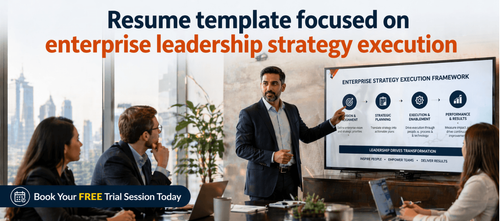

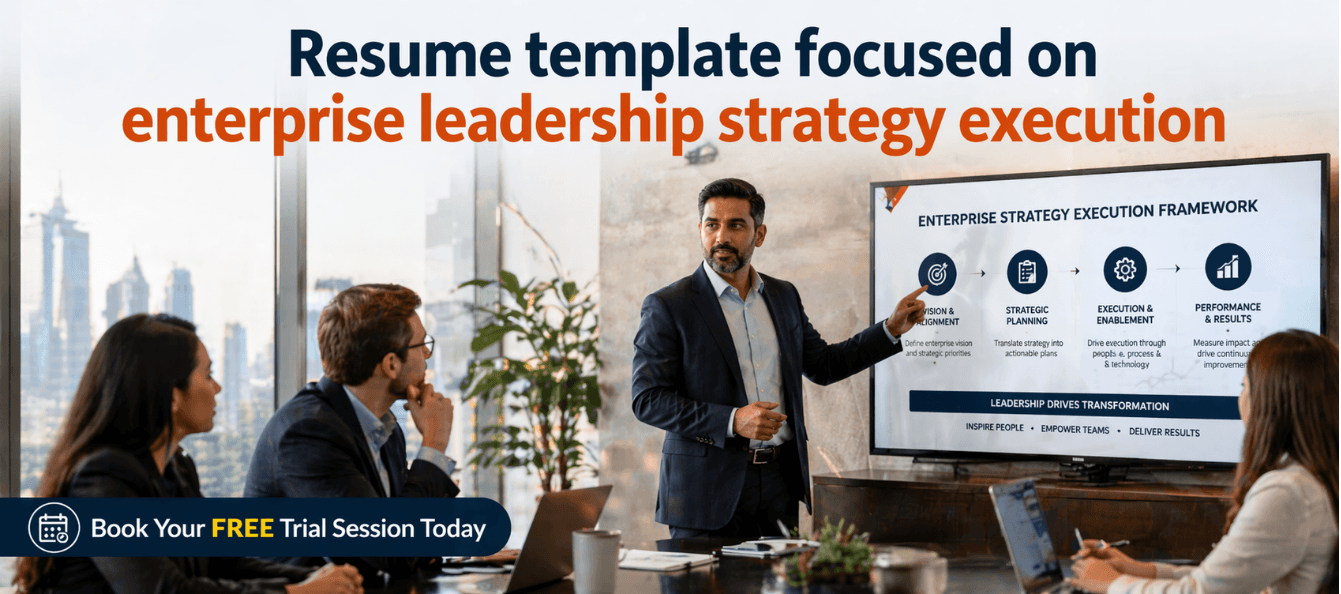
Enterprise Leadership Resume Strategy: How to Position Yourself for High-Impact Roles and Get Shortlisted Faster
Most professionals unknowingly sabotage their career growth at the exact moment it matters most—when applying for senior, strategic, or enterprise-level roles. The issue is rarely a lack of experience. Instead, it’s a failure to communicate that experience in a way that signals leadership, scale, and strategic thinking.
If your resume still reads like a list of responsibilities, timelines, and job descriptions, you are competing at the wrong level. Enterprise hiring managers are not evaluating what you did—they are evaluating how you think, how you lead, and whether you can drive measurable impact across complex systems.
This is where most capable professionals fall short. They undersell their contributions, use generic language, and fail to position themselves as decision-makers. The result? Missed opportunities, fewer callbacks, and stagnation.
The Enterprise Leadership Strategy Execution Resume Playbook is designed to fix exactly this problem. It reframes your resume as a strategic positioning document—one that communicates leadership, impact, and enterprise-level thinking with precision.
Download these resources and apply them alongside your daily work for improved clarity, productivity, and professional growth. You can also book a free trial to gain expert guidance and enhance your communication, problem-solving, and decision-making skills. The materials are designed in a clear, structured format to help professionals learn efficiently and implement insights with confidence.
Who Is This Blog For?
- Mid-level professionals aiming to transition into senior leadership roles
- Managers and team leads looking to position themselves for Director or VP-level opportunities
- Consultants seeking to communicate enterprise-scale impact more effectively
- Career switchers targeting strategy, operations, or transformation roles
- Professionals with 3–15 years of experience involved in cross-functional execution or organisational change
Why This Topic Matters Today?
The hiring landscape for leadership roles has evolved significantly. Organisations are no longer hiring based solely on experience—they are hiring based on demonstrated strategic impact.
According to the playbook, hiring managers in enterprise environments are pattern-matching for specific signals:
- Ability to handle complex, cross-functional initiatives
- Experience translating strategy into execution
- Evidence of measurable outcomes at scale
- Leadership across stakeholders, teams, and business units
The biggest problem? Most professionals default to task-based language like:
- Managed a team
- Worked on projects
- Supported initiatives
This language fails to communicate value. In contrast, enterprise hiring requires impact-driven storytelling:
- Delivered measurable business outcomes
- Led transformation initiatives
- Owned strategic decisions with scale
Without this shift, even highly capable professionals remain invisible in competitive hiring funnels.
Core Concept or Framework Explained
At the heart of the playbook is a powerful repositioning: your resume is not a job history—it is a strategy document.
This means every section must contribute to a clear signal:
- Who you are as a leader
- What problems you solve
- What value you deliver at scale
The playbook introduces a structured “signal architecture” made up of four critical components:
Executive Summary
This is your strategic positioning statement. It defines your leadership identity, domain expertise, and value proposition in 3–5 sentences.
Core Competencies
This section acts as your keyword architecture. It ensures your resume passes Applicant Tracking Systems while also signaling credibility to hiring managers.
Experience Section
This is where your leadership narrative is built through impact-led bullets using the CAR-S model.
Leadership Proof Layer
This is your credibility portfolio—certifications, board roles, and thought leadership that validate your strategic positioning.
The most critical framework introduced is the CAR-S model:
- Challenge: Define the complexity and scale of the problem
- Action: Highlight the leadership decision or initiative you led
- Result: Show measurable outcomes
- Scale: Indicate the breadth of impact (teams, revenue, geographies)
This model transforms generic statements into compelling leadership narratives.
How This Blog and Guidebook Help You?
This framework helps you move from being “qualified” to being “compelling.”
When applied correctly, it enables you to:
- Get shortlisted for roles one to two levels above your current position
- Speak the language of executive hiring committees
- Position yourself as a strategic leader rather than an operator
- Build a resume that doubles as a conversation tool in interviews
- Align your experience with enterprise-level expectations
More importantly, it shifts how you think about your career—not as a sequence of roles, but as a portfolio of strategic impact.
Step-by-Step Breakdown
Step 1: Decode the Enterprise Leadership Resume Formula
Before writing anything, you must understand how enterprise resumes are evaluated.
Each section serves a distinct purpose:
- Executive Summary: Establish leadership identity and value
- Core Competencies: Ensure keyword alignment and ATS optimisation
- Experience: Demonstrate impact using structured narratives
- Leadership Appendix: Provide proof of credibility
The key insight here is signal strength. Every line should reinforce your strategic leadership capability.
Step 2: Build Your Strategic Keyword Architecture
Enterprise roles are filtered through ATS systems before reaching human reviewers.
The playbook introduces a three-tier keyword framework:
Tier 1: Strategic Leadership
Examples include enterprise strategy, P&L ownership, governance frameworks, and transformation leadership
Tier 2: Execution and Delivery
Includes programme management, OKR frameworks, change management, and roadmap execution
Tier 3: Domain and Commercial Acumen
Covers revenue growth, digital transformation, market entry strategy, and data-driven decision-making
Instead of stuffing keywords, the goal is to embed them naturally across:
- Executive summary
- Experience bullets
- Competency sections
This ensures both machine readability and human resonance.
Step 3: Use the Enterprise Resume Template
The playbook provides a structured template with key sections:
Header
Your title should be aspirational and aligned with your target role—not your current job title.
Executive Summary
A concise positioning statement that highlights:
- Leadership identity
- Experience
- Signature strengths
- Proven impact
- Future direction
Core Competencies
Grouped into clusters such as:
- Strategy and planning
- Leadership and governance
- Execution and change
- Commercial and digital
This structure improves clarity and scanning efficiency.
Step 4: Write Impact-Led Experience Bullets
This is where most resumes fail.
Instead of listing responsibilities, each bullet must demonstrate:
- A leadership decision
- A strategic initiative
- A measurable outcome
For example:
Weak: Managed cross-functional teams
Strong: Led cross-functional teams of 60+ to deliver a digital transformation initiative that improved operational efficiency by 30 percent
The playbook recommends:
- 4–6 bullets per role
- Use of strong action verbs
- Inclusion of metrics wherever possible
- Clear demonstration of leadership thinking
Step 5: Build the Leadership Proof Layer
This section differentiates strong candidates from standout leaders.
It includes:
- Education and executive programmes
- Strategic certifications such as PMP or Lean Six Sigma
- Board or advisory roles
- Thought leadership such as publications or speaking engagements
The key principle is quality over quantity. Each element should reinforce your strategic credibility.
Step 6: Apply Real-World Transformation
The case study of a mid-level manager transitioning to a Strategy Director role highlights how this framework works in practice.
Key transformations included:
- Rewriting the executive summary to reflect strategic identity
- Aligning keywords with target job descriptions
- Converting task-based bullets into CAR-S narratives
- Adding a strong proof layer
Within six weeks, this repositioning significantly improved response rates and interview opportunities.
Step 7: Run the Resume Audit Checklist
Before submitting your resume, validate it against a structured checklist:
- Is your title aligned with your target role?
- Does your summary clearly define your leadership identity?
- Are your keywords aligned with job descriptions?
- Do your bullets demonstrate measurable impact?
- Is your resume concise, consistent, and ATS-friendly?
This final step ensures quality control and consistency.
Common Mistakes or Pitfalls to Avoid
The playbook highlights several critical mistakes:
Using “we” instead of “I”
This dilutes ownership. Enterprise hiring focuses on individual accountability.
Burying your strongest achievements
Your biggest impact should appear early—in your summary and first bullet.
Listing duties instead of decisions
Hiring managers care about what you decided and influenced, not just what you were responsible for.
Ignoring ATS optimisation
Failing to use exact keywords from job descriptions can prevent your resume from being seen.
Overloading with irrelevant certifications
A long list of low-value credentials weakens your positioning.
How Should You Use This Guidebook Effectively?
To maximise results, follow a structured workflow:
- Day 1–2: Identify 2–3 target roles and extract keywords
- Day 3: Rewrite your executive summary
- Day 4–5: Transform your experience bullets using CAR-S
- Day 6: Build or refine your leadership proof layer
- Day 7: Run the audit checklist and submit your application
Treat your resume as a living document. Update it quarterly as your experience evolves.
The guidebook is designed for iterative improvement—not one-time perfection.
Key Takeaways
- Your resume is a strategic positioning tool, not a job history
- Enterprise hiring prioritises impact, scale, and leadership thinking
- The CAR-S model transforms generic bullets into powerful narratives
- Keyword architecture is essential for both ATS and human evaluation
- A strong proof layer significantly enhances credibility
- Customisation for each role is non-negotiable
- Consistency, clarity, and measurable outcomes define winning resumes
Your Next Step: Accelerate Your Career with PlanetSpark
Creating an impact-driven resume is not just about landing your next job—it’s about owning your professional story and presenting it with clarity, confidence, and credibility. When your resume clearly communicates value, results, and impact, opportunities follow naturally.
At PlanetSpark, we are committed to empowering working professionals with practical, outcome-focused resources that drive real career growth. From resume building and workplace communication to leadership presence and professional writing, our programs are designed to help you succeed in today’s fast-evolving job market.
Visit https://www.planetspark.in/resources to explore:
- Career and resume-building guides
- Workplace communication and professional writing resources
- Skill-development tools curated for working professionals
Want a deeper, hands-on experience?
You can also book a free trial session to learn more about PlanetSpark’s Working Professional Courses, designed to accelerate your career through personalised coaching, real-world practice, and expert guidance.
Your career deserves more than generic advice.
It deserves clarity, confidence, and measurable impact.
Personalized Communication Roadmaps
Record a video to get a AI generated personalized communication reports