
How to Create a Powerful Personal Brand Tagline (2026 Guide)
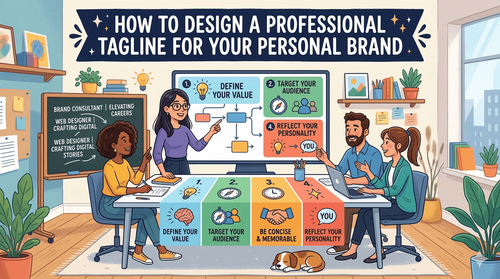

How to Create a Powerful Personal Brand Tagline That Instantly Communicates Your Professional Value
In today’s competitive job market, professionals often have only a few seconds to make a strong first impression. Whether someone is scanning LinkedIn profiles, reviewing resumes, or deciding whom to invite for an interview, attention is limited and decisions happen quickly.
Yet many professionals introduce themselves with vague or generic headlines. Statements like “Passionate professional seeking opportunities” or “Results-driven leader” may sound polished, but they rarely communicate what the person actually does or why their work matters.
This is where a professional tagline becomes powerful.
A well-crafted tagline communicates your professional identity, your unique advantage, and the value you create in a single, memorable line. Instead of forcing recruiters, clients, or colleagues to interpret your experience, a strong tagline immediately clarifies your expertise and impact.
This guide explains how to design a professional tagline that feels both human and strategic. Using a structured framework, you will learn how to translate your experience into a concise positioning statement that strengthens your resume, LinkedIn profile, and professional brand.
Who Is This Blog For?
This blog is designed for professionals who want to communicate their value more clearly and strengthen their personal brand.
- Early and mid-career professionals building a strong LinkedIn presence
- Managers and specialists who want clearer professional positioning
- Career switchers translating experience into a new industry or role
- Consultants and advisors presenting their value to potential clients
- Job seekers who want a resume headline that stands out quickly
- Professionals looking to strengthen their personal brand narrative
Why This Topic Matters Today?
Professional visibility has become a critical factor in career growth. Recruiters, hiring managers, and clients frequently evaluate professionals based on quick online impressions rather than lengthy introductions.
Profiles and resumes are often scanned in seconds, not minutes. In this environment, unclear positioning can cause strong candidates to be overlooked simply because their value is not communicated quickly enough.
Several common problems appear repeatedly in professional profiles:
- Headlines that focus on personality rather than value
- Descriptions that list roles without explaining outcomes
- Overuse of buzzwords such as “passionate,” “dynamic,” or “innovative”
- Messaging that focuses on what the professional wants instead of what they deliver
A strong professional tagline solves these problems by delivering a clear answer to three critical questions:
- Who do you help?
- What do you do well?
- What result does your work create?
When these answers appear in a single concise line, your professional story becomes far easier to understand and remember.
Core Concept or Framework Explained
The most reliable way to create a powerful professional tagline is by using the TAG framework. This structure ensures your tagline is clear, specific, and outcome-driven rather than generic or self-focused.
TAG stands for:
Target
The audience, industry, or group that benefits from your work. This anchors your expertise within a specific context.
Advantage
Your unique capability, method, or differentiator. This may include a skill, toolset, approach, or distinctive professional background.
Gain
The outcome or improvement your work creates. Ideally, this reflects measurable results or meaningful business impact.
The TAG formula is simple:
Target + Advantage + Gain
This structure ensures your tagline communicates both expertise and value. Anyone reading it should quickly understand not just what you do, but why it matters.
For example:
Product leaders who use data-driven experimentation to accelerate revenue growth.
In this line, the audience is product leaders, the advantage is experimentation-driven strategy, and the gain is revenue growth.
This approach turns a vague professional statement into a precise positioning message.
How This Blog and Guidebook Help You?
This guide helps professionals move from unclear self-description to a clear and strategic professional identity.
By following the steps in this framework, you will learn how to:
- Identify the audience you want to influence
- Clarify the strengths and methods that differentiate your work
- Translate your experience into outcomes that matter to others
- Draft multiple tagline options quickly
- Refine your message so it is clear, credible, and memorable
- Adapt your tagline across LinkedIn, resumes, and presentations
Instead of guessing how to present your professional brand, this structured process helps you build a tagline that consistently communicates value across every professional platform.
Step-by-Step Breakdown
Step 1: Clarify Your Audience and Context
Before writing a tagline, you must decide who the message is meant for. Different professional contexts require slightly different emphasis.
Most professional taglines fall into three main scenarios.
Job search positioning
When targeting a new role, the tagline should align with skills and outcomes hiring managers actively seek.
Consulting or advisory positioning
Consultants often frame their tagline around client transformation and business impact.
Internal influence positioning
Within organizations, professionals may focus on leadership, cross-functional collaboration, or strategic outcomes.
Clarifying the context helps determine which outcomes and strengths should appear in your tagline.
To refine your audience, ask three key questions:
- Who needs to immediately understand my value?
- What decision do I want them to make?
- What language does this audience already recognize?
A tagline becomes much stronger when it speaks directly to a specific audience rather than trying to appeal to everyone.
Step 2: Inventory Your Proof and Differentiators
The next step is identifying the proof signals that support your professional credibility.
Strong taglines hint at evidence rather than relying on generic claims.
Examples of credible signals include:
- Measurable metrics such as revenue growth or time savings
- Major projects or initiatives you led
- Tools, platforms, or frameworks you regularly use
- Industry domains where you have deep experience
- Certifications, awards, or formal recognition
- Unique combinations of skills or career backgrounds
For example, someone with both teaching and corporate training experience might position themselves as an educator turned learning designer.
After listing all possible proof signals, narrow them to the three most powerful. Too many signals dilute clarity. Precision makes your message easier to remember.
Step 3: Draft Taglines Using the TAG Formula
Once you have defined your target audience, advantage, and outcome, begin drafting several tagline options.
The goal is not perfection in the first draft. Instead, create three to five quick variations.
Useful structures include:
Outcome-first pattern
Driving [gain] for [target] through [advantage].
Role-first pattern
[Role] helping [target] achieve [gain].
Proof-first pattern
[Credibility marker] delivering [gain] for [target].
Examples might include:
- Marketing strategist helping SaaS teams turn audience insights into measurable growth
- Operations leader improving delivery speed through data-driven process design
- Product marketer accelerating adoption through customer research and positioning
Writing several drafts allows you to compare different angles and discover which version communicates your value most clearly.
Step 4: Tighten, Test, and Tailor Your Tagline
Once you have several draft versions, the next step is refining them.
Focus on three improvement goals.
Replace vague adjectives with evidence
Generic descriptors weaken credibility. Instead of saying “strategic marketing leader,” reference a specific outcome or capability.
Remove repeated meaning
If two phrases communicate the same idea, keep the clearer one.
Tighten the structure for memorability
Shorter lines are easier to scan, repeat, and remember. Aim for roughly 12 to 16 words.
After refinement, adapt your tagline slightly for different platforms.
LinkedIn headline
Include searchable keywords and slightly broader positioning.
Resume header
Keep the line concise and aligned with the role you are targeting.
Presentation or bio introduction
Focus more on credibility and audience value.
The core message should remain consistent, even if the wording shifts slightly depending on context.
Common Mistakes or Pitfalls to Avoid
Many professionals weaken their tagline by repeating common positioning mistakes.
Too vague
Statements that sound polished but communicate little are easily ignored.
All about the professional
Focusing on personal ambitions rather than audience benefit reduces relevance.
Buzzword overload
Terms like passionate, dynamic, and results-driven are widely overused and rarely persuasive.
Excessive length
Long headlines lose clarity and become difficult to scan quickly.
The strongest taglines remain specific, outcome-focused, and audience-centered.
How Should You Use This Guidebook Effectively?
This resource works best when used as a structured exercise rather than a quick read.
Start by reviewing the TAG framework to understand how Target, Advantage, and Gain work together.
Next, complete a short proof inventory where you identify your most credible signals, including outcomes, tools, and domains.
Then draft several tagline options quickly without editing. Rapid drafting helps surface stronger ideas before overthinking begins.
After drafting, refine your best two or three versions by tightening language, removing filler, and sharpening the outcome statement.
Finally, test the tagline using a simple five-second rule. When someone reads your tagline once, they should immediately understand:
- What you do
- Who your work helps
- What result you create
If those three elements are not instantly clear, revise the line again.
Key Takeaways
- A professional tagline communicates your value in a single memorable line
- Generic headlines weaken professional visibility and credibility
- The TAG framework provides a simple structure for effective positioning
- Strong taglines include a clear target audience, advantage, and outcome
- Credibility improves when taglines reference tools, methods, or measurable results
- Drafting multiple versions helps uncover stronger positioning ideas
- Refining for clarity, brevity, and audience benefit creates the strongest final tagline
Your Next Step: Accelerate Your Career with PlanetSpark
Creating an impact-driven resume is not just about landing your next job—it’s about owning your professional story and presenting it with clarity, confidence, and credibility. When your resume clearly communicates value, results, and impact, opportunities follow naturally.
At PlanetSpark, we are committed to empowering working professionals with practical, outcome-focused resources that drive real career growth. From resume building and workplace communication to leadership presence and professional writing, our programs are designed to help you succeed in today’s fast-evolving job market.
Visit https://www.planetspark.in/resources to explore:
- Career and resume-building guides
- Workplace communication and professional writing resources
- Skill-development tools curated for working professionals
Want a deeper, hands-on experience?
You can also book a free trial session to learn more about PlanetSpark’s Working Professional Courses, designed to accelerate your career through personalised coaching, real-world practice, and expert guidance.
Your career deserves more than generic advice.
It deserves clarity, confidence, and measurable impact.
Personalized Communication Roadmaps
Record a video to get a AI generated personalized communication reports