
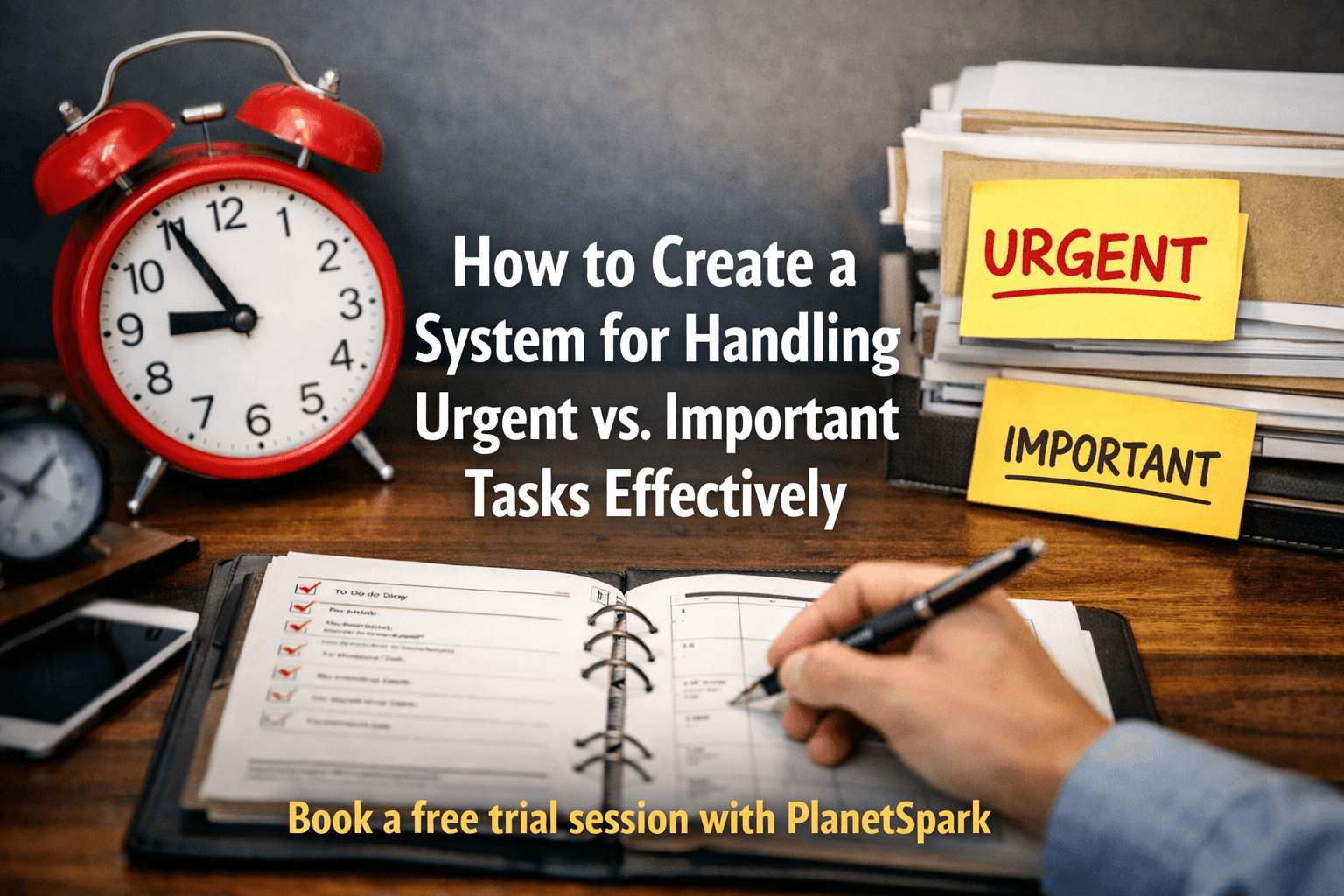
How to Create a System for Handling Urgent vs. Important Tasks Effectively
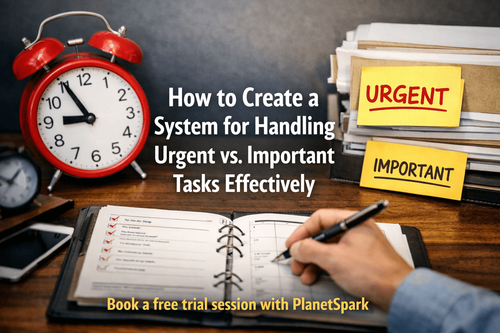

How to Handle Urgent vs Important Tasks: A Practical System to Take Control of Your Time and Productivity
You start your day with a plan. Within minutes, emails start piling up, messages demand attention, and meetings take over your calendar. By the end of the day, you feel busy but not productive. The work that actually matters remains untouched.
This is not a time management issue. It is a prioritisation problem.
Most professionals operate in what the PlanetSpark guidebook calls the urgency trap—constantly reacting instead of leading their time. When everything feels urgent, nothing truly important gets done.
This blog transforms that guidebook into a practical, real-world system. It will help you distinguish urgent from important work, structure your time intentionally, and consistently focus on high-impact tasks that drive career growth. Book your free trial session today with Planetspark.
Download for more details or PDF file.
Who Is This Blog For?
- Working professionals struggling with constant
workload and interruptions
- Managers and team leads balancing strategic and operational responsibilities
- Consultants handling multiple clients and deadlines
- Career switchers trying to build structured work habits
- Professionals who feel busy all day but see little meaningful progress.
Why This Topic Matters Today?
Modern work environments are built for speed, not clarity. Notifications, emails, and meetings create a constant sense of urgency.
As highlighted in the PlanetSpark guidebook :contentReference[oaicite:0]{index=0}, most professionals spend their time reacting to demands instead of working on strategic priorities. This leads to chronic busyness without meaningful output.
The biggest issue is not lack of effort. It is lack of a system.
High performers do not rely on willpower. They rely on structured prioritisation frameworks that help them decide what deserves attention and what does not.
Without such a system, professionals:
- Treat every task as urgent
- Spend most time firefighting
- Delay important long-term work
- Feel overwhelmed despite working long hours
This is why learning to manage urgent vs important tasks is one of the most valuable career skills today.
Core Concept or Framework Explained
The foundation of this system is the Eisenhower Matrix, a simple but powerful framework that classifies tasks based on urgency and importance.
According to the guidebook, every task falls into one of four categories:
- Q1: Urgent and Important
Tasks that require immediate attention such as deadlines, crises, or critical issues
- Q2: Not Urgent but Important
Strategic work like planning, skill development, and relationship building
- Q3: Urgent but Not Important
Tasks driven by others’ priorities that can often be delegated
- Q4: Not Urgent and Not Important
Low-value activities that waste time and should be eliminated
The key insight is simple but powerful:
Most professionals spend too much time in Q1 and Q3, while high performers focus on Q2.
Q2 is where real growth happens.
Another critical distinction explained in the guidebook is:
- Urgent tasks demand immediate attention and are often externally driven
- Important tasks contribute to long-term goals and are internally driven
Understanding this difference changes how you approach work entirely.
How This Blog and Guidebook Help You?
This blog and the original guidebook help you:
- Build a structured system for prioritising tasks
- Stop reacting and start planning your work intentionally
- Identify and focus on high-impact activities
- Reduce time spent on low-value work
- Improve productivity without increasing working hours
The outcome is simple:
More clarity, better decisions, and meaningful progress in your career.
Step-by-Step Breakdown
Step 1: Capture Everything Through a Weekly Brain Dump
You cannot prioritise what you cannot see.
The first step is to externalise all tasks from your mind into a single list.
Set aside 20 to 30 minutes at the start of the week and capture:
- Emails, messages, and calendar items
- Ongoing projects and pending tasks
- Ideas, commitments, and follow-ups
Do not filter or organise at this stage.
This step reduces mental overload and gives you a complete view of your workload.
Step 2: Classify Tasks Using the Eisenhower Matrix
Once you have your list, classify each task by asking:
- Is this urgent?
- Is this important?
Based on the answers, assign tasks to Q1, Q2, Q3, or Q4.
Be careful here. The guidebook highlights that urgency often disguises itself as importance.
Many tasks that feel urgent are actually low-value and belong in Q3.
Step 3: Schedule Your Work Intentionally
Planning without scheduling leads to inaction.
Treat your calendar like a resource allocation tool.
- Schedule Q2 work first
- Allocate time for Q1 tasks
- Leave buffer time for unexpected issues
- Delegate or eliminate Q3 and Q4 tasks
The guidebook makes one rule very clear:
If it is not on your calendar, it is not a commitment.
Step 4: Delegate and Eliminate with Precision
Delegation is not just for managers. It is a productivity multiplier.
Use the DEAR framework for delegation:
- Describe the task clearly
- Explain the desired outcome
- Agree on a deadline
- Remove yourself from execution
At the same time, eliminate Q4 tasks aggressively.
Small distractions may seem harmless but consume significant time over weeks.
Step 5: Apply the Daily Reset Ritual
A weekly plan is not enough. You need a daily anchor.
Spend 10 minutes each morning to:
- Review your priorities
- Identify your top three outcomes
- Select your Most Important Task
Start your day with that task before checking messages or emails.
This simple habit creates clarity and direction.
Step 6: Conduct a Weekly Review
Every week, spend 30 to 45 minutes reviewing your performance.
Ask yourself:
- Where did most of my time go?
- What did not get done and why?
- What recurring problems appeared?
- Did I protect my Q2 time?
- What will I improve next week?
This step ensures continuous improvement.
Common Mistakes or Pitfalls to Avoid
- Treating everything as urgent
This leads to constant stress and low meaningful output
- Scheduling important work last
Q2 tasks get pushed and never completed
- Delegating without clarity
Poor communication results in rework
- Skipping weekly reviews
Without reflection, the system breaks down
- Allowing interruptions to control your day
Reactive behaviour destroys focus and productivity
Avoiding these mistakes significantly improves results.
How Should You Use This Guidebook Effectively?
Follow a structured approach:
- Read the guide once to understand the system
- Perform your first brain dump immediately
- Apply the classification framework
- Schedule your week using the matrix
- Practise the daily reset every morning
- Conduct a weekly review consistently
Time investment:
- Weekly planning: 30 to 45 minutes
- Daily reset: 10 minutes
- Weekly review: 30 minutes
Within 2 to 4 weeks, the system becomes natural.
Key Takeaways
- Not all tasks deserve equal attention
- Distinguish clearly between urgent and important work
- Focus on Q2 tasks for long-term growth
- Schedule important work before anything else
- Delegate and eliminate low-value tasks
- Use daily and weekly reviews to stay on track
- Build a system instead of relying on willpower
Your Next Step: Accelerate Your Career with PlanetSpark
Creating an impact-driven resume is not just about landing your next job—it’s about owning your professional story and presenting it with clarity, confidence, and credibility. When your resume clearly communicates value, results, and impact, opportunities follow naturally.
At PlanetSpark, we are committed to empowering working professionals with practical, outcome-focused resources that drive real career growth. From resume building and workplace communication to leadership presence and professional writing, our programs are designed to help you succeed in today’s fast-evolving job market.
Visit https://www.planetspark.in/resources to explore:
- Career and resume-building guides
- Workplace communication and professional writing resources
- Skill-development tools curated for working professionals
Want a deeper, hands-on experience?
You can also book a free trial session to learn more about PlanetSpark’s Working Professional Courses, designed to accelerate your career through personalised coaching, real-world practice, and expert guidance.
Your career deserves more than generic advice.
It deserves clarity, confidence, and measurable impact.
Start building that advantage today—with PlanetSpark.
Personalized Communication Roadmaps
Record a video to get a AI generated personalized communication reports