
How to Create a Transition Decision Matrix for Evaluating Career Options


A Guide for Creating a Transition Decision Matrix for Comparing Career Options and Making Confident Career Moves
Choosing between multiple career options can feel overwhelming, especially when each path seems promising in its own way. Many working professionals find themselves stuck not because they lack opportunities, but because they lack clarity. When decisions are based on intuition alone, it becomes easy to second-guess, delay action, or regret choices later.
This uncertainty increases when the decision involves long-term consequences—such as switching industries, roles, or career trajectories. Without a structured approach, professionals often rely on incomplete information, emotional bias, or external pressure, leading to inconsistent and risky decisions.
A transition decision matrix offers a practical solution. It allows you to evaluate multiple career options objectively, using clearly defined criteria and measurable comparisons. Instead of guessing which path is right, you create a system that brings clarity, structure, and confidence to your decision-making process.
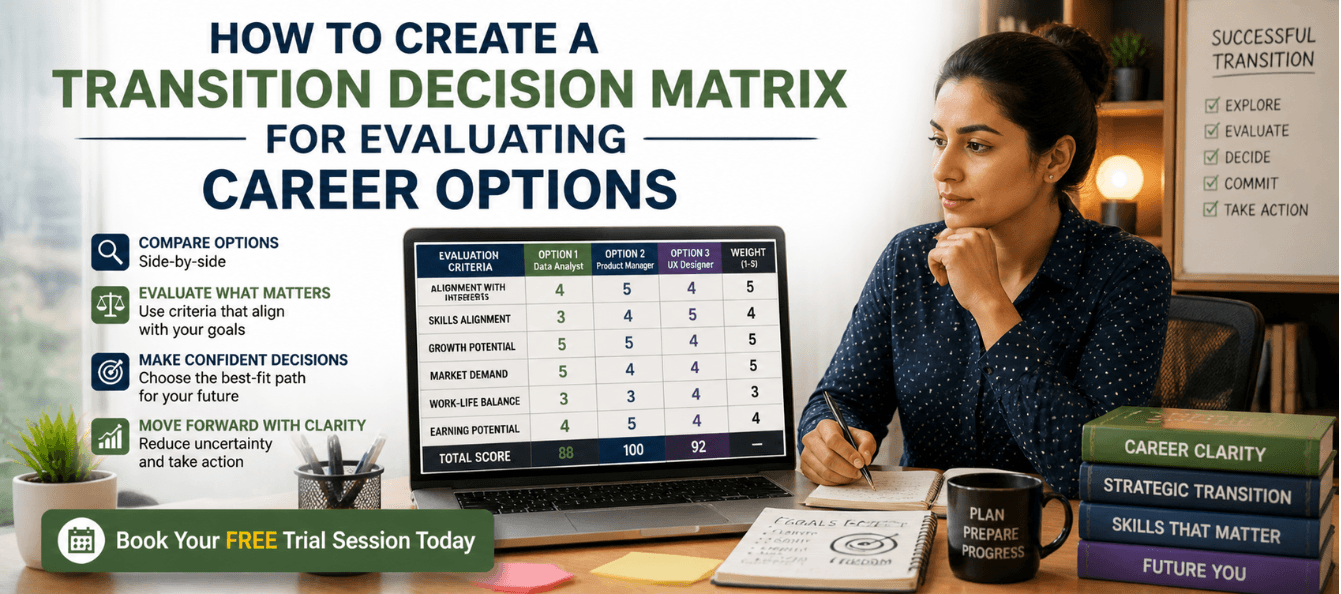
Download these resources and apply them alongside your daily work for improved clarity, productivity, and professional growth. You can also book a free trial to gain expert guidance and enhance your communication, problem-solving, and decision-making skills. The materials are designed in a clear, structured format to help professionals learn efficiently and implement insights with confidence.
Who Is This Blog For?
- Professionals evaluating multiple career paths and struggling to choose one
- Mid-career individuals seeking structured decision-making tools
- Job seekers comparing roles, industries, or opportunities
- Freelancers or consultants deciding between different focus areas
- Anyone looking to reduce uncertainty in high-stakes career decisions
Why This Topic Matters Today?
Today’s professional landscape offers more options than ever before. While this creates flexibility, it also introduces decision fatigue and analysis paralysis.
Common challenges include:
- Too many career options with unclear differentiation
- Difficulty comparing qualitative factors such as interest and growth
- Emotional bias influencing decisions
- Pressure to make quick choices without sufficient evaluation
Without a structured framework, professionals may:
- Choose based on short-term gains instead of long-term fit
- Overlook critical factors such as skill alignment or sustainability
- Delay decisions due to lack of clarity
- Experience regret after committing to a path
A transition decision matrix helps address these challenges by transforming subjective thinking into objective analysis.
Core Concept or Framework Explained
A transition decision matrix is a structured tool used to compare multiple career options against a set of defined criteria. Each option is evaluated systematically, allowing you to identify the most suitable path based on your priorities.
The framework consists of three core components:
Defined Criteria
These are the factors that matter most in your decision. Examples include:
- Skill alignment
- Interest level
- Growth potential
- Financial stability
- Work-life balance
Weighted Importance
Not all criteria are equally important. You assign weights based on your priorities. For example, growth potential may matter more than immediate salary.
Scoring System
Each career option is scored against each criterion. These scores are then combined to create an overall evaluation.
This structured approach reduces bias and ensures that your decision is based on comprehensive analysis rather than intuition alone.
How This Blog and Guidebook Help You?
This guide helps you bring clarity and confidence to complex career decisions.
By applying this framework, you will:
- Break down complex decisions into manageable components
- Evaluate options objectively using consistent criteria
- Align decisions with your personal and professional priorities
- Reduce emotional bias and overthinking
- Make confident, evidence-based career choices
The result is a decision that feels both rational and aligned with your long-term goals.
Step-by-Step Breakdown
Step 1: List Your Career Options Clearly
Start by identifying the options you want to compare. Limit this to 2–4 choices to maintain clarity.
For example:
- Transition into product management
- Move into data analytics
- Continue current role with growth focus
Clarity at this stage ensures meaningful comparison.
Step 2: Define Evaluation Criteria
Identify the factors that matter most to you.
Common criteria include:
- Interest and passion
- Skill alignment
- Learning curve
- Salary potential
- Job market demand
- Work-life balance
Choose criteria that reflect your priorities, not generic standards.
Step 3: Assign Weights to Each Criterion
Determine the importance of each factor by assigning weights.
For example:
- Interest: 30 percent
- Growth potential: 25 percent
- Salary: 20 percent
- Work-life balance: 15 percent
- Skill alignment: 10 percent
This ensures that more important factors have a greater impact on the final decision.
Step 4: Score Each Option
Evaluate each career option against each criterion using a consistent scale, such as 1 to 5.
For example:
- 1 = Poor fit
- 3 = Moderate fit
- 5 = Strong fit
Be honest and objective while scoring.
Step 5: Calculate Weighted Scores
Multiply each score by its corresponding weight and calculate the total for each option.
This creates a clear numerical comparison that highlights the strongest choice.
Step 6: Analyse the Results
Review the final scores and identify patterns.
Ask:
- Which option ranks highest overall?
- Are there close comparisons?
- Which criteria influenced the outcome most?
This helps you understand both the result and the reasoning behind it.
Step 7: Validate with Real-World Insights
Before finalising your decision, validate your findings through:
- Conversations with professionals
- Small experiments or projects
- Industry research
This ensures that your matrix reflects real-world conditions.
Step 8: Make a Confident Decision
Use the matrix as a guide—not a rigid rule.
Combine:
- Data from your matrix
- Insights from validation
- Personal intuition
This balanced approach leads to well-informed decisions.
Common Mistakes or Pitfalls to Avoid
- Using vague or irrelevant criteria
- Assigning equal weight to all factors without prioritisation
- Scoring based on assumptions instead of evidence
- Ignoring emotional alignment entirely
- Overcomplicating the matrix with too many variables
- Treating the matrix as the only decision tool
Avoiding these mistakes ensures that your matrix remains practical and effective.
How Should You Use This Guidebook Effectively?
To use this framework effectively:
- Start with a simple matrix and refine it as needed
- Focus on clarity rather than perfection
- Use real data wherever possible
- Revisit and update your matrix as you gain new insights
- Combine analysis with real-world validation
A practical workflow could be:
- Day 1: Define options and criteria
- Day 2: Assign weights and score options
- Day 3: Analyse results and identify gaps
- Day 4–7: Validate through research or experiments
- Final Step: Make a decision
This structured approach ensures progress without unnecessary delays.
Key Takeaways
- A transition decision matrix brings structure to complex career choices
- Clear criteria and weighted importance drive better decisions
- Objective scoring reduces bias and overthinking
- Real-world validation strengthens decision accuracy
- The matrix should guide, not replace, judgment
- Structured decision-making increases confidence and clarity
Your Next Step: Accelerate Your Career with PlanetSpark
Creating an impact-driven resume is not just about landing your next job—it’s about owning your professional story and presenting it with clarity, confidence, and credibility. When your resume clearly communicates value, results, and impact, opportunities follow naturally.
At PlanetSpark, we are committed to empowering working professionals with practical, outcome-focused resources that drive real career growth. From resume building and workplace communication to leadership presence and professional writing, our programs are designed to help you succeed in today’s fast-evolving job market.
Visit https://www.planetspark.in/resources to explore:
- Career and resume-building guides
- Workplace communication and professional writing resources
- Skill-development tools curated for working professionals
Want a deeper, hands-on experience?
You can also book a free trial session to learn more about PlanetSpark’s Working Professional Courses, designed to accelerate your career through personalised coaching, real-world practice, and expert guidance.
Your career deserves more than generic advice.
It deserves clarity, confidence, and measurable impact.
Start building that advantage today—with PlanetSpark.
Personalized Communication Roadmaps
Record a video to get a AI generated personalized communication reports