
How to Create Effective Checklists for Recurring Life Tasks


How to Design Personal Checklists for Recurring Life Tasks to Boost Your Efficiency
Every working professional knows the feeling of missing important tasks amidst the chaos of daily life. Whether it’s forgetting to send a client report or missing an interview prep step, the mental load of managing recurring tasks can be overwhelming. In fact, these are not failures of intelligence but failures of system.
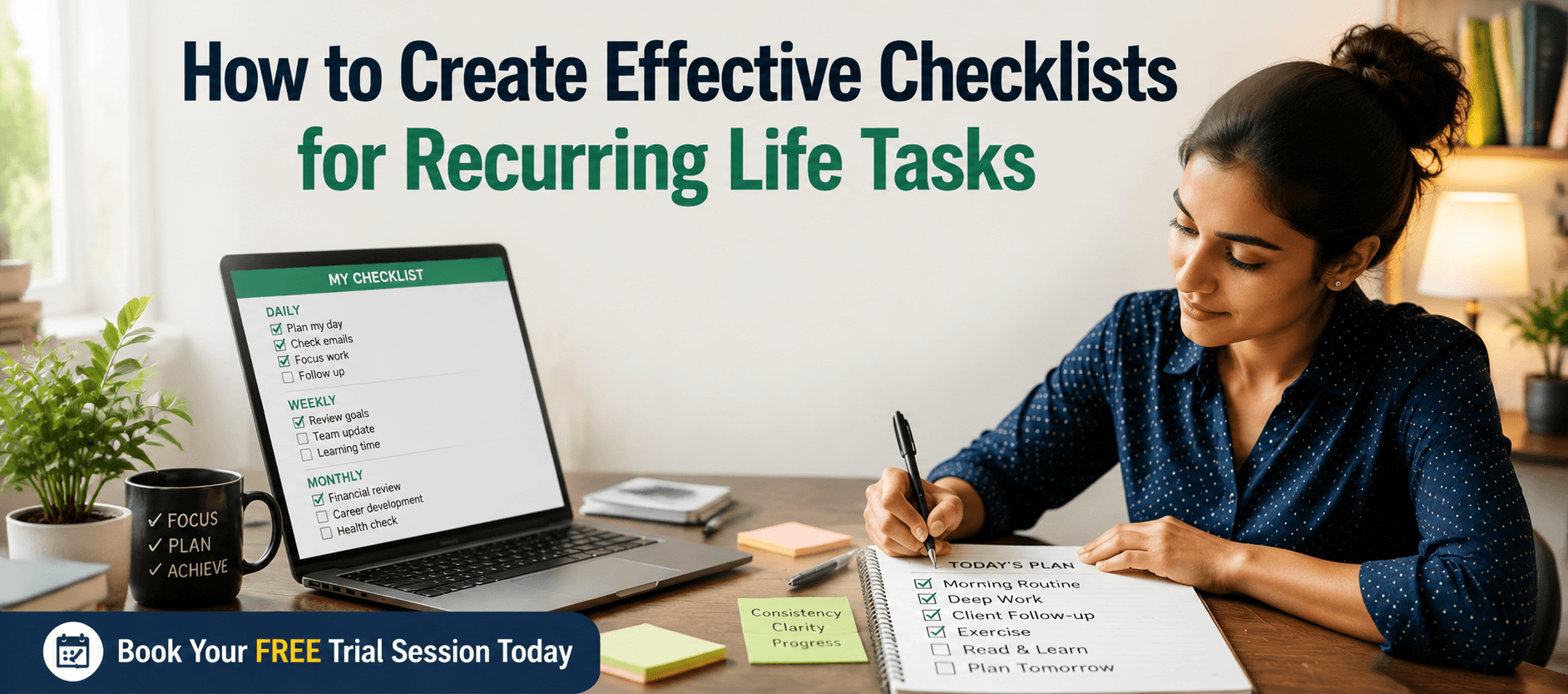
To stop reinventing the wheel and start managing life like a system, the solution lies in creating personal checklists that actually work. This blog will guide you step-by-step through the process of designing checklists that help you stay consistent, reduce stress, and free up mental bandwidth.
Download these resources and apply them alongside your daily work for improved clarity, productivity, and professional growth. You can also book a free trial to gain expert guidance and enhance your communication, problem-solving, and decision-making skills. The materials are designed in a clear, structured format to help professionals learn efficiently and implement insights with confidence.
Who Is This Blog For?
Career changers looking to streamline job application processes
Consultants and managers needing to stay organized in a fast-paced environment
Early to mid-career professionals feeling overwhelmed by recurring tasks
Individuals who want to build more consistent systems for personal and professional life
Freelancers and professionals managing client onboarding and project workflows.
Why This Topic Matters Today?
In Today’s high-stress environment, professionals are juggling multiple tasks, leaving little room for remembering all the small details. According to cognitive science, our brains can only handle around four pieces of information at a time, meaning crucial tasks often slip through the cracks.
This challenge is even more pressing for professionals managing multiple projects, interviews, and personal responsibilities. Effective follow-through on recurring tasks — from monthly reports to job applications — directly impacts productivity, professional growth, and mental well-being.
Implementing structured personal checklists helps avoid missed deadlines, reduces decision fatigue, and boosts the consistency of your output.
Core Concept or Framework Explained
At the heart of this framework lies a simple, yet powerful approach: structured, personalized, and timing-driven checklists. These elements, when combined, allow you to automate your task management and ensure that nothing gets overlooked.
Structured Communication: Your checklists should be broken down into actionable, clear steps. For example, instead of a vague item like "Prepare for interview," a better checklist item would be "Research the company’s mission statement."
Personalization: A checklist should be customized based on the task at hand. By adding personalized touches like specific deadlines or custom action items, you ensure your checklist isn't a generic, one-size-fits-all approach.
Timing and Relevance: Timing is critical in follow-ups. Be it following up after an interview, a job application, or a client meeting, the checklist must factor in when to take action, ensuring relevance and effectiveness.
How This Blog and Guidebook Help You?
This blog and the accompanying guidebook offer actionable templates and frameworks that can immediately enhance your task management systems. Whether you're working through an ongoing project, preparing for a job interview, or just managing your personal life, the systems you create with these checklists will allow you to:
Execute tasks with minimal friction
Save time by eliminating the need to repeatedly plan the same processes
Free up mental bandwidth for higher-priority work
Increase your productivity through structured systems.
Step-by-Step Breakdown
Step 1: Audit Your Life for Repeating Patterns
To design effective checklists, start by identifying which tasks are recurring. This process, called a life audit, helps separate one-time events from tasks that require consistent attention. Consider tasks like weekly reports, monthly financial reviews, or travel packing.
Key categories to audit:
Work Operations: Weekly reports, invoicing cycles
Career Management: Resume updates, job applications
Life Logistics: Travel packing, home maintenance
Step 2: Deconstruct the Task Into Its True Components
Next, break down each task into smaller, actionable steps. For example, if you’re preparing for a client proposal, list every individual action — such as "open proposal template," "draft the introduction," and "format the document."
The key is to be specific and order tasks chronologically. This ensures nothing gets forgotten.
Step 3: Design for Scannability, Not Completeness
A checklist should not be an exhaustive list of every tiny detail. Instead, it should be a scannable list that helps you quickly move through tasks. Use action-first language, and group items into phases (Before, During, After) to increase clarity.
Step 4: Embed Triggers and Timing Into Your System
For a checklist to be effective, it must be automated and connected to your workflow. For example, setting calendar reminders for monthly financial reviews or creating triggers for job application deadlines ensures that your system works without needing constant input.
Step 5: Test, Iterate, and Version-Control Your Checklists
A checklist is not static. The first version is likely to be imperfect. As you use your checklists, iterate them based on real-world feedback. Keep them updated, and review them periodically to make improvements.
Common Mistakes or Pitfalls to Avoid
Many professionals make the mistake of creating long, vague, or incomplete checklists. Here are common mistakes and how to fix them:
Making It Too Long: A checklist with too many items can overwhelm and get abandoned. Limit sections to 5-9 items.
Writing Vague Action Items: Items like "Prepare for interview" are too general. Be specific like "Research company values."
Building It but Never Triggering It: A checklist is useless if you forget to use it. Make sure it’s connected to a clear trigger, like an email notification or calendar reminder.
How Should You Use This Guidebook Effectively?
To get the most from this guide, follow this workflow:
Identify your recurring tasks.
Break down tasks into specific, actionable steps.
Design checklists with scannability in mind.
Set up automatic triggers for each checklist.
Iterate the checklists based on real-world use.
Consistency is key. Even if you start with imperfect lists, your system will improve over time.
Key Takeaways:
Structured checklists boost efficiency and reduce mental overload
Personalizing and timing your checklists enhances effectiveness
Keep checklists short, clear, and scannable
Integrate triggers to automate checklist activation
Iterate and refine checklists for continuous improvement.
Your Next Step: Accelerate Your Career with PlanetSpark
Creating an impact-driven resume is not just about landing your next job—it’s about owning your professional story and presenting it with clarity, confidence, and credibility. When your resume clearly communicates value, results, and impact, opportunities follow naturally.
At PlanetSpark, we are committed to empowering working professionals with practical, outcome-focused resources that drive real career growth. From resume building and workplace communication to leadership presence and professional writing, our programs are designed to help you succeed in today’s fast-evolving job market.
Visit https://www.planetspark.in/resources
to explore:
Career and resume-building guides
Workplace communication and professional writing resources
Skill-development tools curated for working professionals.
Want a deeper, hands-on experience?
You can also book a free trial session to learn more about PlanetSpark’s Working Professional Courses, designed to accelerate your career through personalised coaching, real-world practice, and expert guidance.
Your career deserves more than generic advice.
It deserves clarity, confidence, and measurable impact.
Start building that advantage today—with PlanetSpark.
Personalized Communication Roadmaps
Record a video to get a AI generated personalized communication reports