
How to Create Stable Yet Flexible Systems for Daily Life
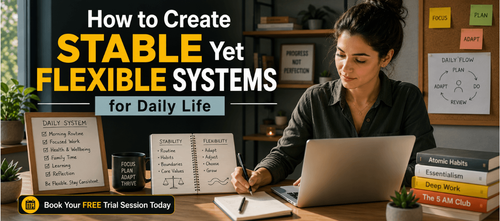

How to Increase Life Stability Without Losing Flexibility in Your Career and Personal Life
In today’s fast-changing professional world, many people feel trapped between two competing goals: stability and flexibility. On one side, professionals want financial security, reliable routines, strong relationships, and predictable progress. On the other, they want freedom, adaptability, career mobility, remote work options, and the ability to pursue new opportunities without feeling stuck.
Unfortunately, modern work culture often presents these two goals as opposites. Stability is portrayed as rigid and restrictive, while flexibility is seen as uncertain and chaotic. As a result, many professionals swing between over-structured routines that feel suffocating and reactive lifestyles that feel unstable. The reality is very different.
True long-term success comes from building systems that create stability at the core while preserving flexibility at the edges. The most resilient professionals are not choosing between security and adaptability. They are intentionally designing both.
This guidebook introduces a practical framework called the Stable-Flexible System. It helps professionals create a strong personal foundation while remaining adaptable to changing opportunities, industries, and life circumstances. Instead of reacting to disruption, professionals learn how to build systems that absorb change without collapsing under pressure.
Download these resources and apply them alongside your daily work for improved clarity, productivity, and professional growth. You can also book a free trial to gain expert guidance and enhance your communication, problem-solving, and decision-making skills. The materials are designed in a clear, structured format to help professionals learn efficiently and implement insights with confidence.
Who Is This Blog For?
- Working professionals navigating career uncertainty or transitions
- Managers and leaders balancing growth with personal stability
- Freelancers and consultants managing variable work structures
- Career changers seeking adaptability without financial chaos
- Professionals feeling overwhelmed by constant unpredictability
- Individuals looking to create a more intentional and resilient lifestyle
- Employees seeking better work-life design and long-term sustainability
Why Does Life Stability Without Rigidity Matter Today?
The professional world has changed dramatically over the last decade. Careers are no longer linear, industries evolve rapidly, remote work is increasingly common, and professionals are expected to adapt constantly.
However, many professionals are adapting without any real foundation.
This creates common challenges such as:
- Financial insecurity despite career growth
- Burnout caused by reactive work patterns
- Weak professional direction and unclear priorities
- Poor work-life boundaries
- Overloaded schedules with little recovery time
- Constant anxiety about future uncertainty
The guidebook explains that instability often comes not from external change itself, but from weak internal systems.
Professionals frequently make the wrong parts of life rigid while leaving critical foundations unstable.
Examples include:
- Rigid schedules but poor financial planning
- Fixed job identities but inconsistent health habits
- Strict work structures but weak relationships
- High workloads without recovery systems
When disruption occurs, these fragile systems collapse quickly.
The Stable-Flexible System solves this problem by separating what must remain stable from what should remain adaptable.
Core Concept or Framework Explained
The guidebook introduces the Stable-Flexible System, a two-layer framework designed for long-term resilience and adaptability.
The Stability Core
The inner core contains the non-negotiable systems that support everything else.
This includes:
- Financial foundation
- Health infrastructure
- Professional identity
- Key relationships
These systems create continuity, resilience, and stability.
When the core is strong:
- Stress reduces significantly
- Decision-making improves
- Career risks become safer to take
- Adaptability increases naturally
The Flexibility Shell
The outer shell contains areas that should remain adaptive and adjustable.
This includes:
- Work arrangements
- Scheduling systems
- Project selection
- Discretionary energy allocation
- Career experiments
The guidebook explains that flexibility is most effective when it exists around a stable center.
Instead of resisting change, professionals learn how to absorb and adapt to it strategically.
How Does This Blog and Guidebook Help You?
This framework helps professionals build intentional systems instead of reacting constantly to external demands.
The guidebook provides:
- A complete framework for balancing stability and adaptability
- Financial planning systems for reducing uncertainty
- Health infrastructure routines that survive busy periods
- Professional identity exercises for career clarity
- Work architecture strategies for sustainable productivity
- Relationship investment systems for long-term resilience
- Decision-making frameworks for faster and better choices
The outcome is greater confidence, reduced stress, and improved professional flexibility without sacrificing security.
Step-by-Step Breakdown
Step 1: Build Your Financial Stability Stack
The guidebook identifies financial instability as one of the biggest causes of professional inflexibility.
When finances are fragile:
- Professionals tolerate poor work environments
- Risk-taking becomes dangerous
- Career pivots feel impossible
- Stress increases significantly
The framework introduces a three-layer Stability Stack.
Layer 1: Cash Buffer
Build 3–6 months of essential expenses in a liquid emergency fund.
This creates immediate psychological and practical stability.
Layer 2: Baseline Income
Establish reliable income that consistently covers non-negotiable expenses.
This may include:
- Full-time employment
- Retainer clients
- Rental income
- Side income streams
Layer 3: Flexibility Fund
Create a separate fund specifically for opportunities such as:
- Career transitions
- Learning programs
- Travel
- Business experiments
- Sabbaticals
The guidebook emphasizes building these layers in sequence rather than chasing investment optimization prematurely.
Step 2: Create a Non-Negotiable Health Infrastructure
Health is presented as foundational infrastructure rather than optional self-care.
The guidebook explains that many professionals sacrifice health during busy periods, mistakenly believing this improves productivity.
In reality, it reduces long-term capacity dramatically.
The framework introduces four health non-negotiables.
Sleep Anchor
Maintain a consistent wake-up time every day.
This improves cognitive performance and energy stability.
Movement Minimum
Commit to at least 20 minutes of daily movement.
Examples include:
- Walking
- Stretching
- Cycling
- Light workouts
Mental Recovery
Introduce one daily mental recovery practice such as:
- Journaling
- Meditation
- Screen-free walks
- Meaningful conversation
Nutrition Anchor
Maintain one consistently nutritious meal daily to stabilize energy and reduce decision fatigue.
The key principle is minimum effective dose.
The goal is consistency under pressure, not perfection.
Step 3: Clarify Your Professional Identity
One of the guidebook’s strongest insights is that unclear professional identity creates instability.
Without clarity:
- Professionals say yes to the wrong opportunities
- Career decisions become reactive
- Long-term direction feels uncertain
The framework defines professional identity through three dimensions.
Core Expertise
What problems do you solve reliably?
What are you genuinely known for?
Working Values
What conditions help you perform at your best?
What are you unwilling to compromise on?
Directional Goal
What does success look like over the next 3–5 years?
This identity clarity acts as an internal compass during career changes and decision-making.
Step 4: Design Flexible Work Architecture
Most professionals inherit work structures by default instead of designing them intentionally.
The guidebook introduces the concept of Work Architecture.
This refers to:
- How you work
- When you work
- Where you work
- How your time is allocated
The framework introduces the Flexibility Budget with four work zones.
Deep Work
Focused, cognitively demanding tasks.
Responsive Work
Meetings, communication, and coordination.
Exploratory Work
Learning, networking, experimentation, and strategic thinking.
Buffer
Recovery, overflow management, and unexpected demands.
The guidebook explains that many professionals operate with no exploratory time and no buffer, creating constant reactivity.
Even small shifts toward these zones improve creativity and resilience.
Step 5: Invest Intentionally in Relationships
The guidebook positions relationships as critical infrastructure rather than optional extras.
Two relationship categories are highlighted.
Anchor Relationships
These are close relationships providing emotional stability and honest support.
Examples include:
- Family
- Close friends
- Trusted mentors
- Core professional allies
Expansion Relationships
These are broader networks providing exposure to opportunities and perspectives.
Examples include:
- Industry peers
- Connectors
- Mentors
- Cross-functional contacts
The framework encourages:
- Depth with anchor relationships
- Breadth with expansion relationships A major warning from the guidebook is that professionals often over-invest in networking while neglecting deeper personal relationships.
This creates professional visibility without emotional stability.
Step 6: Create Systems for Sustainable Flexibility
The final module focuses on maintaining adaptability without chaos.
The guidebook introduces two powerful systems.
The 90-Day Review Rhythm
Every quarter, professionals conduct a structured review across:
- Finances
- Health
- Career direction
- Relationships
- Energy and workload
Questions include:
- What is working?
- What is not working?
- What needs to change?
- What should remain stable?
This prevents professionals from drifting too far from their priorities.
The Decision Filter
The guidebook introduces a simple but powerful decision-making framework.
Professionals evaluate opportunities against criteria such as:
- Alignment with expertise
- Financial impact
- Energy impact
- Long-term direction
- Relationship quality
This reduces impulsive and fear-based decisions significantly.
Real-World Example: Priya’s Transformation
The guidebook shares the example of Priya, a 31-year-old UX designer experiencing financial stress, burnout, and professional uncertainty despite career success.
Over 90 days, she:
- Built a stability buffer
- Created a daily movement routine
- Clarified her working values
- Redesigned her work structure
- Rebuilt key relationships
One of her biggest breakthroughs was realizing she valued creative ownership more than compensation.
This helped her restructure client relationships and launch a small consultancy supported by her Flexibility Fund.
Her experience demonstrates an important principle from the guidebook:
Stability expands risk tolerance because professionals stop gambling with survival.Common Mistakes or Pitfalls to Avoid
The guidebook highlights several patterns that quietly undermine stability.
Optimising Before Stabilising
Many professionals chase investments or career upside before building financial security.
Better approach:
- Build the cash buffer first
- Stabilize baseline income second
- Optimize later
Treating Health as Optional
Professionals often postpone recovery and wellbeing until life becomes “less busy.”
Better approach:
- Maintain minimum viable health systems consistently
Identity by Default
Allowing job titles to define identity creates instability during transitions.
Better approach:
- Clarify expertise, values, and long-term direction intentionally
Saying Yes to Everything
Mistaking variety for flexibility leads to exhaustion and confusion.
Better approach:
- Use a consistent decision filter before accepting commitments
Ignoring Relationship Maintenance
Professionals often network externally while neglecting core personal relationships.
Better approach:
- Protect anchor relationships intentionally
Skipping Reviews
Operating without structured reflection leads to slow drift and reactive living.
Better approach:
- Schedule quarterly recalibration sessions in advance
How Should You Use This Guidebook Effectively?
The guidebook is designed for gradual implementation rather than immediate life overhaul.
Recommended workflow:
- Complete the self-assessment first
- Identify your lowest-scoring area
- Focus on one improvement area for 30–90 days
- Build systems slowly and consistently
- Schedule quarterly reviews immediately
- Use the Decision Filter for all major opportunities
Suggested time investment:
- 30–60 minutes for weekly reflection
- 2 hours every quarter for the 90-Day Review
- Small daily investments in health and relationship systems
The guidebook also includes a practical 30-day implementation plan covering:
- Financial diagnosis
- Health routines
- Work architecture audits
- Relationship rebuilding
- Quarterly review scheduling
The goal is progress through structure, not pressure.
Key Takeaways
- Stability and flexibility are complementary, not competing forces
- Strong internal systems create greater external adaptability
- Financial security increases professional freedom and confidence
- Health infrastructure protects long-term performance capacity
- Professional identity clarity improves decision-making
- Work architecture should be intentionally designed, not inherited
- Relationships function as critical emotional and professional infrastructure
- Quarterly reviews prevent drift and maintain alignment
- Decision filters reduce reactive and impulsive choices
- Small, consistent systems create long-term resilience and freedom
Your Next Step: Accelerate Your Career with PlanetSpark
Creating an impact-driven resume is not just about landing your next job—it’s about owning your professional story and presenting it with clarity, confidence, and credibility. When your resume clearly communicates value, results, and impact, opportunities follow naturally.
At PlanetSpark, we are committed to empowering working professionals with practical, outcome-focused resources that drive real career growth. From resume building and workplace communication to leadership presence and professional writing, our programs are designed to help you succeed in today’s fast-evolving job market.
Visit https://www.planetspark.in/resources to explore:
- Career and resume-building guides
- Workplace communication and professional writing resources
- Skill-development tools curated for working professionals
Want a deeper, hands-on experience?
You can also book a free trial session to learn more about PlanetSpark’s Working Professional Courses, designed to accelerate your career through personalised coaching, real-world practice, and expert guidance.
Your career deserves more than generic advice.
It deserves clarity, confidence, and measurable impact.
Start building that advantage today—with PlanetSpark.
Personalized Communication Roadmaps
Record a video to get a AI generated personalized communication reports