
How to Define Team Roles and Responsibilities Clearly
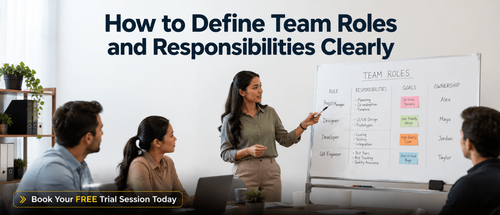

Mapping Team Roles and Responsibilities Clearly: A Practical Guide to Building High-Performing Teams
Every team wants faster execution, smoother collaboration, and stronger accountability. Yet many teams struggle not because people lack talent or commitment, but because they are unclear about who owns what. When responsibilities are blurry, work gets duplicated, deadlines slip, decisions stall, and people begin stepping on each other’s toes.
This is one of the most common workplace problems managers, consultants, and career professionals face. A team may have strong people, ambitious goals, and a supportive culture, but without role clarity, even the best talent can get stuck in confusion. One person assumes someone else is handling a task. Two people unknowingly work on the same outcome. A manager delays delegation because ownership is unclear. A new team member joins but does not know where their role begins or ends.
The guidebook Mapping Team Roles and Responsibilities Clearly solves this challenge with a structured scorecard, diagnostic process, RACI framework, role map worksheet, and five-dimension clarity model. It gives professionals a practical system to define, document, and communicate team roles with precision. Whether you are leading a new team, restructuring an existing one, consulting with a client, or preparing for a leadership role, this resource helps you create shared understanding and stronger execution.
Download these resources and apply them alongside your daily work for improved clarity, productivity, and professional growth. You can also book a free trial to gain expert guidance and enhance your communication, problem-solving, and decision-making skills. The materials are designed in a clear, structured format to help professionals learn efficiently and implement insights with confidence.
Who Is This Blog For?
This blog is designed for professionals who want to improve team performance through clear ownership, better delegation, and stronger accountability.
- Managers who want to reduce confusion around roles and responsibilities
- Team leads managing fast-growing or newly formed teams
- Consultants who need to map client operating structures quickly
- Career professionals transitioning into leadership roles
- HR and people managers supporting team restructuring
- New managers learning how to delegate effectively
- Project leads dealing with duplicated work or unclear handoffs
- Professionals responsible for onboarding new team members
- Leaders who want to create a repeatable system for role clarity
If your team frequently asks, “Who owns this?” or “Why was this not done?” this guidebook gives you a practical way to answer those questions before they become conflicts.
Why This Topic Matters Today?
Role clarity has become more important than ever because modern teams are often cross-functional, fast-moving, and constantly changing. Teams today work across departments, tools, locations, and priorities. Without clear ownership, even small misunderstandings can slow down execution.
The guidebook explains that most team dysfunction does not begin with bad attitudes, poor skills, or weak culture. It begins with blurry lines. When people do not know who owns which outcomes, three problems happen at the same time: duplicated effort wastes time, critical gaps go unnoticed, and interpersonal friction increases.
This is especially relevant for growing organisations, restructured teams, newly formed squads, and career changers stepping into broader responsibilities. In these environments, people often inherit unclear responsibilities without proper documentation. Managers may know what they expect, but that does not mean the team shares the same understanding.
The guidebook also highlights that role ambiguity is a major driver of workplace stress, disengagement, and attrition. Only about 1 in 4 teams report high clarity across all five dimensions of role clarity. Teams that complete structured role mapping exercises report major reductions in redundant work within 90 days, and new team members onboard faster when role maps are shared from Day 1.
In simple terms, role clarity improves productivity, trust, collaboration, onboarding, delegation, and retention. It is not an administrative exercise. It is a leadership advantage.
Core Concept or Framework Explained
The central idea of the guidebook is that clarity is a superpower. When every person on a team knows what they own, what they influence, and where they hand off, execution accelerates and accountability becomes normal.
The guidebook provides a complete system for mapping team roles and responsibilities. This system includes:
- A Role Clarity Diagnostic to audit the current state
- The RACI framework to define ownership and involvement
- A Role Map Builder worksheet to document active roles
- Five dimensions of role clarity to assess depth and quality
- A Role Clarity Scorecard to rate the team’s current clarity level
- Common mistakes and fixes to avoid predictable mapping failures
- A practical action plan for immediate implementation
The most important framework in the guidebook is RACI. RACI stands for Responsible, Accountable, Consulted, and Informed.
Responsible refers to the person or people who do the work. They execute the task or produce the output.
Accountable refers to the single person who owns the outcome and answers for it. There must be exactly one Accountable person per activity.
Consulted refers to people whose input is needed before decisions are made or work proceeds. Their involvement is two-way.
Informed refers to people who need updates but are not involved in making decisions. Communication with them is one-way.
The guidebook makes one rule very clear: there should be only one Accountable owner for each activity. If too many people are Accountable, no one is truly accountable.
How This Blog and Guidebook Help You?
This blog helps you understand and apply the guidebook in a practical, career-focused way. The guidebook gives you the tools. This blog explains how those tools connect to real workplace outcomes.
By using this resource, you can:
- Identify where role confusion currently exists
- Reduce duplicated effort across your team
- Clarify ownership for key outcomes and decisions
- Improve delegation by defining what each person owns
- Resolve recurring conflicts around responsibilities
- Support faster onboarding for new team members
- Map dependencies between roles and functions
- Build a shared understanding of boundaries and handoffs
- Create a living role map that stays useful over time
- Improve team accountability without creating unnecessary control
The guidebook is especially useful because it does not require complex HR systems or organisational design expertise. It gives you focused questions, practical templates, and a repeatable process. You can use it as a manager, consultant, team lead, or professional preparing for leadership.
Step-by-Step Breakdown
Step 1: Recognise the Cost of Blurry Responsibilities
The first step is understanding that unclear roles create real business costs. When responsibilities are not clearly mapped, teams waste time, duplicate effort, miss important work, and create unnecessary friction.
For example, if three people believe they own the content calendar, decisions may slow down because no one knows who has final authority. If no one owns stakeholder reporting, updates may become inconsistent. If a manager assumes a team member owns an outcome but the team member believes they are only supporting it, accountability breaks down.
The guidebook encourages professionals to treat role clarity as a foundation for trust. When people know what they own, they can collaborate without defending territory.
Step 2: Run the Role Clarity Diagnostic
Before building a role map, you need to understand your current state. The Role Clarity Diagnostic helps surface gaps, overlaps, and assumptions that may be slowing the team down.
The diagnostic includes four key actions.
First, list every active role. This means writing down every position on the team, including informal roles people may have taken on naturally. Do not rely only on the org chart. Document what people actually do.
Second, identify what each role owns. For every role, list the top 5 outcomes they are responsible for delivering. The guidebook stresses the difference between tasks and outcomes. “Sends weekly reports” is a task. “Ensures stakeholders have accurate data to make decisions” is an outcome.
Third, flag overlaps and gaps. Look for outcomes assigned to more than one role and outcomes assigned to no one. These are the areas most likely to create confusion and conflict.
Fourth, score current clarity. Rate each role from 1 to 5, where 1 means completely unclear and 5 means crystal clear. Any role scoring 3 or below needs immediate attention.
The guidebook also warns managers not to assume that because they understand each person’s role, the team does too. Role clarity requires shared understanding.
Step 3: Use the RACI Framework as Your Mapping Tool
Once you understand the current state, use RACI to map responsibility clearly.
RACI helps answer four questions:
- Who does the work?
- Who owns the outcome?
- Who must be consulted before action?
- Who only needs to be informed?
This distinction prevents confusion. For example, in a hiring process, an HR Partner may be Responsible for coordinating steps, the Hiring Manager may be Accountable for the final outcome, Team Peers may be Consulted, and the Director may be Informed.
The guidebook provides examples such as setting quarterly OKRs, hiring a new team member, publishing a client report, and approving budget spend. In each case, RACI clarifies who executes, who owns, who advises, and who receives updates.
The most common mistake is assigning too many people as Accountable. Another mistake is marking everyone as Responsible to avoid discomfort. The guidebook recommends being precise because a bloated RACI creates false confidence.
Step 4: Build Your Team’s Role Map
The Role Map Builder turns analysis into a working document. This is the document your team should return to repeatedly. It should be accessible, versioned, and reviewed regularly.
The worksheet begins with basic team inventory details:
- Team or function name
- Date of mapping
- Person who created the map
- Review date
Then it asks you to complete role entries for each team member:
- Full name and title
- Primary outcomes owned
- Key decisions they make
- Who they are accountable to
- Who they depend on
- Where their role ends
These prompts force clarity beyond job titles. They help define outcomes, decisions, dependencies, reporting lines, and boundaries.
The guidebook also includes reflection questions to surface hidden assumptions. For example, if a person were absent for two weeks, which tasks would stall and why? Which decisions currently require more people than they should? Are there tasks everyone assumes someone else is doing? Where does recurring friction happen?
These questions help teams identify the informal realities that org charts often miss.
Step 5: Validate the Map With the Team
Validation is one of the most important steps. The guidebook notes that this is where many teams skip, but it is also where the greatest value appears.
A manager may create a role map based on their understanding, but team members may see their responsibilities differently. That mismatch is exactly what the mapping process is designed to uncover.
Validation means each team member reviews their own role entry. They confirm what feels accurate, challenge what feels unclear, and identify missing responsibilities. The conversation may feel uncomfortable, but it creates shared understanding.
The goal is not to impose clarity from above. The goal is to co-create clarity with the people doing the work.
Step 6: Assess the Five Dimensions of Role Clarity
The guidebook explains that a job title and RACI matrix are useful, but they are not enough. True role clarity operates across five dimensions.
The first dimension is Outcome Clarity. This means each person knows the 3 to 5 key results they are responsible for delivering. They should be able to explain these without reading their job description.
The second dimension is Boundary Clarity. This means each person knows where their responsibilities end and where a colleague’s responsibilities begin. Clear handoff points reduce conflict.
The third dimension is Decision Clarity. This means each person knows which decisions they can make independently, which require consultation, and which need escalation.
The fourth dimension is Dependency Clarity. This means each person knows who they depend on and who depends on them. Mapping dependencies prevents blockers and improves sequencing.
The fifth dimension is Growth Clarity. This means each person understands how their role may evolve, what skills they should develop, and what success looks like at the next level.
Together, these five dimensions move role clarity from a static document to a powerful management and development tool.
Step 7: Learn From the Case Example of Priya’s Marketing Team
The guidebook includes a case example of Priya, who leads a 7-person marketing team at a Series B SaaS company. Her team was talented, but campaigns launched late, approvals took too long, and two team members were doing almost identical work without realising it.
During a retrospective, three different people claimed to own the content calendar. This revealed that the problem was not motivation or capability. The problem was unclear ownership.
Priya ran a two-hour Role Clarity Workshop using the scorecard. She began with the diagnostic and discovered that content calendar ownership had been assumed by three people without explicit agreement. She then created a RACI matrix for five core marketing processes: campaign briefing, content creation, design review, stakeholder approval, and performance reporting.
Within two weeks, the team had a shared, documented role map. Campaign launch time dropped by 30 percent. The two people doing overlapping work were re-scoped, with one owning SEO content and the other owning social and paid distribution. Both reported higher job satisfaction in the next pulse survey.
The lesson is clear: many team conflicts are structural, not personal. When roles are mapped clearly, people often feel freer, not more restricted.
Step 8: Use the Role Clarity Scorecard
The Role Clarity Scorecard helps teams measure their clarity across the five dimensions. Each section has a maximum of 20 points, creating a total score out of 100.
The sections are:
- Outcome Clarity
- Boundary Clarity
- Decision Clarity
- Dependency Clarity
- Growth Clarity
Each statement is scored from 1, meaning strongly disagree, to 5, meaning strongly agree.
The score interpretation is practical:
- 85 to 100 means Excellent
- 65 to 84 means Good Foundation
- 45 to 64 means Needs Attention
- Below 45 means Critical Gap
The scorecard helps you avoid vague impressions. Instead of saying, “We need better clarity,” you can identify the exact section that needs work. For example, your team may have strong outcome clarity but weak decision clarity. That means your next action should focus on decision rights and approval chains.
Step 9: Take the Next 5 Actions
The guidebook ends with five practical actions:
- Run the Role Clarity Diagnostic with your team this week
- Build a RACI matrix for your top 5 team processes
- Complete the Role Map Worksheet for every active role
- Score your team on the Role Clarity Scorecard
- Schedule a quarterly role map review in your team calendar
These actions turn the resource into a working system. The goal is not just to read about role clarity. The goal is to build it into your team’s operating rhythm.
Common Mistakes or Pitfalls to Avoid
The guidebook highlights several mistakes that can weaken role mapping exercises.
One common mistake is mapping titles instead of outcomes. Job titles do not tell you what someone delivers. A better question is, “What would fail if this role did not exist?”
Another mistake is assigning multiple Accountable owners. This often happens when managers want to avoid conflict, but it weakens ownership. RACI requires one Accountable person per activity.
A third mistake is building the map without the team. When managers create role maps alone and present them as final, team members may feel excluded, and the map may not reflect reality. Co-creation improves accuracy and buy-in.
Another mistake is creating the map and then hiding it in a document no one uses. A role map must be shared, included in onboarding, and easy to access.
A final mistake is treating the role map as static. Teams change, priorities evolve, and responsibilities shift. The guidebook recommends a 30-minute quarterly review to keep the map accurate and useful.
How Should You Use This Guidebook Effectively?
Use this guidebook as a practical team clarity tool, not just a reading resource.
Start by reviewing the Role Clarity Diagnostic. Complete it first as a solo exercise if you are a manager or consultant, then validate it with the team. This helps you compare your assumptions with the team’s lived experience.
Next, choose the most important team processes or responsibilities to map. Do not try to map everything at once. Begin with the areas causing the most confusion, delays, or duplicated work.
Then build a RACI matrix for your top processes. Be strict about assigning only one Accountable owner per activity. This may create difficult conversations, but those conversations are where clarity emerges.
After that, complete the Role Map Builder for every active role. Focus on outcomes, decisions, dependencies, and boundaries rather than job descriptions alone.
Use the five dimensions of role clarity to assess whether each role is clear enough. A role is not fully clear unless the person understands outcomes, boundaries, decisions, dependencies, and growth expectations.
Finally, complete the Role Clarity Scorecard and schedule a quarterly review. Role mapping is not a one-time fix. It is a management habit.
A practical workflow could look like this:
- Day 1: Complete the Role Clarity Diagnostic
- Day 2: Identify top 5 processes that need mapping
- Day 3: Build the RACI matrix
- Day 4: Draft role entries for each team member
- Day 5: Validate the map with the team
- End of Month: Review the map and adjust unclear areas
- Quarterly: Update the map as roles and priorities evolve
For most teams, a focused two-hour workshop can create a strong first version of the role map. The key is to keep the document alive through regular use.
Key Takeaways
- Role clarity is essential for high-performing teams
- Blurry responsibilities create duplicated effort, missed tasks, and interpersonal friction
- Managers should map outcomes, not just job titles
- The Role Clarity Diagnostic helps reveal gaps, overlaps, and assumptions
- RACI is the core tool for mapping responsibility and accountability
- Responsible means doing the work, while Accountable means owning the outcome
- There should be exactly one Accountable person for each activity
- The Role Map Builder helps document outcomes, decisions, dependencies, and boundaries
- Team validation is essential because role clarity must be shared, not assumed
- True role clarity includes outcome, boundary, decision, dependency, and growth clarity
- The Role Clarity Scorecard helps teams measure their current clarity level
- Role maps should be accessible, versioned, and reviewed quarterly
- Most role conflicts are structural, not personal
- Clarity frees people to collaborate with confidence
- The best role maps are co-created, validated, shared, and updated regularly
Your Next Step: Accelerate Your Career with PlanetSpark
Creating an impact-driven resume is not just about landing your next job—it’s about owning your professional story and presenting it with clarity, confidence, and credibility. When your resume clearly communicates value, results, and impact, opportunities follow naturally.
At PlanetSpark, we are committed to empowering working professionals with practical, outcome-focused resources that drive real career growth. From resume building and workplace communication to leadership presence and professional writing, our programs are designed to help you succeed in today’s fast-evolving job market.
Visit https://www.planetspark.in/resources to explore:
- Career and resume-building guides
- Workplace communication and professional writing resources
- Skill-development tools curated for working professionals
Want a deeper, hands-on experience?
You can also book a free trial session to learn more about PlanetSpark’s Working Professional Courses, designed to accelerate your career through personalised coaching, real-world practice, and expert guidance.
Your career deserves more than generic advice.
It deserves clarity, confidence, and measurable impact.
Personalized Communication Roadmaps
Record a video to get a AI generated personalized communication reports