
How to Define Your Value Proposition for Career Growth
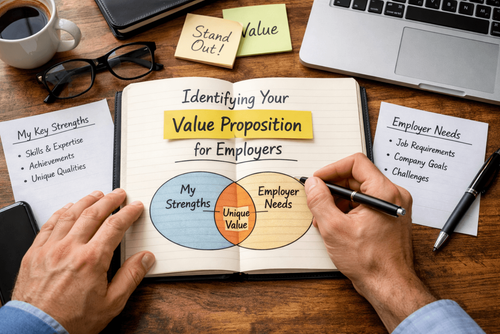

How to Define Your Employer Value Proposition and Stand Out to Employers
In today’s competitive job market, standing out from the crowd is more important than ever. But many professionals struggle to articulate what sets them apart from other candidates. The solution? Developing a strong Employer Value Proposition (EVP). This strategic tool helps you clearly communicate what makes you uniquely valuable to employers, positioning you as the ideal candidate for the job.
The Stand Out. Get Hired. Own Your Worth. guide provides a step-by-step approach to building and refining your EVP, helping you showcase your strengths with confidence and precision. Whether you’re job hunting, transitioning careers, or seeking a promotion, mastering your EVP can make all the difference.
Who Is This Blog For?
* Job seekers looking to communicate their value effectively
* Career changers seeking to pivot into a new role
* Mid-career professionals aiming for promotion
* Consultants and managers eager to articulate their unique strengths
* Anyone interested in refining their professional narrative
Why This Topic Matters Today?
Many professionals are skilled at what they do but struggle to communicate their value to potential employers. As a result, their LinkedIn profiles, resumes, and interview responses lack the impact needed to stand out. By crafting a clear EVP, you can avoid generic self-descriptions and instead present a compelling narrative that resonates with hiring managers and sets you apart from other candidates.
In the current job market, where competition is fierce, a well-defined EVP is your key to unlocking new opportunities.
Core Concept or Framework Explained
The process of creating your EVP involves five key steps:
1. Audit Your Professional Assets: Identify and list your hard skills, soft skills, domain knowledge, and proven outcomes.
2. Identify Your Differentiators: Understand what makes you uniquely valuable by mapping your strengths, passions, and market demand.
3. Understand What Employers Actually Need: Research job postings, talk to insiders, and track industry trends to align your EVP with employer priorities.
4. Build Your EVP Statement: Draft a concise, outcome-driven statement that clearly communicates your value.
5. Deploy and Adapt Your EVP: Use your EVP in job interviews, on LinkedIn, in cover letters, and at networking events. Tailor it to different situations while maintaining consistency.
How This Blog and Guidebook Help You?
By following the steps in this guide, you will:
* Gain clarity on your unique professional strengths
* Create a compelling EVP statement that will capture the attention of employers
* Tailor your value proposition for different roles and industries
* Gain confidence in every professional conversation, from job interviews to networking events
Step-by-Step Breakdown
Step 1: Audit Your Professional Assets
Before you can communicate your value, you need to identify your assets.
* Hard Skills: These include technical abilities, certifications, and methodologies (e.g., Python, financial modeling).
* Soft Skills: Interpersonal skills such as leadership, communication, and conflict resolution.
* Domain Knowledge: Industry-specific expertise, regulatory awareness, and customer understanding.
* Proven Outcomes: Quantifiable results such as revenue generated or costs reduced.
Use the worksheet in the guide to list your top 3–5 examples in each category.
Step 2: Identify Your Differentiators
Your differentiators come from the intersection of what you excel at, what you enjoy, and what the market values.
* Reflect on what you do better than most in your industry.
* Consider what skills or experiences are rare in your field.
* Write down your top 3 differentiators based on these reflections.
Step 3: Understand What Employers Actually Need
Research the roles you're targeting by reviewing job postings, talking to insiders, and tracking industry signals.
* Research: Identify recurring job requirements and pain points in job descriptions.
* Talk to Insiders: Conduct informational interviews to gain insights into employer priorities.
* Track Industry Signals: Follow thought leaders and industry publications to stay informed on current trends.
Step 4: Build Your EVP Statement
Now, combine everything into a clear and compelling statement using the EVP formula:
“I help [target employer] achieve [specific outcome] by bringing [unique skills/experience], as proven by [quantified result].”
Example:
"I help tech companies improve operational efficiency by combining my expertise in Lean Six Sigma and data analytics, resulting in $4M in cost savings and 15% faster project delivery".
Step 5: Deploy and Adapt Your EVP
Once you have your EVP, use it across various professional contexts:
* Job Interviews: Tailor your EVP to answer common interview questions like "Tell me about yourself" and "Why should we hire you?"
* LinkedIn: Open with your EVP in your summary and follow it up with proof points.
* Cover Letters: Use your EVP to immediately address the value you’ll bring to the specific role.
* Networking: Craft a 20-second verbal version of your EVP for use at networking events.
Common Mistakes or Pitfalls to Avoid
* Mistake: Being too generic.
* Fix: Focus on specific results and outcomes, not just vague descriptors.
* Mistake**: Focusing on what you want, not what the employer needs.
* Fix: Frame your EVP around the employer’s pain points and how you can solve them.
* Mistake**: Forgetting to include proof points.
* Fix: Always back up claims with quantifiable results.
* Mistake: Using the same EVP for every application.
* Fix: Tailor your EVP to each employer’s unique needs and language.
How Should You Use This Guidebook Effectively?
* Full Guide Mode: Read through the entire guide once to gain an understanding of the process.
* Worksheet Mode: Jump directly to the worksheets if you need to develop your EVP quickly for a job search.
* Reference Mode: Return to the guide when you need to refine your EVP or tailor it for a new role .
Key Takeaways
* Your EVP should be employer-centric, outcome-oriented, and specific.
* Specificity and proof points are critical—avoid vague statements.
* Always tailor your EVP for the role or industry you’re targeting.
* Your EVP is a living document that should evolve as your career progresses.
Your Next Step: Accelerate Your Career with PlanetSpark
Creating an impact-driven resume is not just about landing your next job—it’s about owning your professional story and presenting it with clarity, confidence, and credibility. When your resume clearly communicates value, results, and impact, opportunities follow naturally.
At PlanetSpark, we are committed to empowering working professionals with practical, outcome-focused resources that drive real career growth. From resume building and workplace communication to leadership presence and professional writing, our programs are designed to help you succeed in today’s fast-evolving job market.
Visit (https://www.planetspark.in/resources) to explore:
* Career and resume-building guides
* Workplace communication and professional writing resources
* Skill-development tools curated for working professionals
Want a deeper, hands-on experience?
You can also book a free trial session to learn more about PlanetSpark’s Working Professional Courses, designed to accelerate your career through personalised coaching, real-world practice, and expert guidance.
Your career deserves more than generic advice.
It deserves clarity, confidence, and measurable impact.