
How to Design Flexible, Adaptable Systems for Your Ever-Changing Life
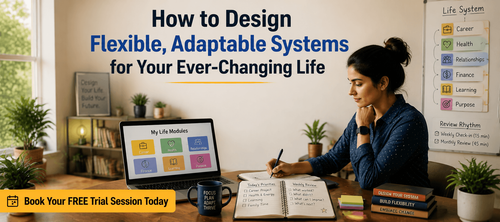

How to Design a Modular Life System for Maximum Flexibility and Adaptability
In today's fast-paced world, the ability to adapt and remain flexible in the face of ever-changing circumstances is a crucial skill for career success. Whether you're switching careers, managing a busy professional life, or balancing personal commitments, creating a personal operating system that allows you to navigate challenges with ease is essential. In this blog, we’ll explore how to build a modular life system that is adaptable, resilient, and capable of supporting long-term success.
Download these resources and apply them alongside your daily work for improved clarity, productivity, and professional growth. You can also book a free trial to gain expert guidance and enhance your communication, problem-solving, and decision-making skills. The materials are designed in a clear, structured format to help professionals learn efficiently and implement insights with confidence.
Who Is This Blog For?
Career changers looking to pivot into new roles or industries
Professionals with 3–15 years of experience navigating complex, evolving work environments
Consultants and managers trying to balance multiple high-priority projects
Individuals seeking to design a life that’s flexible and resilient to change
Time-poor professionals who want to create a reliable system for managing their work-life balance.
Why This Topic Matters Today?
The modern professional landscape is increasingly characterized by rapid change and complexity. Gone are the days when careers followed linear paths. Roles evolve, industries converge, and personal circumstances shift unexpectedly. In this environment, professionals must rely on systems that allow them to be adaptable without completely rebuilding their lives each time a change occurs. The modular life system framework is designed to do just that.
In the absence of a flexible system, many professionals find themselves constantly reacting to challenges, losing momentum, and experiencing burnout. The key to success today lies not in doing more but in designing a system that helps you do the right things at the right time with the least friction possible.
Core Concept or Framework Explained
The Modular Life System is based on three key principles: Decomposition, Interoperability, and Reconfigurability. These concepts help create a structure that allows each part of your life to function independently, yet seamlessly connect with the whole.
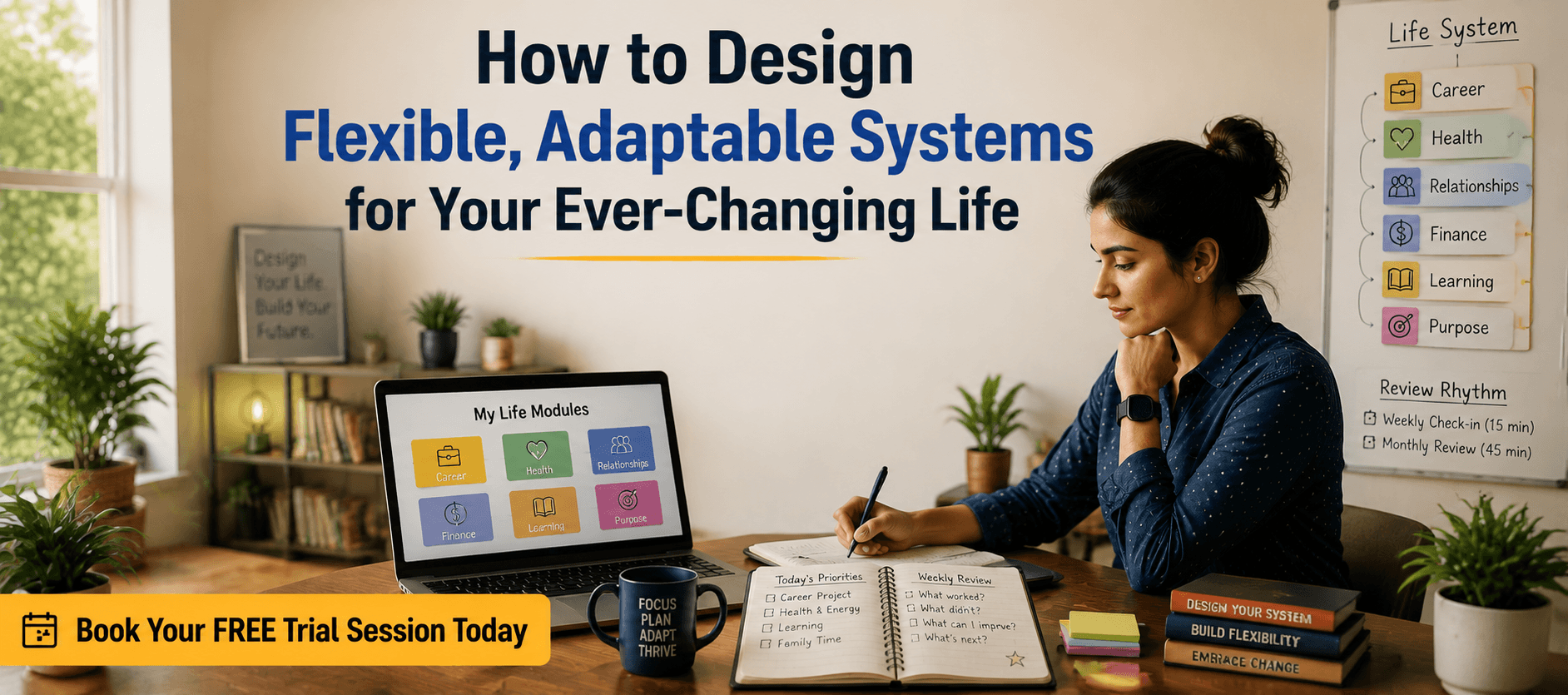
Decomposition: Break down your life into distinct domains—Career, Health, Relationships, Finance, Learning, and Purpose. Each domain operates with its own rhythm, rules, and review cadence.
Interoperability: Ensure that each domain interacts with others smoothly. For instance, a decision in your career module should have predictable impacts on your health or relationship modules.
Reconfigurability: Design your system so that each domain can be adjusted as needed, without disrupting the entire framework. This allows you to focus on specific areas of your life while keeping the others in maintenance mode.
How This Blog and Guidebook Help You?
This blog and the associated guidebook provide you with the tools to create your own adaptable system. By following the principles outlined, you can design a modular system that works for you—one that doesn’t just survive disruptions but thrives because of them. With a structured approach, you’ll gain clarity and control over how to manage competing priorities while adapting to new opportunities or challenges.
Step-by-Step Breakdown
Building your Modular Life System is a four-phase process. Each phase can be completed in a focused session of 30–60 minutes.
Phase 1: Audit Your Current Modules
Start by evaluating each of the six core modules—Career, Health, Relationships, Finance, Learning, and Purpose. For each module, assess your current state, desired state, and the gap between them. Rate your module's health on a scale from 1 to 10.
Phase 2: Set Mode & Priority
Assign each module one of three modes:
Active: You’re investing energy to grow this area.
Maintenance: You’re sustaining it with minimal effort.
Pause: You’re temporarily deprioritizing it.
Phase 3: Map the Interfaces
Identify how each module interacts with others. For example, a career project might affect your health, relationships, and learning. Mapping these interactions prevents negative cascading effects when decisions are made.
Phase 4: Activate Your Review Rhythm
Set a weekly 15-minute check-in and a monthly 45-minute full-system review. These non-negotiable calendar blocks ensure your system stays live and responsive.
Common Mistakes or Pitfalls to Avoid
Here are some common mistakes professionals make when designing their life systems:
Treating all modules as equally active: You can’t focus on everything at once. Limit yourself to a maximum of two active modules at any given time.
Skipping reviews during busy periods: A system without a review rhythm becomes stale. Make your weekly check-ins a priority, even when things get busy.
Designing for your ideal self: Your system should be based on what you can realistically maintain, even during challenging times. MVMs (Minimum Viable Modules) must be achievable even on your worst days.
How Should You Use This Guidebook Effectively?
To get the most out of this guidebook:
Start with the Module Audit Worksheet to identify where you are currently.
Set modes for each module and define your Minimum Viable Modules (MVMs) to ensure sustainability.
Incorporate a weekly and monthly review rhythm to keep the system calibrated.
Key Takeaways:
Flexibility is built, not inherited—create pre-defined responses for disruption.
Limit yourself to two active modules at once to avoid burnout.
The review rhythm is essential for maintaining an adaptable system.
MVMs should be realistic, not aspirational.
Major life transitions are opportunities for system redesign.
Start with the audit—everything else builds from there.
Your Next Step: Accelerate Your Career with PlanetSpark
Creating an impact-driven resume is not just about landing your next job—it’s about owning your professional story and presenting it with clarity, confidence, and credibility. When your resume clearly communicates value, results, and impact, opportunities follow naturally.
At PlanetSpark, we are committed to empowering working professionals with practical, outcome-focused resources that drive real career growth. From resume building and workplace communication to leadership presence and professional writing, our programs are designed to help you succeed in today’s fast-evolving job market.
Visit https://www.planetspark.in/resources
to explore:
Career and resume-building guides
Workplace communication and professional writing resources
Skill-development tools curated for working professionals.
Want a deeper, hands-on experience?
You can also book a free trial session to learn more about PlanetSpark’s Working Professional Courses, designed to accelerate your career through personalised coaching, real-world practice, and expert guidance.
Your career deserves more than generic advice.
It deserves clarity, confidence, and measurable impact.
Start building that advantage today—with PlanetSpark.
Personalized Communication Roadmaps
Record a video to get a AI generated personalized communication reports