
How to Develop System Thinking Skills for Life Optimization
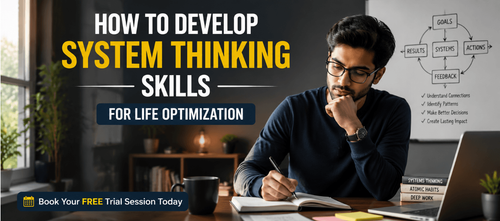

How to Strengthen Systems Thinking for Life Optimization: A Guide for Professionals
In the professional world, many problems are approached in isolation—fix the bug, close the deal, hit the deadline. However, life and work are interconnected systems, and solving problems in isolation rarely leads to long-term success. From your career trajectory to your health, relationships, and financial well-being, everything in your life is connected. Systems thinking is the discipline of seeing the whole picture—the interconnections, feedback loops, and hidden leverage points that determine why things happen the way they do.
This blog will help you build the skills necessary to adopt systems thinking in your personal and professional life, transforming the way you solve complex problems and make decisions. It’s about shifting your mindset to not just react to symptoms but to redesign the underlying systems that produce outcomes.
Download these resources and apply them alongside your daily work for improved clarity, productivity, and professional growth. You can also book a free trial to gain expert guidance and optimize your performance. The materials are designed in a clear, structured format to help professionals learn efficiently and implement insights with confidence.
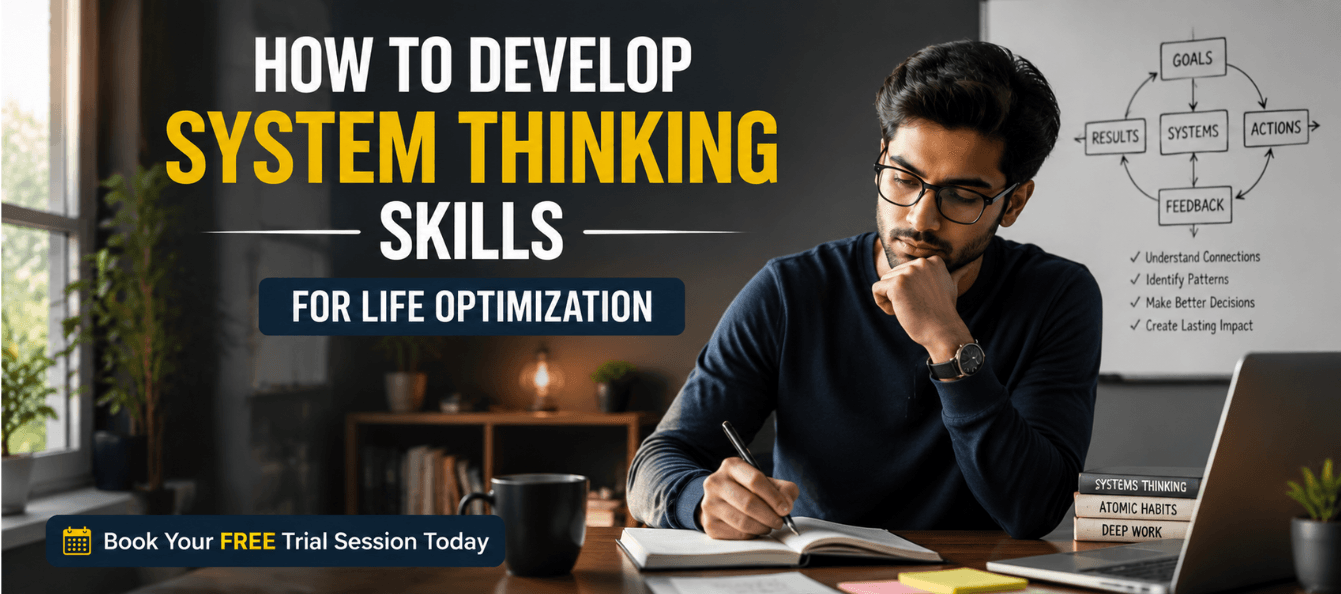
Who Is This Blog For?
This blog is for professionals who want to leverage systems thinking to solve complex problems and optimize their life. It’s especially useful for:
- Managers who need to improve team workflows and decision-making processes
- Consultants who are managing complex projects with interconnected elements
- Early to mid-career professionals who want to improve problem-solving and make smarter decisions
- Career changers looking to apply systems thinking in a new role or industry
Why This Topic Matters Today?
In today’s fast-paced world, most professionals are focused on short-term tasks and outcomes—meeting deadlines, sending emails, and checking off to-do lists. While all of these things are necessary, they often lead to a narrow view of the problems at hand. By applying systems thinking, you shift your perspective from isolated problems to holistic solutions that address root causes rather than symptoms.
Systems thinking isn’t just for engineers or strategists; it’s a powerful framework that anyone can use to improve their decision-making, problem-solving, and life design. By understanding how various elements in your life are interconnected, you can make smarter choices, achieve better outcomes, and create sustainable systems for long-term success.
Core Concept or Framework Explained
Systems thinking is the ability to understand how parts of a system are interconnected and how they influence one another. Instead of focusing on individual problems, systems thinking helps you see patterns, cycles, and cause-and-effect relationships that drive outcomes.
There are five key elements of any system:
1. Stocks: These are accumulated resources such as energy, reputation, savings, skills, and trust. Stocks change slowly and act as buffers.
2. Flows: These are the rates that change stocks, such as spending, learning, or relationship investment. Flows represent your daily actions and decisions.
3. Feedback Loops: These are mechanisms that govern how a system self-regulates. Feedback loops can be either reinforcing (amplifying) or balancing (stabilizing).
4. Delays: The time lag between cause and effect. Delays often cause impulsive decisions and overcorrections.
5. Leverage Points: These are the places where small changes produce a disproportionately large impact. Identifying leverage points is key to creating real, lasting change.
By learning to recognize these elements, you can make more informed decisions and optimize systems in your personal and professional life.
How This Blog and Guidebook Help You?
This guide will help you build a practical, actionable framework for applying systems thinking to optimize your life. The benefits include:
- Improved Problem-Solving: By understanding patterns and feedback loops, you’ll approach problems more strategically and make decisions with greater clarity.
- Better Decision-Making: Systems thinking enables you to make smarter decisions by focusing on root causes and leverage points rather than surface-level symptoms.
- Sustainable Life Design: Instead of relying on willpower or trial-and-error, you’ll have a proven system for designing and optimizing every area of your life.
- Increased Focus: Systems thinking reduces the cognitive load of decision-making, allowing you to focus on the highest-leverage tasks.
Step-by-Step Breakdown
Step 1: Map Your Current Life System
You can’t optimize a system you can’t see. The first step in developing systems thinking is to create an honest, visual map of how the major domains of your life are currently interconnected. Most people have never done this, and they’re consistently surprised by what they discover.
How to Map Your Life System:
- Identify Your Key Domains: Career, health, relationships, finances, learning, energy, and other personal domains.
- Draw Connections: Map how these domains feed into each other. Where are the bottlenecks? Which areas are quietly draining resources from everything else?
- Spot Drains: Look for “silent drainers”—areas that are consuming disproportionate resources without being obvious problems. Examples might include a long commute eating into your health or chronic overwork depleting the energy needed for strategic thinking.
Once you’ve mapped your system, you’ll have a clearer understanding of where your efforts are misaligned and where interventions are most needed.
Step 2: Identify Your Feedback Loops
Feedback loops are the engine of every system. They explain why some people get better and better over time, while others stay stuck in the same cycles year after year. Understanding your personal feedback loops is one of the most clarifying exercises in this guide.
There are two types of loops:
- Reinforcing Loops: These loops amplify whatever is already happening, for better or worse. A positive reinforcing loop might be: exercise → better sleep → more energy → higher productivity → more confidence → more exercise.
- Balancing Loops: These loops resist change and pull systems back toward equilibrium. For example, trying to improve something might trigger resistance from existing habits or energy limitations.
How to Map Your Feedback Loops:
- Identify loops that are amplifying either positive or negative patterns.
- Look for the most influential loops in your system.
- Identify leverage points within these loops where small changes can have a large impact.
Step 3: Recognize Delays and Stop Misreading Them
Delays are the most misunderstood element of systems thinking. A delay is the gap between when you take an action and when you see its effect. Most impulsive decisions and frustrations are delay problems in disguise.
Examples of Delay Problems:
- The Investment Trap: You put effort into a new initiative but see no results, so you stop before the delayed return appears.
- The Overcorrection Spiral: You react impulsively to delayed feedback, causing new problems in the opposite direction.
- The Accumulation Blindspot: You don’t notice gradual depletion (e.g., energy, time) until it hits a crisis point.
By recognizing delays, you can avoid the urge to overreact and make decisions with more patience and understanding.
Step 4: Find Your Leverage Points
In every system, a small number of changes produce a disproportionately large effect. These are leverage points, and identifying them is where systems thinking pays its biggest dividend. Leverage points often challenge conventional thinking and appear counterintuitive.
High-Leverage Moves:
- Change what you measure: Shift your focus to track behaviors and metrics that lead to the desired outcome.
- Change your environment: Modify your surroundings to encourage the behaviors you want without relying on discipline alone.
- Change your internal narrative: Challenge limiting beliefs that are holding you back and expand your perception of what's possible.
- Change the goal itself: Sometimes, the system struggles because the goal is misaligned or poorly defined.
Step 5: Design Feedback Mechanisms That Actually Work
Feedback is essential for continuous improvement. Tight, honest, and timely feedback loops allow you to adjust your system before small issues become major crises.
How to Design Feedback Loops:
- Weekly System Review: Spend 20 minutes every week reviewing your key life domains and rating them on a 1-5 scale. Look for trends and course-correct when necessary.
- Lead vs. Lag Indicators: Track behaviors (lead indicators) rather than just outcomes (lag indicators). This helps you make proactive adjustments before results appear.
- Environmental Feedback: Get external feedback from trusted people in different life domains to identify blind spots.
Step 6: Apply the SHIFT Framework for Life Design
The SHIFT framework is a five-stage process for auditing your current life system, identifying where it's working against you, and redesigning it with structure rather than willpower.
The SHIFT Framework:
1. See: Map your current life system honestly, without judgment.
2. Hypothesize: Identify the root structure causing current outcomes.
3. Intervene: Choose the highest-leverage intervention point.
4. Feed Back: Implement tight, honest feedback mechanisms.
5. Tune: Iterate and adjust your system regularly.
Key Takeaways
- Systems thinking helps you understand how the parts of your life are interconnected.
- Mapping your system reveals hidden problems that traditional problem-solving overlooks.
- Feedback loops and delays are key concepts that help you optimize your life more effectively.
- Leverage points are small changes that create big results, and they are often counterintuitive.
- The SHIFT framework gives you a structured process for redesigning your life.
Your Next Step: Accelerate Your Career with PlanetSpark
Creating an impact-driven resume is not just about landing your next job—it’s about owning your professional story and presenting it with clarity, confidence, and credibility. When your resume clearly communicates value, results, and impact, opportunities follow naturally.
At PlanetSpark, we are committed to empowering working professionals with practical, outcome-focused resources that drive real career growth. From resume building and workplace communication to leadership presence and professional writing, our programs are designed to help you succeed in today’s fast-evolving job market.
Visit https://www.planetspark.in/resources to explore:
- Career and resume-building guides
- Workplace communication and professional writing resources
- Skill-development tools curated for working professionals
Want a deeper, hands-on experience?
You can also book a free trial session to learn more about PlanetSpark’s Working Professional Courses, designed to accelerate your career through personalized coaching, real-world practice, and expert guidance.
Your career deserves more than generic advice.
It deserves clarity, confidence, and measurable impact.
Start building that advantage today—with PlanetSpark.
Personalized Communication Roadmaps
Record a video to get a AI generated personalized communication reports