
How to Evaluate Job Offers Using a Career Decision Framework

How to Evaluate Job Offers Objectively: The Job Decision Scoring Matrix Every Professional Needs
Most professionals don’t make career decisions—they react to them. A recruiter calls, a deadline looms, a salary bump looks attractive, and suddenly you’re choosing your next job based on instinct, urgency, or external pressure. The result? Roles that seem exciting today often lead to burnout, stagnation, or regret within a year.
The real issue isn’t lack of intelligence—it’s lack of structure. Job decisions are complex, emotional, and time-sensitive. Without a framework, even experienced professionals fall into bias-driven choices.
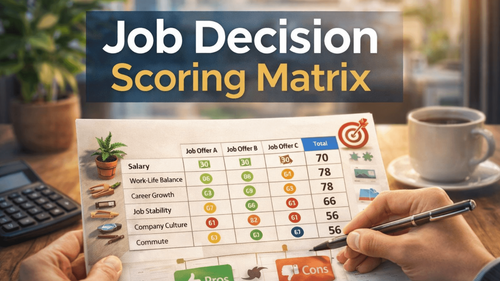
This is exactly where the Job Decision Scoring Matrix comes in. As outlined in the PlanetSpark career tool, this structured framework helps you evaluate opportunities objectively, assign priorities, and make confident, evidence-based career decisions—without second-guessing later.
Who Is This Blog For?
- Professionals evaluating multiple job offers
- Career switchers navigating high-stakes decisions
- Mid-level managers balancing growth, stability, and lifestyle
- Consultants and freelancers considering full-time roles
- Early-career professionals seeking clarity in their first major move
Why This Topic Matters Today?
Today’s job market is more dynamic—and more confusing—than ever. Professionals are juggling multiple offers, hybrid work options, startup vs corporate trade-offs, and global opportunities.
However, most decisions are still made using:
- Gut feeling or excitement
- Peer or family influence
- Short-term financial gain
- Fear of missing out
According to the framework outlined in the guide, this leads to poor alignment between expectations and reality, often resulting in dissatisfaction within 12–18 months.
The cost is not just professional—it’s:
- Financial instability
- Loss of confidence
- Burnout
- Delayed career growth
A structured evaluation system is no longer optional—it’s a necessity.
Core Concept or Framework Explained
The Job Decision Scoring Matrix is a weighted decision-making framework designed to remove emotional bias and replace it with structured clarity.
At its core, the framework works on three principles:
- Define what truly matters to you
- Assign importance (weights) to each factor
- Score each job objectively based on evidence
Instead of asking “Do I like this job?”, you ask:
“How well does this job align with my priorities?”
The matrix transforms subjective decision-making into measurable evaluation. It does not eliminate intuition—it strengthens it with data.
The framework ensures that:
- Your values drive your decision
- External pressure does not override priorities
- Every opportunity is evaluated consistently
How This Blog and Guidebook Help You?
By applying this framework, you gain:
- Clarity on what truly matters in your career
- Confidence in making high-stakes decisions
- A repeatable system for every job opportunity
- Reduced anxiety and second-guessing
- Better long-term career alignment
Instead of reacting emotionally, you begin to operate strategically.
Step-by-Step Breakdown
Step 1: Define What Actually Matters to You
Before evaluating any job, you must define your criteria. This is the most critical—and most ignored—step.
The guide identifies six foundational categories:
- Compensation and benefits
- Growth and learning
- Culture and people
- Work-life integration
- Company stability
- Mission and meaning
Each category represents a dimension of career satisfaction.
For example:
- Compensation includes salary, bonuses, and benefits
- Growth includes mentorship, learning opportunities, and career trajectory
- Culture reflects team dynamics and psychological safety
The key rule is to limit your criteria to 5–8 factors. Too many criteria dilute decision-making. Too few oversimplify it.
Most importantly, these criteria must reflect your reality—not societal expectations or peer influence.
Step 2: Assign Weights Because Not Everything Matters Equally
Once your criteria are defined, you assign weights to each—expressed as percentages that total 100.
This step forces honesty.
For instance:
- Early-career professionals may prioritise growth (25–35%)
- Mid-career professionals may prioritise compensation and stability
- Senior professionals may prioritise meaning and autonomy
The weighting process makes trade-offs explicit.
Common mistakes to avoid:
- Giving equal weight to all criteria
- Changing weights after seeing an offer
- Prioritising what “sounds good” rather than what matters
The guide emphasises a critical rule:
Weights must be set before evaluating any job.
Step 3: Score Each Opportunity Honestly
Now you evaluate each job against your criteria using a score from 1 to 10.
But here’s the key:
Scores must be based on evidence—not assumptions.
Sources of evidence include:
- Interview interactions
- Employee reviews
- Company research
- Offer letter details
- Conversations with insiders
Score interpretation:
- 1–3: Poor fit (red zone)
- 4–6: Acceptable but average (amber zone)
- 7–8: Strong alignment (green zone)
- 9–10: Exceptional (rare and meaningful)
A critical insight from the guide:
If you lack information to score confidently, that itself is a signal.
Step 4: Calculate Your Weighted Score
This is where the framework becomes powerful.
You multiply each score by its weight and sum the results to get a total score out of 100.
This number represents how well the job aligns with your priorities.
Score interpretation:
- Below 55: Weak fit
- 55–69: Conditional fit
- 70–79: Strong fit
- 80+: Exceptional fit
What makes this step valuable is not just the number—but the insight.
Often, professionals discover that:
- The “exciting” job scores lower
- The “safe” job scores higher
This gap reveals hidden biases and misaligned priorities.
Step 5: Use the Worksheet and Gut Check Questions
The framework includes a structured worksheet divided into three parts:
- Criteria and weights
- Scoring and calculations
- Reflection questions
The reflection questions are crucial because they address emotional factors.
Examples include:
- Does the score feel right?
- Am I influenced by fear or external pressure?
- What would success look like one year from now?
- Would I feel relief or disappointment if the offer disappeared?
These questions ensure that logic and intuition work together.
Common Mistakes or Pitfalls to Avoid
Changing Weights After Seeing the Offer
This is the most common error. It turns the framework into a justification tool instead of a decision tool.
Scoring Based on Potential Instead of Evidence
Hope is not a metric. Always score based on verified information.
Using the Matrix to Confirm a Pre-Made Decision
If every score supports your preferred choice, your evaluation is biased.
Ignoring Dealbreakers
Some factors are non-negotiable. These must be treated as veto criteria, not averaged into the score.
Using Too Many Criteria
More criteria reduce clarity. Limit your list to essential factors.
Skipping Reflection Questions
Numbers alone cannot capture emotional truth. Reflection is essential.
Not Revisiting Decisions
A post-decision review after 6 months helps refine future decisions.
How Should You Use This Guidebook Effectively?
To maximise the value of this framework:
- Step 1: Read the full guide once to understand the structure
- Step 2: Define your criteria and weights before any job offer
- Step 3: Use the worksheet for every opportunity
- Step 4: Spend 20–30 minutes per evaluation
- Step 5: Complete the reflection questions honestly
- Step 6: Compare multiple offers using the same framework
Best practice workflow:
- Create a digital template of the worksheet
- Save one copy per job opportunity
- Avoid external opinions until after scoring
Time investment is minimal—but the impact is significant.
Key Takeaways
- Job decisions fail when driven by emotion instead of structure
- Defining criteria before offers ensures clarity under pressure
- Weighting forces honest prioritisation
- Scoring must be evidence-based, not assumption-driven
- Weighted totals reveal true alignment with your priorities
- Reflection questions bridge logic and intuition
- Dealbreakers must be treated separately from scores
- Consistency across opportunities leads to better decisions
- Revisiting decisions improves long-term career judgment
Your Next Step: Accelerate Your Career with PlanetSpark
Creating an impact-driven resume is not just about landing your next job—it’s about owning your professional story and presenting it with clarity, confidence, and credibility. When your resume clearly communicates value, results, and impact, opportunities follow naturally.
At PlanetSpark, we are committed to empowering working professionals with practical, outcome-focused resources that drive real career growth. From resume building and workplace communication to leadership presence and professional writing, our programs are designed to help you succeed in today’s fast-evolving job market.
Visit https://www.planetspark.in/resources to explore:
- Career and resume-building guides
- Workplace communication and professional writing resources
- Skill-development tools curated for working professionals
Want a deeper, hands-on experience?
You can also book a free trial session to learn more about PlanetSpark’s Working Professional Courses, designed to accelerate your career through personalised coaching, real-world practice, and expert guidance.
Your career deserves more than generic advice.
It deserves clarity, confidence, and measurable impact.
Personalized Communication Roadmaps
Record a video to get a AI generated personalized communication reports