
How to Explain Skill Relevance After Career Gaps
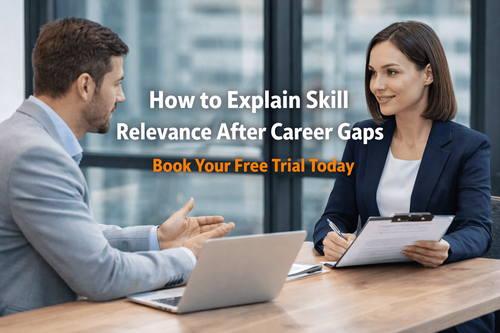

How to Communicate Skill Relevance After a Career Gap
Taking a career break—whether for family, health, personal growth, or transition—is more common than ever. Yet, when it comes to re-entering the workforce, many professionals face one persistent challenge: explaining their gap with confidence.
In interviews, networking conversations, or even on LinkedIn, the question often arises—“What were you doing during this time?” For many, this moment creates hesitation, self-doubt, and uncertainty. Not because they lack skills, but because they struggle to communicate their relevance effectively.
This is where a structured, strategic approach makes all the difference. This guide transforms your career gap from a perceived weakness into a powerful narrative—one that highlights your skills, growth, and readiness to contribute.
The first step in reframing your career break is shifting your mindset. Instead of viewing the gap as lost time, recognize it as a period of development—whether that meant managing responsibilities, learning new skills, or gaining clarity about your career direction. Employers today value adaptability, resilience, and real-world problem-solving. When you articulate your experience with intention, you demonstrate not just what you did, but how it strengthened your professional capabilities.
Next, focus on structuring your explanation with clarity and relevance. A strong narrative is concise, honest, and aligned with your career goals. Briefly state the reason for your break, highlight any productive activities or learnings during that time, and then confidently connect it back to the role you are pursuing. This approach reassures employers that your break was purposeful and that you are prepared to transition smoothly back into a professional environment.
Finally, consistency across platforms is key. Whether it’s your resume, LinkedIn profile, or interview responses, your story should be aligned and intentional. When your messaging is clear and confident, it eliminates doubt and builds trust. Over time, this consistency not only helps you navigate questions about your gap more effectively but also positions you as a self-aware and proactive professional—someone who takes ownership of their journey and is ready for the next opportunity.
Book your free trial session today with Planetspark.
Download for more details or PDF file.
Who Is This Blog For?
This blog and guide are designed
for:
- Professionals with 0–15 years of experience returning after a career gap
- Individuals transitioning to a new industry or role after time away
- Caregivers, freelancers, or entrepreneurs re-entering structured employment
- Mid-career professionals aiming to rebuild confidence and credibility
- Job seekers struggling to explain gaps during interviews or applications
Why This Topic Matters Today?
The professional world has evolved significantly in recent years. Career paths are no longer linear, and breaks are increasingly normalised. Research indicates that a large percentage of professionals have experienced some form of career gap, and hiring managers are becoming more open to non-traditional career journeys.
However, acceptance does not eliminate expectations. Employers still seek clarity, relevance, and confidence. They want to understand:
- Can you still perform effectively?
- Are your skills up to date?
- What value will you bring immediately?
The real challenge is not the gap itself—it is how you communicate it. Professionals who proactively address their gap and connect it to value are significantly more likely to succeed than those who avoid the conversation.
Core Concept or Framework Explained
At the heart of communicating skill relevance after a career gap lies one key idea: it is not a skills gap, it is a narrative gap.
Most professionals already possess valuable, transferable skills. These include communication, problem-solving, leadership, adaptability, and decision-making. These skills do not disappear during a break—they often strengthen.
The problem arises when these skills are not translated into a language employers understand.
To bridge this gap, the guide introduces three powerful frameworks:
- Skills Mapping Framework
Identify → Anchor → Quantify → Connect
This helps translate your experiences into clear, job-relevant skills.
- Gap Narrative Formula
A structured way to explain your career break confidently and professionally
- STAR+ Method
Situation → Task → Action → Result → Relevance
This ensures every example you share directly connects to the role you are targeting
Together, these frameworks help you transform your experience into a compelling professional story.
How This Blog and Guidebook Help You?
By applying the concepts in this guide, you will be able to:
- Identify valuable skills gained before, during, and after your career gap
- Translate non-traditional experiences into professional language
- Build a confident and structured narrative for interviews and networking
- Demonstrate relevance using clear examples and measurable outcomes
- Present a consistent professional story across resume, LinkedIn, and conversations
The result is not just clarity—it is confidence, credibility, and stronger career opportunities.
Step-by-Step Breakdown
Step 1: Audit Your Skills Honestly
The first step is a structured self-assessment of everything you have done across three phases: before the gap, during the gap, and while preparing to return.
Many professionals undervalue their experiences during a gap because they define “work” too narrowly. Activities like caregiving, freelancing, managing finances, or upskilling involve high-level competencies.
Start by listing:
- Activities and responsibilities during the gap
- Projects, courses, or freelance work completed
- Problems solved or systems managed
- Any form of leadership, coordination, or decision-making
Then map each activity to a skill. This exercise reveals that your gap period was far more productive than you assumed.
Step 2: Map Skills to Employer Language
Once you identify your skills, the next step is translating them into professional language.
Use this structured approach:
- Identify the skill clearly using industry-relevant terms
- Anchor it with a real example from your experience
- Quantify wherever possible using numbers or scale
- Connect it directly to the role you are targeting
For example, managing a household budget becomes financial planning and resource management when framed correctly.
Step 3: Build Your Gap Narrative
Your gap narrative is a short, structured explanation of your career break. It should be:
- Honest without over-explaining
- Purposeful and aligned with your goals
- Forward-looking and confident
A simple structure works best:
During a specific time period, you stepped away for a reason. During that time, you developed or maintained certain skills. Now, you are ready to apply those skills in a professional setting.
This approach shifts the focus from absence to value.
Step 4: Adapt Your Narrative for Different Situations
A single explanation is not enough. You need multiple versions of your narrative:
- 30-second version for networking conversations
- 2-minute version for interviews
- Written version for LinkedIn and cover letters
- Resume version as part of your professional timeline
Consistency across all formats builds trust and strengthens your personal brand.
Step 5: Use the STAR+ Method to Prove Your Skills
To demonstrate credibility, you need structured examples. The STAR+ method helps you do this effectively.
For every experience, explain:
- The situation and context
- Your responsibility
- The actions you took
- The results you achieved
- Why this example is relevant to the role
This final step—relevance—is what makes your answer impactful and memorable.
Step 6: Update Your Professional Presence
Your narrative must be reflected across all professional platforms.
For your resume:
- Use a hybrid format with a strong skills summary
- Clearly label your career gap with a professional title
- Highlight achievements and skills instead of focusing only on timelines
For LinkedIn:
- Write a narrative-driven summary
- Use the career break feature to add context
- Stay active by sharing insights or content
Consistency between your resume, LinkedIn, and communication builds credibility.
Step 7: Prepare for Tough Questions
Questions about your career gap are inevitable. The key is preparation.
Handle them with a structured approach:
- Acknowledge the gap honestly
- Share what you did during that time
- Highlight what you learned or achieved
- Reinforce your readiness to contribute
Confidence in delivery often matters more than the content itself.
Common Mistakes or Pitfalls to Avoid
Avoid these common errors that weaken your professional narrative:
- Starting conversations with apologies
- Leaving the gap unexplained on your resume
- Over-explaining personal details
- Assuming the gap has no value
- Using only outdated pre-gap examples
- Failing to practise responses aloud
- Waiting until interviews to address the gap
Correcting these mistakes can immediately improve how you are perceived.
How Should You Use This Guidebook Effectively?
To get the best results, follow a structured approach:
- Read the guide once to understand the full framework
- Complete the exercises step by step
- Build your narrative and practise it aloud
- Update your resume and LinkedIn simultaneously
- Allocate 30–60 minutes daily over 2–4 weeks
Consistency and application are key. The more you practise, the more natural and confident your communication becomes.
Key Takeaways
- A career gap is a narrative challenge, not a skills problem
- Transferable skills remain valuable and often grow during breaks
- Structured frameworks help translate experience into relevance
- Confidence comes from preparation and practice
- Consistency across platforms builds credibility
- Proactive communication is more effective than reactive explanation
- Every experience can be turned into a strong professional example
Your Next Step: Accelerate Your Career with PlanetSpark
Creating an impact-driven resume is not just about landing your next job—it’s about owning your professional story and presenting it with clarity, confidence, and credibility. When your resume clearly communicates value, results, and impact, opportunities follow naturally.
At PlanetSpark, we are committed to empowering working professionals with practical, outcome-focused resources that drive real career growth. From resume building and workplace communication to leadership presence and professional writing, our programs are designed to help you succeed in today’s fast-evolving job market.
Visit https://www.planetspark.in/resources to explore:
- Career and resume-building guides
- Workplace communication and professional writing resources
- Skill-development tools curated for working professionals
Want a deeper, hands-on experience?
You can also book a free trial session to learn more about PlanetSpark’s Working Professional Courses, designed to accelerate your career through personalised coaching, real-world practice, and expert guidance.
Your career deserves more than generic advice.
It deserves clarity, confidence, and measurable impact.
Start building that advantage today—with PlanetSpark
Personalized Communication Roadmaps
Record a video to get a AI generated personalized communication reports