
How to Handle Rapid-Fire Interview Questions- 2026 Guide

Mastering High-Pressure Interview Questions: A Practical Guide to Thinking Fast and Answering Confidently
Many professionals prepare thoroughly for interviews. They research the company, rehearse their career stories, and anticipate common questions. Yet when the interview actually begins and questions come rapidly one after another, many capable candidates struggle to respond clearly.
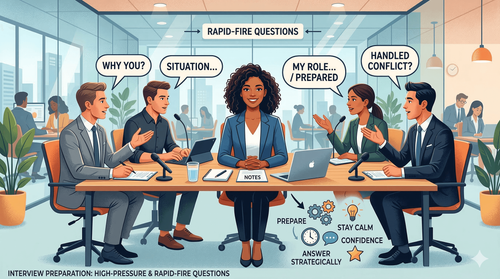
High-pressure and rapid-fire interviews create a completely different environment. Interviewers may interrupt, change direction suddenly, or ask multiple questions back-to-back. Under this kind of cognitive pressure, even well-prepared candidates can lose their structure, speak too quickly, or give incomplete answers.
This is not a problem of knowledge or competence. It is a performance problem.
The Interview Preparation for High-Pressure and Rapid-Fire Questions guidebook was designed to solve exactly this challenge. Instead of focusing only on what to say, it teaches professionals how to think quickly, organize their thoughts under pressure, and deliver clear answers even when the interview becomes intense.
By learning the frameworks and preparation strategies outlined in the guidebook, professionals can transform stressful interviews into opportunities to demonstrate clarity, confidence, and leadership.
Who Is This Blog For?
This guidebook and blog are designed for professionals who want to improve their interview performance when stakes are high.
- Job seekers preparing for competitive interviews
- Career changers transitioning into new industries or roles
- Consultants and professionals facing panel interviews
- Managers interviewing for leadership positions
- Early and mid-career professionals with 0 to 15 years of experience
- Candidates preparing for high-pressure or rapid-fire interview formats
- Professionals who struggle with thinking quickly under interview stress
If you have ever left an interview feeling that you knew the answer but could not express it clearly in the moment, this framework is particularly valuable.
Why This Topic Matters Today?
Modern interviews are evolving. Employers are no longer only evaluating experience and technical knowledge. They are increasingly testing how candidates think under pressure.
In many industries, interviews now include rapid questioning, follow-up probes, and unexpected shifts in topic. These techniques are designed to observe how candidates respond when they cannot rely on memorized answers.
Several factors make high-pressure interview preparation essential today.
- Time constraints during interviews often force candidates to respond quickly
- Interview panels may ask multiple questions in quick succession
- Stress responses can interfere with clear thinking and communication
- Ambiguous questions may require candidates to interpret intent before answering
Traditional interview preparation often fails because it focuses only on rehearsing specific answers. When the structure of the interview changes, those prepared scripts collapse.
The guidebook addresses this problem by helping professionals build a mental architecture for responding quickly and effectively in dynamic interview situations.
Core Concept or Framework Explained
The central idea of the guidebook is that interview performance is a trainable skill. Instead of memorizing responses, candidates should develop a structured approach that allows them to think clearly even under pressure.
Three core principles shape this approach.
First, candidates must manage cognitive load. When several questions arrive rapidly, the brain can become overwhelmed. Having a structured response framework reduces this mental load and makes it easier to organize thoughts quickly.
Second, candidates need a rapid response architecture. This is a repeatable mental structure that helps transform an unexpected question into a clear, logical answer.
Third, candidates benefit from building a personal answer library. Rather than memorizing entire responses, professionals develop a collection of stories, examples, and achievements that can be adapted to different questions.
When these three elements work together, candidates become more flexible and confident in interviews. Instead of reacting to each question from scratch, they retrieve structured responses from an organized mental system.
How This Blog and Guidebook Help You?
The strategies in the guidebook help professionals shift from reactive answering to deliberate communication.
By applying the frameworks provided, candidates can achieve several important outcomes.
- Respond clearly even when questions arrive quickly
- Maintain composure when interviewers interrupt or change topics
- Structure answers in a logical and persuasive way
- Demonstrate leadership and communication ability under pressure
- Avoid rambling or incomplete responses
- Present achievements with clarity and confidence
In practical terms, this means that candidates who previously struggled in fast-paced interviews can transform their performance. Instead of feeling overwhelmed, they become structured and composed.
This shift is often what separates candidates who simply know the material from those who demonstrate professional presence during interviews.
Step-by-Step Breakdown
Understanding the Nature of High-Pressure Interviews
The first step is recognizing that high-pressure interviews are intentionally designed to test performance under stress.
Interviewers may use techniques such as rapid-fire questioning, interruptions, or sudden changes in topic. These strategies reveal how candidates process information and communicate in demanding situations.
Candidates who expect a calm, sequential interview often become disoriented when this structure changes. Preparation should therefore simulate the real conditions of pressure and unpredictability.
Building a Rapid Response Framework
A key skill in high-pressure interviews is quickly structuring an answer.
Rather than responding immediately with unorganized thoughts, candidates benefit from mentally structuring their response in a clear sequence.
A simple structure might include:
- Brief context or situation
- The action taken
- The result or outcome
- A short insight or learning
This structure ensures that answers remain focused and meaningful even when delivered quickly.
With practice, this mental framework becomes automatic, allowing candidates to answer confidently even when questions come unexpectedly.
Developing a Personal Answer Library
One of the most powerful preparation strategies in the guidebook is building an answer library.
This library consists of professional stories and experiences that demonstrate key skills such as leadership, problem solving, collaboration, and decision making.
Instead of memorizing answers to specific questions, candidates identify versatile examples from their careers.
These examples can then be adapted to different types of questions.
For instance, a single project example might demonstrate:
- Leadership
- Conflict resolution
- Strategic thinking
- Collaboration
- Problem solving
By organizing these examples ahead of time, candidates can retrieve relevant stories quickly when interview questions arise.
Managing Cognitive Load During Rapid-Fire Questions
When several questions arrive at once, many candidates attempt to answer immediately. This often leads to confusion or incomplete responses.
The guidebook recommends slowing down slightly to organize thoughts before speaking.
Short pauses are not a weakness in interviews. They signal thoughtful communication.
Candidates can briefly acknowledge the question, mentally structure their response, and then deliver a clear answer.
This small shift dramatically improves clarity and confidence.
Using Clarification When Questions Are Ambiguous
High-pressure interviews sometimes include intentionally vague or complex questions.
Instead of guessing the interviewer’s intent, strong candidates clarify the question.
For example, candidates may briefly restate the question or confirm what aspect the interviewer would like them to address.
This ensures that the response is relevant and prevents miscommunication.
Practicing Under Realistic Conditions
Preparation should mirror the conditions of high-pressure interviews.
This means practicing with time limits, unexpected follow-up questions, and simulated rapid questioning.
Practice sessions may include:
- Mock interviews with rapid question sequences
- Recording answers to evaluate clarity and structure
- Practicing concise storytelling
- Rehearsing responses to ambiguous questions
Over time, these exercises train the brain to perform effectively even when stress increases.
Reflecting and Improving After Practice
Effective preparation includes reflection.
After each practice session, candidates should evaluate their performance.
Questions for reflection might include:
- Did the answers follow a clear structure?
- Were responses concise and relevant?
- Did stress affect clarity or pacing?
- Which examples were most effective?
This reflection process helps candidates refine their answer library and communication style.
Common Mistakes or Pitfalls to Avoid
Many professionals unknowingly weaken their interview performance through avoidable mistakes.
Some of the most common pitfalls include:
- Memorizing answers instead of developing adaptable examples
- Speaking too quickly under pressure
- Rambling without a clear structure
- Providing overly brief responses that lack context
- Failing to pause and organize thoughts before answering
- Ignoring the intent behind complex or ambiguous questions
These mistakes often occur because candidates focus only on content preparation rather than performance preparation.
The guidebook encourages candidates to practice the delivery process as seriously as they practice their answers.
How Should You Use This Guidebook Effectively?
To gain the most value from the guidebook, professionals should approach it as a practical training resource rather than passive reading material.
A recommended workflow includes:
- First reading the guidebook to understand the overall framework
- Identifying personal career examples for the answer library
- Completing the worksheets and templates provided
- Practicing structured responses using mock interview scenarios
- Reviewing performance and refining answers regularly
Candidates may initially spend 60 to 90 minutes building their answer library and structuring examples.
After this foundation is created, short practice sessions can reinforce the framework before interviews.
The guidebook is designed to be reused repeatedly as professionals prepare for new roles or more advanced positions.
Key Takeaways
- High-pressure interviews test performance under stress rather than memorized answers
- Traditional preparation often fails because it does not simulate cognitive pressure
- A structured response framework helps organize thoughts quickly
- Building a personal answer library improves flexibility during interviews
- Short pauses and clarification improve clarity and confidence
- Practicing under realistic conditions strengthens interview performance
- Reflection and refinement are essential for continuous improvement
Your Next Step: Accelerate Your Career with PlanetSpark
Creating an impact-driven resume is not just about landing your next job—it’s about owning your professional story and presenting it with clarity, confidence, and credibility. When your resume clearly communicates value, results, and impact, opportunities follow naturally.
At PlanetSpark, we are committed to empowering working professionals with practical, outcome-focused resources that drive real career growth. From resume building and workplace communication to leadership presence and professional writing, our programs are designed to help you succeed in today’s fast-evolving job market.
Visit https://www.planetspark.in/resources to explore:
- Career and resume-building guides
- Workplace communication and professional writing resources
- Skill-development tools curated for working professionals
Want a deeper, hands-on experience?
You can also book a free trial session to learn more about PlanetSpark’s Working Professional Courses, designed to accelerate your career through personalised coaching, real-world practice, and expert guidance.
Your career deserves more than generic advice.
It deserves clarity, confidence, and measurable impact.
Personalized Communication Roadmaps
Record a video to get a AI generated personalized communication reports