
How to Highlight Cross-Functional Collaboration in Cover Letters
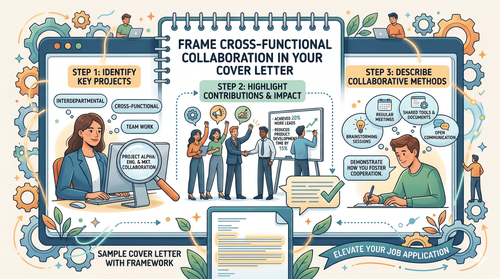

How to Frame Cross-Functional Collaboration in Your Cover Letter: A Guide for Career Growth
As the job market becomes more competitive, hiring managers are increasingly focused on one key trait: the ability to collaborate across functions. Whether you're pivoting industries, stepping into management, or positioning yourself as a strategic consultant, the skill of cross-functional collaboration sets you apart. However, many candidates fail to showcase this crucial ability effectively in their cover letters, often leading to missed opportunities.
This guidebook is designed to close the gap and help you position your cross-functional experience with clarity and confidence, giving you a competitive edge.
Who Is This Blog For?
- Career changers looking to leverage their cross-functional experience
- Managers and consultants who need to demonstrate leadership in collaborative settings
- Early to mid-career professionals seeking to highlight their team-working capabilities
- Anyone looking to effectively communicate their ability to work across departments and drive business outcomes
Why This Topic Matters Today?
Cross-functional collaboration is one of the most sought-after skills in today's job market, yet it remains poorly communicated by candidates. Many cover letters fail to highlight how candidates drive outcomes through collaboration across departments. By strategically framing your collaborative experiences, you can showcase your leadership potential and strategic thinking. Hiring managers are looking for more than just team players; they want professionals who can manage complexity, influence stakeholders, and produce measurable results.
Core Concept or Framework Explained
The core concept of this guidebook is to help you articulate cross-functional collaboration in a way that resonates with hiring managers. The key lies in framing your role and the impact of your collaboration. You should move beyond generic terms like "team player" and instead focus on the specific outcomes you achieved by working across functions.
The CCAR Framework—Context, Challenge, Action, Result—provides the ideal structure to present your collaboration story. By using this framework, you can clearly show what the business challenge was, how you contributed, and the measurable results of your work.
How This Blog and Guidebook Help You
This blog and guidebook provide you with a step-by-step process for drafting a compelling collaboration story. It includes:
- A structured framework to frame your collaborative experiences
- Examples and templates to help you articulate your role and impact
- Common mistakes to avoid when writing about collaboration
By following the steps outlined, you can ensure your cover letter clearly communicates the value of your cross-functional experience, making you a more compelling candidate.
Step-by-Step Breakdown
Step 1: Audit Your Collaboration Inventory
Start by reflecting on your past experiences and identifying key projects where you collaborated across different functions. Look for specific examples, and focus on your contributions rather than just team achievements.
Step 2: Choose the Right Story
Select the most relevant and impactful collaboration example. Ensure it aligns with the target role’s requirements, demonstrates complexity, and includes measurable results.
Step 3: Apply the CCAR Framework
Structure your story using the CCAR framework:
- Context: What was the business challenge or goal?
- Challenge: What made the collaboration difficult?
- Action: What steps did you take to drive collaboration and solve the problem?
- Result: What measurable outcome did you achieve?
Step 4: Use High-Signal Collaboration Language
Avoid generic phrases like "helped with" or "worked alongside." Instead, use high-impact verbs such as "orchestrated," "synthesized," and "aligned" to clearly demonstrate your leadership and contributions.
Step 5: Draft and Position Your Collaboration Paragraph
Place your collaboration story in the second paragraph of your cover letter to ensure maximum impact. Keep it concise, focused on outcomes, and framed using the CCAR structure.
Common Mistakes or Pitfalls to Avoid
- Mistake 1: The Generic Team Player Statement
Replace vague statements like "I am a team player" with specific examples of your cross-functional achievements.
- Mistake 2: Listing Functions Without Showing Difficulty
Simply listing departments you've worked with doesn't convey the complexity of collaboration. Show how you overcame challenges like conflicting priorities.
- Mistake 3: Claiming Group Credit for Individual Action
Focus on your personal contributions. Hiring managers want to know what you specifically did to drive the collaboration.
- Mistake 4: Omitting the Business Context
Always connect your collaboration efforts to the business goal or challenge. Show how your actions impacted the organization.
- Mistake 5: No Bridge to the Target Role
Close your collaboration story by connecting it to the specific needs of the role you're applying for.
How Should You Use This Guidebook Effectively?
To maximize the effectiveness of this guidebook, follow each step sequentially. Take time to reflect on your experiences, choose the most relevant story, and use the CCAR framework to draft a strong collaboration narrative. Once you’ve completed your draft, use the language bank to elevate your language and avoid weak phrasing.
Revisit this guide whenever you’re drafting a new cover letter or applying to a different role, as the principles remain consistent across industries.
Key Takeaways
- Ownership & Contribution: Always frame your collaboration as an active contribution, not passive participation.
- Quantify Impact: Use numbers and measurable results to validate the outcomes of your collaboration.
- Integration & Results: Focus on how you integrated teams and drove results across functions.
Your Next Step: Accelerate Your Career with PlanetSpark
Creating an impact-driven resume is not just about landing your next job—it’s about owning your professional story and presenting it with clarity, confidence, and credibility. When your resume clearly communicates value, results, and impact, opportunities follow naturally.
At PlanetSpark, we are committed to empowering working professionals with practical, outcome-focused resources that drive real career growth. From resume building and workplace communication to leadership presence and professional writing, our programs are designed to help you succeed in today’s fast-evolving job market.
Visit https://www.planetspark.in/resources to explore:
- Career and resume-building guides
- Workplace communication and professional writing resources
- Skill-development tools curated for working professionals
Want a deeper, hands-on experience?
You can also book a free trial session to learn more about PlanetSpark’s Working Professional Courses, designed to accelerate your career through personalised coaching, real-world practice, and expert guidance.
Your career deserves more than generic advice.
It deserves clarity, confidence, and measurable impact.
Personalized Communication Roadmaps
Record a video to get a AI generated personalized communication reports