
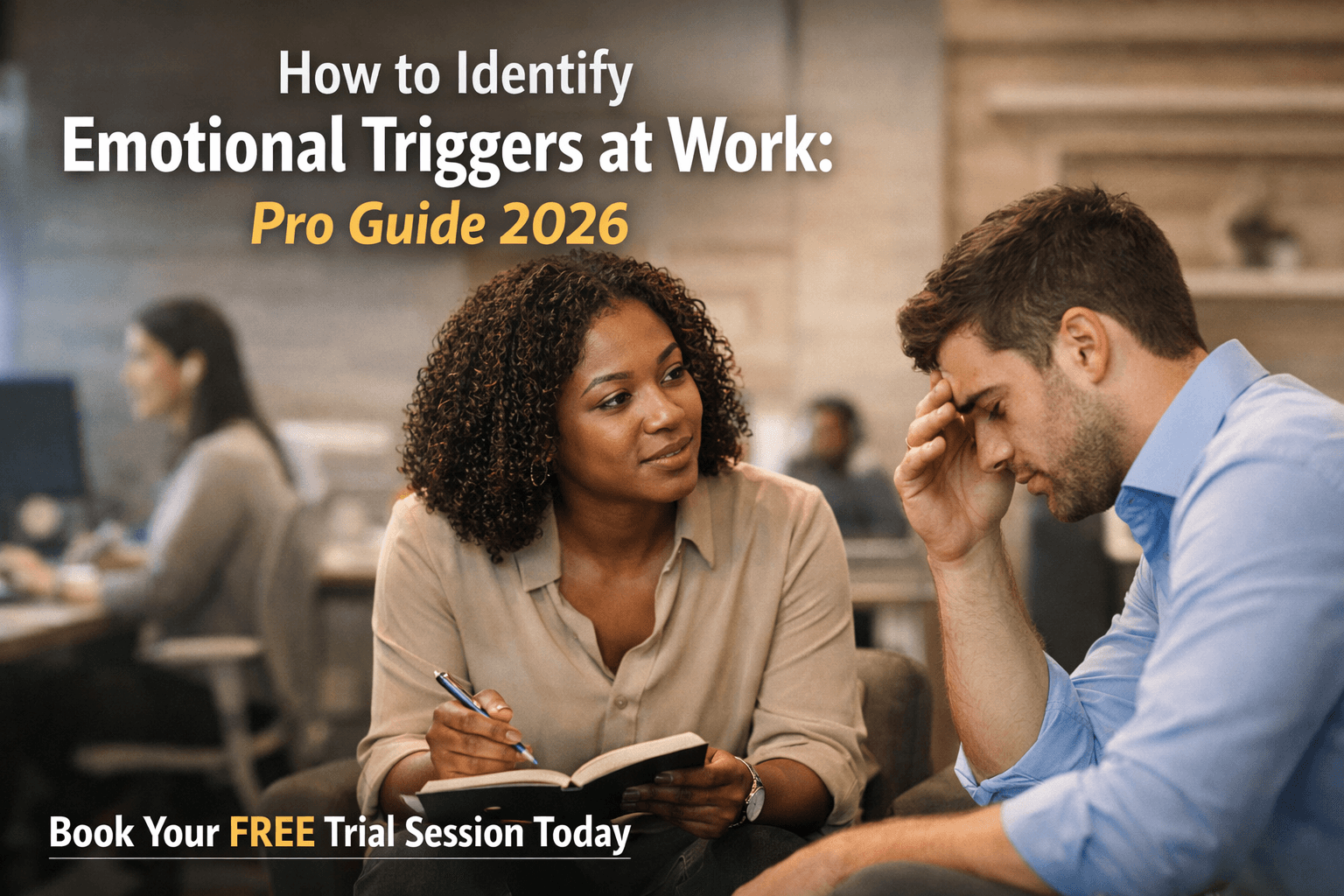
How to Identify Emotional Triggers at Work: Pro Guide 2026


Stay Calm, Stay in Control: A Practical Guide to Managing Emotional Responses at Work
You are in a meeting. A
colleague dismisses your idea. Your manager gives unclear feedback. A deadline suddenly shifts. In seconds, your body reacts—your heart races, your jaw tightens, and your thoughts spiral. You may stay silent and resentful or respond in a way you later regret.
This is not a lack of professionalism. It is an emotional trigger in action.
Most working professionals experience these moments regularly but never pause to understand them. As a result, reactions become patterns, patterns shape behaviour, and behaviour begins to impact reputation, relationships, and growth. The real challenge is not the trigger itself—it is the lack of awareness and strategy to manage it.
This is exactly where a structured approach like the Workplace Emotional Triggers Identification Worksheet becomes powerful. It helps you move from reactive behaviour to intentional response by identifying patterns, decoding root causes, and building a personalised action plan.
When you begin to consciously map your triggers, something important shifts. You stop seeing these moments as random or unavoidable. Instead, you start recognizing predictable situations—specific people, environments, or communication styles—that consistently activate a reaction. This awareness creates a pause, and in that pause lies your power to choose differently.
Over time, this process strengthens emotional intelligence in a practical, visible way. You become more composed in difficult conversations, clearer in your communication, and more intentional in your responses. Rather than being controlled by the moment, you start leading yourself through it.
In a professional environment where perception, collaboration, and decision-making matter deeply, this shift is not just personal—it is strategic. Managing emotional triggers effectively can enhance your credibility, improve stakeholder relationships, and position you as someone who brings stability and clarity under pressure.
Download these resources and apply them alongside your daily work for improved clarity, productivity, and professional growth. You can also book a free trial to gain expert guidance and enhance your communication, problem-solving, and decision-making skills. The materials are designed in a clear, structured format to help professionals learn efficiently and implement insights with confidence.
Who Is This Blog For?
- Working professionals dealing with stress, conflict, or workplace pressure
- Managers and leaders aiming to improve emotional intelligence
- Individuals who feel reactive in meetings or difficult conversations
- Professionals seeking better control over communication and behaviour
- Anyone committed to long-term career growth and self-awareness
Why This Topic Matters Today?
In today’s workplace, technical skills alone are no longer enough. Emotional intelligence has become a critical differentiator.
As highlighted in the worksheet, emotional triggers directly impact:
- Professional reputation during high-pressure situations
- Quality of workplace relationships
- Decision-making and communication clarity
- Leadership perception and growth opportunities
Many professionals unknowingly damage their credibility not because of lack of skill, but because of unmanaged reactions. A single triggered response in a meeting can overshadow consistent performance.
Understanding and managing emotional triggers is no longer optional—it is a core professional skill.
Core Concept or Framework Explained
At the heart of this guide is a powerful idea: emotional triggers are not weaknesses—they are signals.
The worksheet explains that triggers typically originate from three core sources:
Values-Based Triggers
These occur when something violates what you deeply care about, such as respect, fairness, or autonomy.
Example: Feeling frustrated when micromanaged because you value independence.
Identity-Based Triggers
These activate when your sense of self is threatened.
Example: Feeling defensive during public criticism because it challenges your competence.
Pattern-Based Triggers
These stem from past experiences repeating in current situations.
Example: Reacting strongly to authority figures due to past negative experiences.
Understanding these categories helps shift your mindset from “Why is this happening to me?” to “What is this telling me about myself?”
How This Blog and Guidebook Help You?
This blog and the worksheet together provide:
- A structured method to identify emotional triggers
- A framework to analyse reactions and patterns
- Practical tools to manage responses in real-time
- Long-term strategies to build emotional control
The outcome is not just awareness—it is transformation. You move from reacting impulsively to responding strategically, which directly improves your professional image and effectiveness.
Step-by-Step Breakdown
Step 1: Build Your Emotional Trigger Inventory Start by identifying real situations where you felt triggered. According to the worksheet , this involves documenting:
- The situation or event
- Your emotional reaction
- Physical sensations such as tension or rapid heartbeat
- Your behaviour after the trigger
For example:
A manager dismisses your idea → You feel anger → Your face flushes → You withdraw from the meeting
This step builds raw awareness.
Step 2: Identify Your Trigger Patterns
Once you document multiple incidents, patterns begin to emerge.
Common workplace triggers include:
- Being ignored or talked over
- Receiving unclear feedback
- Experiencing unfair credit distribution
- Feeling excluded from decisions
- Being micromanaged
The goal is to identify 3–5 recurring themes that consistently trigger you.
Step 3: Decode the Root Cause
This is the most transformative step.
Each trigger must be analysed through three lenses:
- What value is being violated?
- What identity fear is being activated?
- What past experience might be influencing this reaction?
For example:
Being interrupted → Value: respect → Fear: “I am not valued” → Origin: past experiences of not being heard
This step moves you from reaction to understanding.
Step 4: Map Your Response Pattern
The worksheet identifies three default response styles:
Fight
- Arguing, interrupting, or becoming defensive
Flight
- Avoiding, withdrawing, or disengaging
Freeze
- Going silent, feeling stuck, or complying
Recognising your default pattern is critical because it reveals how you behave under pressure.
Step 5: Build Your Trigger Management Plan
Awareness without action does not create change.
A strong plan includes:
- In-the-moment strategy
Example: pause, breathe, or step away
- Regulation practice
Example: journaling, exercise, or mindfulness
- Communication approach
Example:
When this happens, I feel this, and I would like this
This structured approach ensures you respond with intention rather than emotion.
Step 6: Apply the 5-Day Awareness Challenge
The worksheet introduces a practical challenge:
- Day 1: Identify one emotional reaction
- Day 2: Notice physical signals
- Day 3: Trace the root cause
- Day 4: Apply a strategy
- Day 5: Reflect and commit
This converts knowledge into habit.
Step 7: Use the STOP Framework in Real-Time
A quick-response system from the worksheet:
- Stop
- Breathe
- Name the emotion
- Decode the trigger
- Choose your response
This simple process helps you regain control in critical moments.
Common Mistakes or Pitfalls to Avoid
Many professionals struggle because of these common mistakes:
- Over-analysing without changing behaviour
- Blaming others instead of focusing on their response
- Expecting immediate transformation
- Suppressing emotions instead of regulating them
A better approach is to:
- Combine awareness with action
- Focus on controllable responses
- Practice consistently
- Allow emotions but manage behaviour
How Should You Use This Guidebook Effectively?
To maximise results:
- First read the entire worksheet for context
- Then actively fill in each section honestly
- Revisit your trigger profile after difficult situations
- Conduct monthly reviews to track progress
Time investment:
- Initial setup: 30–45 minutes
- Daily reflection: 3–5 minutes
- Monthly review: 15–20 minutes
Consistency over time leads to measurable improvement in emotional control.
Key Takeaways
- Emotional triggers are signals, not weaknesses
- Most triggers fall into predictable patterns
- Understanding the root cause reduces emotional intensity
- Fight, flight, and freeze responses can be changed
- A structured plan is more effective than willpower
- Daily awareness builds long-term emotional intelligence
- Consistency is the key to transformation
Your Next Step: Accelerate Your Career with PlanetSpark
Creating an impact-driven resume is not just about landing your next job—it’s about owning your professional story and presenting it with clarity, confidence, and credibility. When your resume clearly communicates value, results, and impact, opportunities follow naturally.
At PlanetSpark, we are committed to empowering working professionals with practical, outcome-focused resources that drive real career growth. From resume building and workplace communication to leadership presence and professional writing, our programs are designed to help you succeed in today’s fast-evolving job market.
Visit https://www.planetspark.in/resources to explore:
- Career and resume-building guides
- Workplace communication and professional writing resources
- Skill-development tools curated for working professionals
Want a deeper, hands-on experience?
You can also book a free trial session to learn more about PlanetSpark’s Working Professional Courses, designed to accelerate your career through personalised coaching, real-world practice, and expert guidance.
Your career deserves more than generic advice.
It deserves clarity, confidence, and measurable impact.
Start building that advantage today—with PlanetSpark.
Personalized Communication Roadmaps
Record a video to get a AI generated personalized communication reports