
How to Identify strategic roles that match your experience
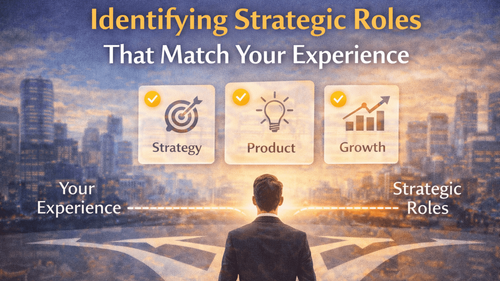

Strategic Role Mapping: How to Identify the Right Career Opportunities and Accelerate Your Growth
Most professionals approach job searching the same way.
They scroll endlessly, apply to multiple roles, tweak their resumes slightly, and hope something works.
But here is the harsh reality: this reactive approach rarely leads to meaningful career growth.
Instead, it leads to mismatched roles, frustrating interviews, and slow progress.
The real problem is not effort. It is lack of strategy.
In today’s dynamic job market—where roles evolve rapidly and skills transfer across industries—success belongs to professionals who move with clarity and intention.
This is where Strategic Role Mapping changes everything.
Instead of chasing opportunities, you identify and pursue roles that are already aligned with your strengths, experience, and long-term goals.
This guide shows you how to do exactly that.
Who Is This Blog For?
This blog and guidebook are designed for professionals ready to take control of their career trajectory.
- Working professionals with 0–15 years of experience seeking faster growth
- Career changers exploring new industries or functions
- Consultants and specialists aiming to reposition their expertise
- Mid-career professionals targeting strategic or leadership roles
- Job seekers frustrated with low response rates despite strong profiles
Why This Topic Matters Today?
The modern job market is more complex than ever.
Job titles are no longer fixed. Industries overlap. Skills are transferable across functions in ways that did not exist before.
Yet most professionals still define themselves by their last job title.
This creates a major limitation.
When you think in titles, you see fewer opportunities.
When you think in capabilities, the market expands dramatically.
Employers today are not hiring based on titles alone. They are hiring for:
- Problem-solving ability
- Cross-functional thinking
- Strategic impact
Without a structured approach, professionals:
- Apply to roles that are not aligned
- Miss high-fit opportunities in adjacent domains
- Waste time on low-probability applications
Strategic Role Mapping solves this by helping you focus only on roles where your value is strongest and most relevant.
Core Concept or Framework Explained
At the heart of this guide is a powerful mindset shift:
Your career is not a sequence of job titles. It is a portfolio of high-value capabilities.
Strategic Role Mapping is built on a structured framework that includes:
- Auditing your experience assets
- Defining your Career Positioning Statement
- Mapping roles to your asset profile
- Decoding job descriptions strategically
- Assessing transferability across industries
- Building a focused role shortlist.
This framework allows you to move from reactive job searching to deliberate career design.
Instead of asking “What jobs can I apply to?” you start asking:
“Where does my experience create the most value?”
How This Blog and Guidebook Help You?
By applying this framework, you gain clarity, direction, and confidence in your job search.
You will be able to:
- Identify your strongest, most transferable capabilities
- Target roles that align with your strengths and aspirations
- Evaluate opportunities quickly and accurately
- Reduce wasted effort on low-fit applications
- Position yourself as a high-value candidate
This approach does not just improve your job search. It transforms how you think about your career.
Step-by-Step Breakdown
Step 1: Audit Your Experience as Strategic Assets
Your experience is more than a list of roles. It is a collection of assets that create value.
Start by identifying:
- Hard skills such as data analysis, financial modelling, or product strategy
- Soft skills demonstrated in real contexts like stakeholder management or leadership
- Domain knowledge including industry expertise or market understanding
- Outcome patterns such as cost reduction, growth, or process optimisation
Focus on patterns that appear consistently across your career.
These recurring strengths are your core differentiators.
Step 2: Define Your Career Positioning Statement
Your Career Positioning Statement acts as your internal compass.
It clearly defines:
- Who you help
- What outcome you deliver
- How you deliver it
The structure is simple:“I help [type of organisation] achieve [specific outcome] by applying my expertise in [core assets].”
This statement allows you to quickly evaluate whether a role aligns with your strengths and goals.
Step 3: Map Roles to Your Asset Profile
Instead of searching by job title, focus on alignment.
Compare your top assets with the core requirements of roles across different function families such as:
- Business strategy
- Operations
- Product and delivery
- Growth and revenue
- People and organisational development
When your assets match the core requirements, you have a high-fit role—even if the title is different from your current one
Step 4: Decode Job Descriptions Strategically
Most candidates read job descriptions superficially.
Strategic professionals go deeper.
Every job description has three layers:
- Requirements such as skills and qualifications
- Organisational signals such as company stage or culture
- Success profile including expected outcomes and KPIs
Look for alignment between:
- Your top assets and key requirements
- Your Career Positioning Statement and the role’s objectives
Also watch for signals:
Green flags
- Your strengths appear early in the description
- Outcomes match your expertise
- The role has clear impact and ownership
Red flags
- Too many unrelated requirements
- Lack of clarity in outcomes
- Heavy reliance on skills you do not possess
This helps you invest your time where it matters most.
Step 5: Assess Transferability Across Industries
Many professionals hesitate to switch industries.
But strategic roles prioritise functional expertise over domain familiarity.
To assess transferability:
- Separate what you do from where you did it
- Identify skills that apply across industries
- Learn basic domain language of your target industry
- Reframe your experience using relevant metrics
For example, cost reduction in one industry can translate directly into efficiency gains in another.This expands your opportunity set significantly.
Step 6: Build Your Strategic Role Shortlist
Now, create a focused list of 5–8 roles.
Divide them into three tiers:
- Tier 1: High fit and high aspiration roles
- Tier 2: Strong fit but slightly lower aspiration roles
- Tier 3: Stretch roles that require growth
For each role, define:
- Target companies
- Key asset alignment
- Your differentiating angle
- Access strategy such as networking or direct application
A focused shortlist is far more effective than applying to dozens of random roles.
Common Mistakes or Pitfalls to Avoid
Even experienced professionals make predictable mistakes.
- Searching by job title instead of function
- Undervaluing domain knowledge
- Applying without networking support
- Using vague positioning statements
- Treating job search as a volume game
These mistakes reduce effectiveness and waste valuable time.
Fixing them can significantly improve your success rate.
How Should You Use This Guidebook Effectively?
To get maximum results, follow a structured workflow:
- Complete your experience asset audit first
- Draft your Career Positioning Statement
- Map and shortlist roles before applying
- Decode job descriptions before investing effort
- Focus on high-fit opportunities
- Combine applications with networking
You can implement the full framework in a structured 30-day plan:
- Week 1: Audit experience and define positioning
- Week 2: Map roles and build shortlist
- Week 3: Decode job descriptions and validate fit
- Week 4: Apply strategically and activate network
Consistency and focus are the keys to success.
Key Takeaways
- Your career is a portfolio of capabilities, not just job titles
- Strategic role mapping helps you identify high-fit opportunities
- A clear Career Positioning Statement improves decision-making
- Role fit is based on function and outcomes, not titles
- Skills transfer across industries more than you think
- Focused role targeting outperforms mass applications
- Networking significantly increases your chances of success
- Strategic thinking leads to faster and more meaningful career growth
Your Next Step: Accelerate Your Career with PlanetSpark
Creating an impact-driven resume is not just about landing your next job—it’s about owning your professional story and presenting it with clarity, confidence, and credibility. When your resume clearly communicates value, results, and impact, opportunities follow naturally.
At PlanetSpark, we are committed to empowering working professionals with practical, outcome-focused resources that drive real career growth. From resume building and workplace communication to leadership presence and professional writing, our programs are designed to help you succeed in today’s fast-evolving job market.
Visit https://www.planetspark.in/resources to explore:
- Career and resume-building guides
- Workplace communication and professional writing resources
- Skill-development tools curated for working professionals
Want a deeper, hands-on experience?
You can also book a free trial session to learn more about PlanetSpark’s Working Professional Courses, designed to accelerate your career through personalised coaching, real-world practice, and expert guidance.
Your career deserves more than generic advice.
It deserves clarity, confidence, and measurable impact.
Start building that advantage today—with PlanetSpark.
Personalized Communication Roadmaps
Record a video to get a AI generated personalized communication reports