
How to Improve Decision Clarity in Uncertain Work Situations
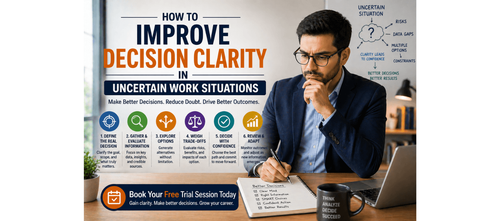

Increasing Decision Clarity in Ambiguous Situations Using a Proven Professional Framework
You’re in a meeting, faced with a decision that matters—but the information is incomplete, opinions are conflicting, and the path forward isn’t obvious. You hesitate. You gather more data. You wait for clarity that never fully arrives.
This is the reality of modern professional life. The higher you grow in your career, the less defined your problems become. There are no perfect answers—only better decisions made under uncertainty.
Most professionals struggle here not because they lack intelligence, but because they lack a structured system to think clearly in ambiguity. They rely on instinct, past experience, or consensus—leading to inconsistency, delays, and second-guessing.
This is exactly where a Decision Clarity Framework becomes essential. It gives you a structured, repeatable way to move from confusion to confident action—even when the path isn’t fully clear.
Download these resources and apply them alongside your daily work for improved clarity, productivity, and professional growth. You can also book a free trial to gain expert guidance and enhance your communication, problem-solving, and decision-making skills. The materials are designed in a clear, structured format to help professionals learn efficiently and implement insights with confidence.
Who Is This Blog For?
- Working professionals making decisions with incomplete information
- Managers and leaders handling complex, high-stakes choices
- Career switchers navigating uncertain opportunities
- Consultants advising clients in ambiguous situations
- Early to mid-career professionals aiming to build decision confidence
Why This Topic Matters Today?
Ambiguity is no longer an exception—it is the default.
Professionals today face:
- Incomplete or rapidly changing information
- Multiple stakeholders with conflicting priorities
- Pressure to act quickly without full certainty
- Fear of making the wrong decision
This leads to:
- Decision fatigue and analysis paralysis
- Over-reliance on consensus
- Delayed action and missed opportunities
- Reduced stakeholder confidence
The guidebook highlights a critical truth: better decisions don’t come from trying harder—they come from using better tools.
A structured decision-making system transforms ambiguity from a barrier into a strategic advantage.
Core Concept or Framework Explained
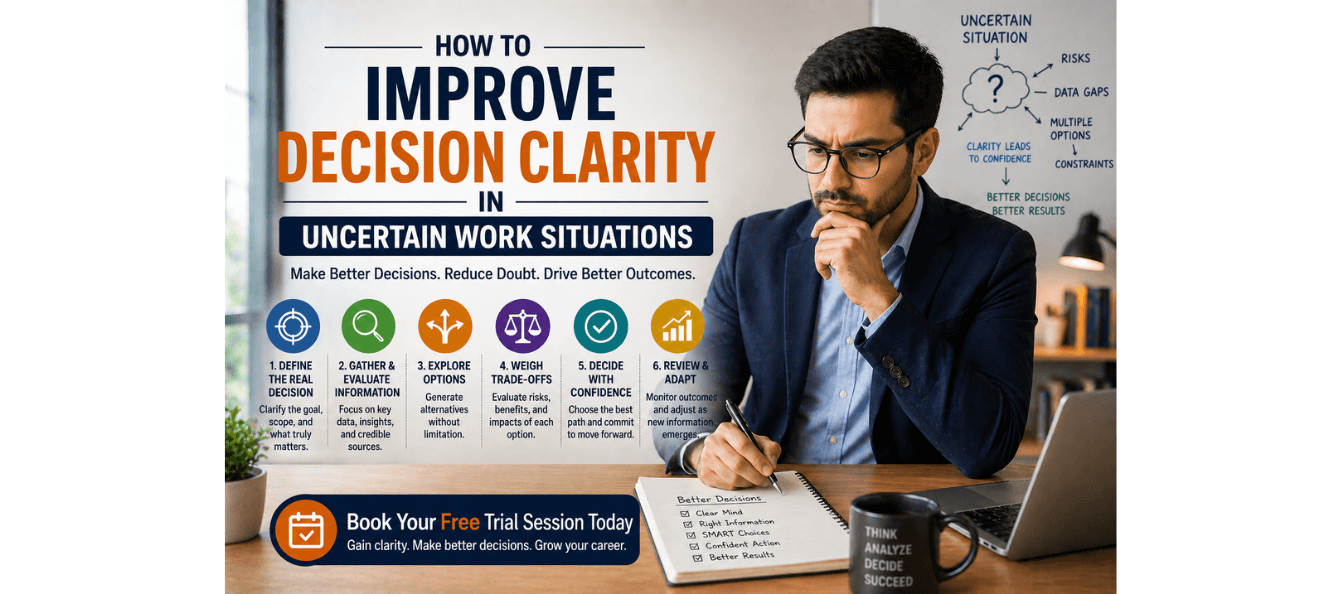
The Decision Clarity Framework is a step-by-step system designed to help you think clearly, act decisively, and communicate confidently in uncertain situations.
It follows a logical progression:
Diagnose
Understand the type of ambiguity and the real problem
Reduce Noise
Focus on essential information and eliminate distractions
Generate Options
Create multiple meaningful alternatives
Evaluate and Align
Use structured tools to compare options and align stakeholders
Commit and Communicate
Make the decision and express it with clarity and confidence
Review and Learn
Reflect on outcomes to improve future decisions
This framework ensures that every decision is structured, intentional, and actionable.
How This Blog and Guidebook Help You?
This blog and the guidebook provide:
- A complete system for decision-making under uncertainty
- Practical tools like Clarity Audit, Decision Matrix, and RACI
- Techniques to reduce overthinking and increase action
- A repeatable process to improve decision quality over time
The result is stronger judgment, faster execution, and increased professional credibility.
Step-by-Step Breakdown
Step 1: Diagnose — What Kind of Ambiguity Are You Facing?
Not all ambiguity is the same. Identifying the type determines the solution.
Four types of ambiguity:
- Information ambiguity: Missing or unclear data
- Option ambiguity: Too many choices
- Stakeholder ambiguity: Misalignment or unclear ownership
- Outcome ambiguity: Undefined success criteria
Once identified, you can apply the right tool instead of guessing.
A key starting tool is the Clarity Audit:
- What do I know for certain?
- What am I assuming?
- What do I need to know?
- What can I decide now anyway?
This separates facts from assumptions and reveals hidden clarity.
Step 2: Reduce Noise — What Information Actually Matters?
More information does not always mean better decisions.
Focus on:
- Minimum Viable Information: The single most critical input needed
- Information deadlines: Decide by a specific time
- Signal vs noise: Prioritise relevant inputs
- Acceptable risk: Define what you can tolerate
This prevents analysis paralysis and enables action.
Step 3: Generate Options — How Do You Expand Your Thinking?
Many poor decisions come from limited options.
Apply the Rule of Three:
- Always generate at least three distinct options
- Ensure differences in risk, effort, and time horizon
- Avoid evaluating options while generating them
This expands your thinking and avoids false binary choices.
Step 4: Evaluate and Align — How Do You Make a Strong Decision?
Use structured tools to compare options and align stakeholders.
Decision Matrix:
- Define evaluation criteria
- Assign weights based on importance
- Score each option
- Compare weighted outcomes
Stakeholder Alignment:
- Use RACI to define roles
- Responsible
- Accountable
- Consulted
- Informed
- Create a one-page alignment brief including:
- Decision statement
- Options considered
- Criteria used
- Recommendation
- Next steps
This ensures clarity, ownership, and alignment before action.
Step 5: Commit and Communicate — How Do You Lead with Confidence?
A decision is incomplete until it is clearly communicated.
Best practices:
- Lead with the decision, not the explanation
- Acknowledge uncertainty without hesitation
- Define reversibility where applicable
- Clearly state next steps, owners, and timelines
Confidence in communication builds trust—even in uncertainty.
Step 6: Review and Learn — How Do You Improve Over Time?
Decision-making is a skill that improves with reflection.
Use a Decision Debrief:
- What decision did I make?
- What did I know vs assume?
- What worked and what didn’t?
- What will I do differently next time?
Regular reflection turns experience into expertise.
Common Mistakes or Pitfalls to Avoid
Professionals often fall into predictable traps:
- Waiting for complete certainty before acting
- Seeking consensus instead of clarity
- Thinking in binary options
- Over-collecting information beyond usefulness
- Confusing intuition with bias
- Communicating decisions with excessive hesitation
A better approach is to:
- Decide with sufficient, not perfect, information
- Generate multiple options
- Use structured tools consistently
- Communicate clearly and confidently
How Should You Use This Guidebook Effectively?
To maximise results:
- Start with one real decision you are currently facing
- Apply each step of the framework sequentially
- Use tools like Clarity Audit and Decision Matrix in writing
- Avoid skipping steps, even under pressure
Suggested workflow:
- Spend 10–15 minutes diagnosing the problem
- Allocate focused time for option generation and evaluation
- Use structured tools for alignment and communication
Consistency builds clarity over time.
Key Takeaways
- Ambiguity is a normal part of professional decision-making
- Structured frameworks improve clarity and reduce overthinking
- Diagnosing the type of ambiguity is the first critical step
- Minimum viable information is enough to act confidently
- Generating multiple options improves decision quality
- Clear ownership and alignment prevent delays
- Strong communication completes the decision process
- Reflection ensures continuous improvement
Your Next Step: Accelerate Your Career with PlanetSpark
Creating an impact-driven resume is not just about landing your next job—it’s about owning your professional story and presenting it with clarity, confidence, and credibility. When your resume clearly communicates value, results, and impact, opportunities follow naturally.
At PlanetSpark, we are committed to empowering working professionals with practical, outcome-focused resources that drive real career growth. From resume building and workplace communication to leadership presence and professional writing, our programs are designed to help you succeed in today’s fast-evolving job market.
Visit https://www.planetspark.in/resources to explore:
- Career and resume-building guides
- Workplace communication and professional writing resources
- Skill-development tools curated for working professionals
Want a deeper, hands-on experience?
You can also book a free trial session to learn more about PlanetSpark’s Working Professional Courses, designed to accelerate your career through personalised coaching, real-world practice, and expert guidance.
Your career deserves more than generic advice.
It deserves clarity, confidence, and measurable impact.
Start building that advantage today—with PlanetSpark.
Personalized Communication Roadmaps
Record a video to get a AI generated personalized communication reports