
How to Manage Decision Fatigue: A Roadmap for Professionals
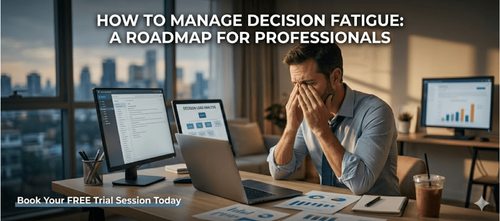

How to Diagnose and Overcome Decision Fatigue in High-Pressure Roles: A Practical Toolkit for Better Decision-Making
Every day at work, you are making decisions—some small, some critical, and many that feel urgent. From responding to emails to managing teams and making strategic calls, your brain is constantly processing choices. But by the end of the day, even simple decisions start to feel overwhelming.
If you’ve ever struggled to decide what to prioritise, delayed important calls, or made impulsive choices you later regretted, you are not alone. This is not a lack of discipline or capability—it is decision fatigue, a cognitive condition that affects even the most high-performing professionals.
The challenge is that decision fatigue often goes unnoticed. You continue working, but the quality of your thinking declines. This is where a structured diagnostic and recovery approach becomes essential.
This guide is designed to help you identify your decision fatigue triggers, assess your current state, and build systems that improve your decision-making quality without increasing your workload.
Download these resources and apply them alongside your daily work for improved clarity, productivity, and professional growth. You can also book a free trial to gain expert guidance and enhance your communication, problem-solving, and decision-making skills. The materials are designed in a clear, structured format to help professionals learn efficiently and implement insights with confidence.
Who Is This Blog For?
- Working professionals in high-pressure roles managing multiple responsibilities
- Managers and team leaders making frequent people and performance decisions
- Consultants and client-facing professionals handling complex stakeholder dynamics
- Career switchers navigating uncertainty and new environments
- Early-career professionals dealing with high cognitive workloads
Why This Topic Matters Today?
In today’s fast-paced work environment, professionals make an estimated 35,000 to 70,000 decisions per day. While many are unconscious, a significant portion requires active thinking and judgment.
The problem is not the volume alone—it is the lack of recovery and structure.
As decision load increases:
- Cognitive resources get depleted throughout the day
- Decision quality declines without noticeable warning
- Professionals become more impulsive, avoidant, or reactive
- Important decisions are made in low-energy states
This creates a hidden gap between effort and performance. You may be working hard, but your decisions may not reflect your true capability.
In a competitive workplace, where judgment and clarity define success, managing decision fatigue is no longer optional—it is a professional necessity.
Core Concept or Framework Explained
At its core, decision fatigue is a form of cognitive depletion. It is not the same as stress or burnout, although it often overlaps with both.
The framework in this guide explains decision fatigue through four key mechanisms:
Ego Depletion
Your brain has a limited cognitive budget. Every decision—whether trivial or complex—draws from the same pool of mental energy. As the day progresses, this resource gets depleted.
Decision Avoidance
When fatigue sets in, the brain tends to delay or avoid decisions altogether. This results in missed deadlines, postponed actions, and reliance on others to decide.
Impulsive Shortcuts
The opposite of avoidance is impulsivity. Instead of analysing options, the brain chooses the quickest available solution just to reduce cognitive load.
Emotional Dysregulation
As cognitive resources decline, emotional control weakens. This leads to irritability, reactive communication, and reduced empathy in professional interactions.
Understanding these mechanisms is the first step toward improving your decision-making system.
How This Blog and Guidebook Help You?
This blog and the underlying toolkit provide a structured approach to managing decision fatigue effectively.
You will be able to:
- Diagnose your current level of decision fatigue
- Identify your personal fatigue triggers
- Map where your cognitive energy is being spent
- Apply immediate recovery strategies during workdays
- Build long-term systems that reduce decision overload
The outcome is not just better decisions—but more consistent, confident, and high-quality thinking across your workday.
Step-by-Step Breakdown
Step 1: Assess Your Decision Fatigue Level
Start with a self-assessment based on your recent work experience.
Ask yourself:
- Do decisions feel harder later in the day?
- Do you delay important choices?
- Do you feel mentally exhausted without physical work?
- Do you make impulsive decisions you later regret?
Based on your responses, you can classify your fatigue level as low, moderate, or high.
This awareness is critical before making any changes.
Step 2: Map Your Decision Load
Track your decisions over two working days and identify your most frequent or draining ones.
Common examples include:
- Prioritising tasks
- Responding to emails
- Managing team performance
- Handling stakeholder requests
Then evaluate each decision based on:
- Cognitive cost (how mentally demanding it is)
- Frequency (how often it occurs)
This helps you identify high-impact areas for improvement.
Step 3: Use the Decision Drain Matrix
Categorise your decisions into four types:
- High-cost, high-frequency (priority for system design)
- High-cost, low-frequency (schedule during peak energy)
- Low-cost, high-frequency (automate or routinise)
- Low-cost, low-frequency (minimal focus needed)
This framework helps you allocate your mental energy more strategically.
Step 4: Identify Your Personal Triggers
Decision fatigue is not the same for everyone. Identify what specifically drains you.
Common triggers include:
- Back-to-back meetings without breaks
- Unclear priorities requiring constant re-evaluation
- Complex stakeholder interactions
- Frequent interruptions and context switching
Use reflection questions to pinpoint:
- When your decision quality drops
- Which tasks or interactions drain you most
- How your behaviour changes under fatigue
Once identified, these triggers become predictable—and preventable.
Step 5: Apply Immediate Recovery Strategies
When you feel fatigued, use targeted recovery techniques:
- Take 10-minute cognitive micro-breaks without screens
- Use the Pause-Restore-Reset-Reenter cycle
- Eat properly to maintain glucose levels
- Write down pending decisions to reduce mental load
These strategies restore your cognitive capacity within the same workday.
Step 6: Build Structural Defences
Long-term improvement comes from redesigning how decisions enter your day.
Key strategies include:
- Blocking a morning decision window for high-priority thinking
- Creating decision-free zones during the day or week
- Routinising recurring decisions with templates or checklists
- Delegating decision authority, not just tasks
These changes reduce dependency on willpower and create sustainable performance.
Step 7: Follow a Daily, Weekly, and Monthly System
Consistency is critical.
Daily:
- Identify top 3 decisions
- Schedule recovery breaks
- Avoid back-to-back critical decisions
Weekly:
- Review decision patterns
- Reduce unnecessary meetings
- Delegate one recurring decision
Monthly:
- Reassess fatigue levels
- Review decision systems
- Identify areas for improvement
This creates a repeatable system for continuous optimisation.
Common Mistakes or Pitfalls to Avoid
Many professionals unintentionally accelerate decision fatigue through poor habits.
Common mistakes include:
- Treating all decisions as equally urgent
- Pushing through fatigue using willpower
- Equating busyness with productivity
- Keeping decisions in memory instead of documenting them
- Waiting for perfect conditions before deciding
Better alternatives:
- Prioritise decisions based on impact
- Take structured recovery breaks
- Focus on decision quality, not quantity
- Externalise decisions using logs or notes
- Set clear deadlines for decision-making
These small changes significantly improve mental clarity and effectiveness.
How Should You Use This Guidebook Effectively?
To maximise the value of this toolkit, follow a structured approach:
- Start with the self-assessment to establish your baseline
- Track your decisions for 2–3 days
- Identify top fatigue triggers
- Implement one structural change at a time
- Review your progress weekly
Suggested time investment:
- 15–20 minutes for initial assessment
- 10 minutes daily for tracking and reflection
- 30–60 minutes weekly for system review
The key is consistency. Avoid trying to change everything at once—focus on incremental improvement.
Key Takeaways
- Decision fatigue is a real and measurable cognitive challenge
- Decision quality declines without proper recovery and structure
- Not all decisions require equal mental energy
- Identifying personal triggers enables targeted improvements
- Short recovery strategies can restore decision-making capacity quickly
- Structural systems are more effective than relying on willpower
- Externalising decisions reduces cognitive overload
- Consistent review and optimisation lead to long-term performance gains
Your Next Step: Accelerate Your Career with PlanetSpark
Creating an impact-driven resume is not just about landing your next job—it’s about owning your professional story and presenting it with clarity, confidence, and credibility. When your resume clearly communicates value, results, and impact, opportunities follow naturally.
At PlanetSpark, we are committed to empowering working professionals with practical, outcome-focused resources that drive real career growth. From resume building and workplace communication to leadership presence and professional writing, our programs are designed to help you succeed in today’s fast-evolving job market.
Visit https://www.planetspark.in/resources to explore:
- Career and resume-building guides
- Workplace communication and professional writing resources
- Skill-development tools curated for working professionals
Want a deeper, hands-on experience?
You can also book a free trial session to learn more about PlanetSpark’s Working Professional Courses, designed to accelerate your career through personalised coaching, real-world practice, and expert guidance.
Your career deserves more than generic advice.
It deserves clarity, confidence, and measurable impact.
Start building that advantage today—with PlanetSpark.
Personalized Communication Roadmaps
Record a video to get a AI generated personalized communication reports