
How to Map Output vs Effort to Boost Efficiency in Your Career


Boost Your Productivity and Career Growth with the Output vs Effort Scorecard: A Practical Guide for Working Professionals
In today’s fast-paced work environment, being busy is often mistaken for being productive. You attend back-to-back meetings, respond to endless emails, and complete a long list of tasks—yet, at the end of the week, it still feels like you haven’t made meaningful progress.
This is one of the biggest hidden challenges professionals face today: the gap between effort and actual output. Many professionals work extremely hard but fail to see proportional results because their time is spent on low-impact activities. This not only slows career growth but also leads to burnout and frustration. In fact, it can sometimes feel like you're putting in all your energy but still falling short of achieving the real milestones that matter.
The real issue isn’t a lack of effort—it’s a lack of clarity on where that effort is going and how much value it creates. Without a structured way to measure this, it becomes nearly impossible to optimise your work and focus on what truly matters. You might be stuck in a cycle of overwork, unable to break free and make strides toward your larger goals.
This is exactly where the Output vs Effort Scorecard becomes a game-changer. It provides a clear, practical framework to evaluate how your time and energy translate into results. By regularly using this scorecard, you can pinpoint inefficiencies, reclaim lost time, and shift your focus toward high-impact work that truly drives career growth. This structured approach helps you see the bigger picture and make informed decisions that align your actions with your long-term goals.
Download these resources and applying them alongside your daily work, you’ll gain clarity on your most effective activities. It’s not just about doing more—it’s about doing what matters more efficiently. For even greater results, consider booking a free trial to access expert guidance that will help you enhance your communication, problem-solving, and decision-making skills. With the support of tailored resources and actionable insights, you’ll be able to grow in your professional journey with confidence and purpose.
Who Is This Blog For?
- Working professionals who feel busy but not productive
- Managers aiming to improve team efficiency and output
- Career switchers looking to maximise impact in new roles
- Consultants and freelancers optimising time and client delivery
- Early and mid-career professionals seeking smarter work strategies
Why This Topic Matters Today?
Modern workplaces often reward visible effort rather than meaningful results. Long hours, packed schedules, and constant responsiveness are seen as indicators of productivity—even when they deliver minimal value.
This creates what the resource identifies as the effort-visibility trap. Professionals appear busy but are not necessarily effective. Over time, this leads to:
- Invisible productivity loss due to low-value tasks
- Misalignment between effort and outcomes
- Reduced career momentum despite high effort
- Lack of evidence to advocate for better workload distribution
In a competitive and fast-evolving job market, this gap can significantly limit your growth. Professionals who can demonstrate measurable impact—not just activity—are the ones who stand out, grow faster, and unlock better opportunities.
The ability to strategically allocate effort is no longer optional—it is essential.
Core Concept or Framework Explained
At the heart of this guide is the Output vs Effort Scorecard—a structured framework that helps you evaluate and optimise how your work translates into results.
The framework is built on three core components:
Effort Awareness
The first step is understanding where your time and energy actually go. Most professionals rely on assumptions rather than data, which leads to poor decision-making.
By capturing real activities from your week, you gain visibility into your actual work patterns.
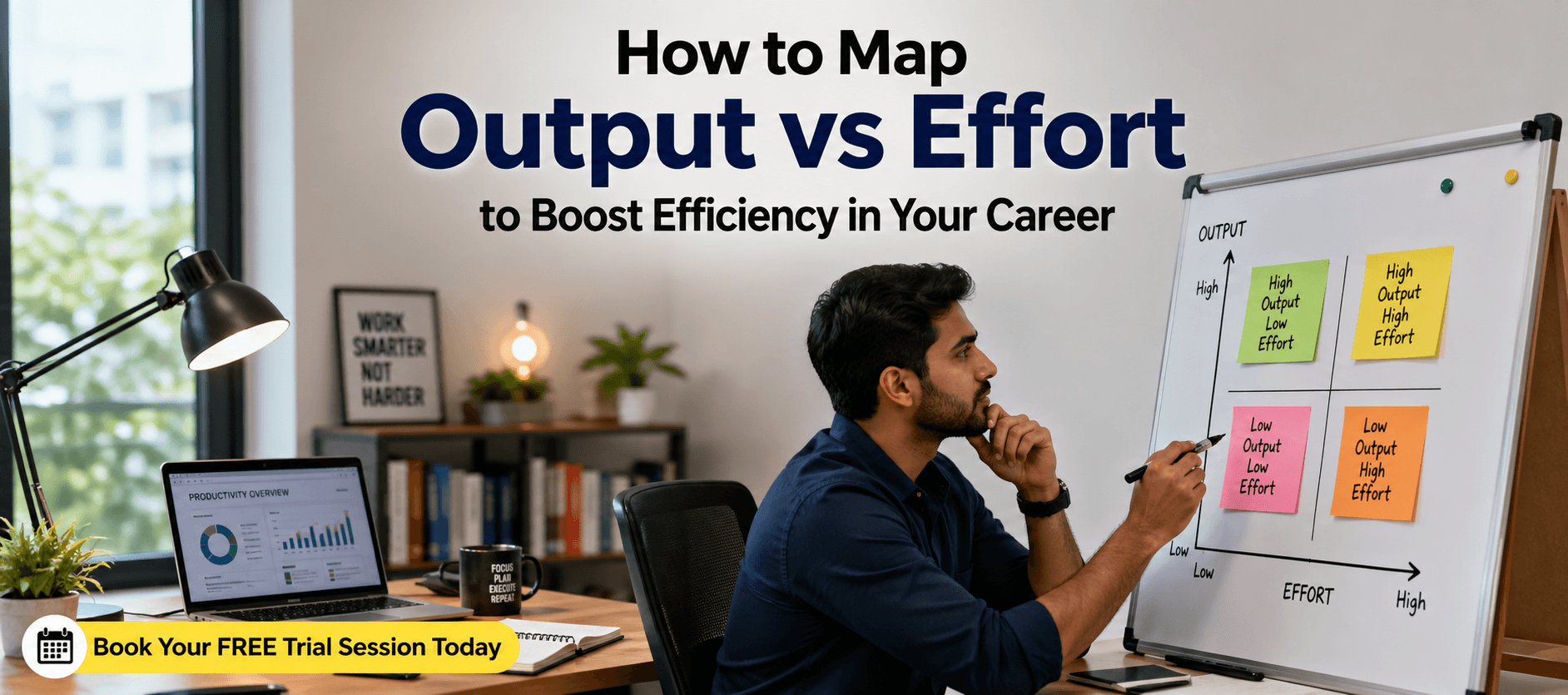
Output vs Effort Matrix
Each task is evaluated on two dimensions:
- Output Value: How much impact the task creates
- Effort Cost: How much time and energy it consumes
This creates a 2×2 matrix that reveals four key zones:
- High Output, Low Effort (Leverage Zone)
- High Output, High Effort
- Low Output, Low Effort
- Low Output, High Effort (Efficiency Drains)
This matrix becomes your decision-making tool for improving productivity.
Strategic Action Framework
Once tasks are mapped, the guide introduces four clear actions:
- Protect high-value, low-effort tasks
- Optimise high-value, high-effort tasks
- Delegate low-value, low-effort tasks
- Eliminate low-value, high-effort tasks
This ensures your time is consistently aligned with impact.
How This Blog and Guidebook Help You?
This blog and the underlying scorecard provide a practical system to transform how you work.
You will be able to:
- Identify time-draining activities that limit your growth
- Focus on high-impact tasks that deliver measurable results
- Reclaim hours every week by eliminating inefficiencies
- Build a data-backed case for smarter workload management
- Improve both productivity and professional visibility
Over time, these improvements compound, leading to stronger performance, better recognition, and accelerated career growth.
Step-by-Step Breakdown
Step 1: The Effort Audit
The first step is to capture everything you do in a typical week.
Key actions:
- List 10–15 tasks from your recent workweek
- Include meetings, emails, planning, execution, and informal tasks
- Be specific about time spent
This step focuses on awareness, not judgment. The goal is to build a clear picture of your effort distribution.
Step 2: Score Each Task
Once your tasks are listed, evaluate each one using two metrics:
- Output value (impact on meaningful results)
- Effort cost (time and energy required)
Use a simple scale from 1 to 5 for both.
This helps you identify which tasks deliver high returns and which ones consume disproportionate effort.
Step 3: Identify Your Efficiency Gains
After scoring, categorise tasks into four action areas:
- Protect: High output, low effort tasks
- Optimise: High output, high effort tasks
- Delegate: Low output, low effort tasks
- Eliminate: Low output, high effort tasks
Even small adjustments here can help you reclaim 3–8 hours per week.
Step 4: Use the Weekly Efficiency Scorecard
The scorecard combines all your insights into a single weekly review tool.
Key elements include:
- Task list with output and effort scores
- Assigned action (protect, optimise, delegate, eliminate)
- Weekly reflection questions
This step ensures consistency and continuous improvement.
Step 5: Reflect and Adjust
Use reflection questions to improve decision-making:
- Which task delivered the highest value for the least effort?
- Which task drained energy with minimal results?
- What can be delegated or eliminated next week?
This reflection helps you refine your strategy over time.
Step 6: Track Your Efficiency Metrics
Measure your weekly performance using indicators such as:
- Percentage of time spent in high-leverage tasks
- Time spent on core work versus maintenance
- Reduction in efficiency drains
Tracking these metrics ensures sustained progress.
Common Mistakes or Pitfalls to Avoid
Many professionals struggle with efficiency because of predictable mistakes.
Common pitfalls include:
- Scoring tasks based on how they feel instead of actual impact
- Confusing urgency with importance
- Avoiding delegation due to control concerns
- Treating the scorecard as a one-time exercise
- Equating busyness with productivity
A better approach is to:
- Base decisions on measurable outcomes
- Continuously review and adjust your workflow
- Focus on impact rather than activity
How Should You Use This Guidebook Effectively?
To maximise the value of the Output vs Effort Scorecard, follow a simple routine:
- Spend 20–30 minutes completing your first effort audit
- Score tasks using the output vs effort matrix
- Identify at least one task to eliminate or delegate
- Protect at least one high-leverage task in your schedule
- Repeat the scorecard weekly for at least four weeks
Time investment:
- Initial setup: 20–30 minutes
- Weekly review: 15–20 minutes
Consistency is critical. The real value comes from identifying patterns over time, not just one-time insights.
Key Takeaways
- Effort and output are not the same—focus on impact, not activity
- High-leverage tasks should be protected and prioritised
- Efficiency drains consume time without delivering value
- Delegation is essential for scaling your effectiveness
- Small changes in time allocation can create significant results
- Consistent tracking leads to better decision-making
- Productivity is about doing what matters, not doing more
Your Next Step: Accelerate Your Career with PlanetSpark
Creating an impact-driven resume is not just about landing your next job—it’s about owning your professional story and presenting it with clarity, confidence, and credibility. When your resume clearly communicates value, results, and impact, opportunities follow naturally.
At PlanetSpark, we are committed to empowering working professionals with practical, outcome-focused resources that drive real career growth. From resume building and workplace communication to leadership presence and professional writing, our programs are designed to help you succeed in today’s fast-evolving job market.
Visit https://www.planetspark.in/resources to explore:
- Career and resume-building guides
- Workplace communication and professional writing resources
- Skill-development tools curated for working professionals
Want a deeper, hands-on experience?
You can also book a free trial session to learn more about PlanetSpark’s Working Professional Courses, designed to accelerate your career through personalised coaching, real-world practice, and expert guidance.
Your career deserves more than generic advice.
It deserves clarity, confidence, and measurable impact.
Start building that advantage today—with PlanetSpark.
Personalized Communication Roadmaps
Record a video to get a AI generated personalized communication reports