
How to Map Your Experience Against Employer Needs
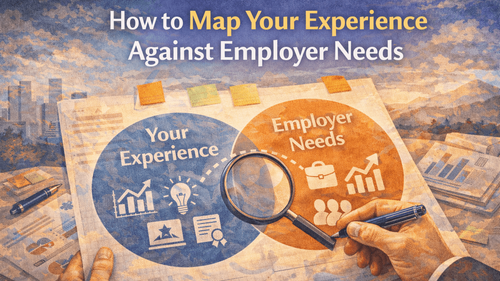

How to Map Your Experience to Employer Needs and Get More Interview Calls
You may have the right skills,
the right experience, and even the right attitude—yet still struggle to get interview calls.
Sound familiar?
The issue is rarely about your qualifications. It is about alignment.
Recruiters are not reading your resume to understand your journey. They are scanning it to answer one critical question: Can this person solve my problem?
When your experience is presented in your own language instead of the employer’s, it creates friction. And in a hiring process where decisions are made in seconds, friction leads to rejection.
This is where most professionals lose opportunities—not because they are unqualified, but because they fail to connect their experience to what employers actually need.
This guide transforms that gap into your biggest advantage. It gives you a structured, step-by-step approach to map your experience directly to employer expectations, making your value clear, relevant, and compelling.
Who Is This Blog For?
This blog and guidebook are designed for professionals who want to position themselves more effectively in the job market.
- Working professionals with 0–15 years of experience seeking better opportunities
- Career changers struggling to make their experience look relevant
- Mid-career professionals aiming for strategic or leadership roles
- Job seekers facing low interview response rates
- Professionals who feel they are underselling their skills
Why This Topic Matters Today?
The hiring landscape has changed dramatically.
Employers are no longer impressed by job titles or years of experience alone. They are looking for direct alignment between their needs and your capabilities.
The biggest challenge is this:
- Most candidates present their experience as a timeline
- Employers evaluate candidates based on problem-solving ability
This mismatch creates a disconnect.
Another critical issue is what the guide calls “biographical bias.” Professionals tend to describe their careers chronologically, focusing on what they did over time. But employers do not care about timelines—they care about solutions.
When your resume forces recruiters to interpret your experience, you lose.
When you translate your experience into their language, you win.
This shift—from storytelling to solution-mapping—is what separates average applications from high-impact ones.
Core Concept or Framework Explained
The core idea of this guide is simple but powerful:
You must bridge the gap between your experience and employer needs.
This is done through a structured five-step framework:
- Decode the job description
- Audit your experience
- Build the experience-to-employer bridge
- Craft proof points
- Address gaps strategically
At the heart of this framework is a critical insight:
Employers hire for outcomes, not histories.
Instead of expecting recruiters to connect the dots, you connect them yourself. You show exactly how your past work solves their current problems.
This turns your application from a generic profile into a targeted solution.
How This Blog and Guidebook Help You?
By applying this framework, you transform how you present yourself professionally.
You will be able to:
- Translate your experience into employer-relevant language
- Identify and highlight transferable skills
- Create targeted resumes for specific roles
- Build confidence in interviews and applications
- Stand out as a clear match for the role
Instead of hoping recruiters understand your value, you make it obvious.
Step-by-Step Breakdown
Step 1: Decode the Job Description Like an Insider
Before writing your resume, you must understand what the employer actually wants.
Every job description has three layers:
Explicit Layer
This includes clearly stated requirements such as skills, tools, qualifications, and years of experience.
Implicit Layer
This includes hidden signals like “fast-paced environment,” “self-starter,” or “collaborative.” These indicate working style and cultural expectations.
Outcome Layer
This is the most important layer. It represents what the employer actually wants to achieve through this role.
For example, a requirement for technical expertise and ownership may actually indicate the need to manage a complex system independently.
Your goal is to extract all three layers before you describe yourself.
Step 2: Audit Your Experience With Fresh Eyes
Most professionals underestimate their own experience.
They describe high-impact work as “just part of the job.”
This step helps you uncover everything that could be relevant.
Think across key dimensions:
- Roles and responsibilities
- Projects and initiatives
- Outcomes delivered
- Skills applied
- Context and environment
Include everything:
- Formal job responsibilities
- Side projects or freelance work
- Volunteer experience
- Leadership or mentoring roles
The goal is not to filter yet. It is to create a complete inventory of your professional value.
Step 3: Build the Experience-to-Employer Bridge
This is the most important step.
Here, you connect your experience directly to employer needs.
The bridge has three components:
- Your experience
- Transferable mechanism
- Employer requirement
For example:
- Experience: Managed a cross-functional project
- Mechanism: Stakeholder coordination and execution
- Employer need: Leading cross-functional teams
This step ensures that your experience is not just listed—it is aligned.
This is especially powerful for career transitions, where the context changes but the underlying skills remain the same.
Step 4: Craft Proof Points That Land
Once your experience is mapped, you need to present it effectively.
This is done using the CAR framework:
Context
What situation or challenge were you in?
Action
What did you specifically do?
Result
What was the outcome, ideally with measurable impact?
Strong proof points are:
- Specific
- Action-oriented
- Outcome-driven
For example:
Instead of saying “Handled client issues,” say:
Resolved high-priority client escalations by redesigning response workflows, reducing resolution time by 40 percent.
These statements make your impact clear and credible.
Step 5: Address Gaps Without Apology
Every professional has gaps.
The difference is how you handle them.
The guide categorises gaps into three types:
Bridgeable Gaps
You have related experience that can be reframed.
Development Gaps
You are still building this skill but showing progress.
Non-Critical Gaps
These are secondary requirements that do not significantly impact your fit.
Instead of ignoring or apologising for gaps, address them strategically.
This builds credibility and shows self-awareness.
Common Mistakes or Pitfalls to Avoid
Even strong candidates make avoidable mistakes that weaken their applications.
- Describing responsibilities instead of outcomes
- Using industry-specific jargon that employers may not understand
- Sending the same resume for every role
- Ignoring the implicit signals in job descriptions
- Treating gaps as disqualifiers
Each of these mistakes reduces clarity and impact.
Fixing them can dramatically improve your chances of getting shortlisted.
How Should You Use This Guidebook Effectively?
To maximise results, follow a structured approach:
- Read the full framework once to understand the process
- Choose a target role before starting
- Complete each step in sequence
- Spend focused time on each worksheet
- Apply insights directly to your resume or cover letter
- Reuse the framework for every new application
You can complete the full process in a few focused sessions.
Consistency is key. The more you use this framework, the faster and more effective you become.
Key Takeaways
- Employers hire based on alignment, not just experience
- Always decode job descriptions before writing your resume
- Audit your experience thoroughly before filtering
- Use transferable skills to bridge experience gaps
- Structure your achievements using the CAR framework
- Address gaps strategically instead of avoiding them
- Customise your resume for every role
- Make it easy for employers to see your value
Your Next Step: Accelerate Your Career with PlanetSpark
Creating an impact-driven resume is not just about landing your next job—it’s about owning your professional story and presenting it with clarity, confidence, and credibility. When your resume clearly communicates value, results, and impact, opportunities follow naturally.
At PlanetSpark, we are committed to empowering working professionals with practical, outcome-focused resources that drive real career growth. From resume building and workplace communication to leadership presence and professional writing, our programs are designed to help you succeed in today’s fast-evolving job market.
Visit https://www.planetspark.in/resources to explore:
- Career and resume-building guides
- Workplace communication and professional writing resources
- Skill-development tools curated for working professionals
Want a deeper, hands-on experience?
You can also book a free trial session to learn more about PlanetSpark’s Working Professional Courses, designed to accelerate your career through personalised coaching, real-world practice, and expert guidance.
Your career deserves more than generic advice.
It deserves clarity, confidence, and measurable impact.
Start building that advantage today—with PlanetSpark.
Personalized Communication Roadmaps
Record a video to get a AI generated personalized communication reports