
How to Master Business Models: A Guide for Professionals

Business Model Understanding to Accelerate Your Career
In today’s competitive landscape, understanding how businesses create, deliver, and capture value is more crucial than ever. Whether you’re analysing a potential career move, advising clients, or leading an internal strategy discussion, being able to understand and apply business models gives you a strategic edge. However, most professionals are never formally taught how to decode and apply business models — until now.
This blog draws from our comprehensive Business Model Understanding Guide to help you build that essential skill. In the next few sections, we’ll walk you through the basics of business models, guide you through practical applications, and show you how to leverage business model thinking for career growth.
Download these resources and apply them alongside your daily work for improved clarity, productivity, and professional growth. You can also book a free trial to gain expert guidance and enhance your communication, problem-solving, and decision-making skills. The materials are designed in a clear, structured format to help professionals learn efficiently and implement insights with confidence.
Who Is This Blog For?
This blog and accompanying guidebook are perfect for:
- Working professionals looking to move into strategy or leadership roles
- Career changers seeking to deepen their business acumen
- Consultants and managers looking to enhance their strategic decision-making skills
- Job seekers who want to stand out by demonstrating commercial intelligence in interviews
Why This Topic Matters Today?
The importance of business model literacy in today’s job market cannot be overstated. As companies shift their operations to remain competitive, knowing how to evaluate a business’s core model can significantly boost your career. Yet, many professionals lack the ability to understand how their organizations truly function behind the scenes — this is where business model fluency gives you a strategic edge.
According to the guidebook, without understanding the fundamental structure of your company or industry, your ability to contribute strategically becomes limited. Moreover, nearly 75% of resumes are filtered by ATS systems before they even reach hiring managers. Professionals who know how to apply business model thinking can translate their work experience into tangible, high-level value, making them stand out in the hiring process.
Core Concept or Framework Explained
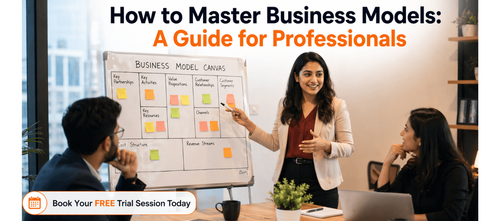
At the heart of this guidebook is the Business Model Canvas — a tool that helps you map how a business creates, delivers, and captures value. Created by Alexander Osterwalder, this framework breaks down a business model into nine key components:
- Customer Segments: Who are your customers?
- Value Propositions: What problems do you solve for these customers?
- Channels: How do you deliver value to your customers?
- Customer Relationships: What kind of relationships do you establish with each segment?
- Revenue Streams: How do you make money?
- Key Resources: What critical assets are required?
- Key Activities: What essential tasks must be performed?
- Key Partnerships: Who are your external partners?
- Cost Structure: What are the major costs involved?
These nine building blocks are interconnected and allow professionals to map any organization’s business model. Mastery of this framework is the foundation of understanding how businesses operate.
How This Blog and Guidebook Help You?
This blog, paired with the Business Model Understanding Guide, will help you:
- Gain clarity on how organizations create value and make strategic decisions
- Develop critical thinking to evaluate business models from a high-level perspective
- Improve your strategic conversations, whether with leadership or clients
- Use business model thinking to make better decisions, enhance your role's impact, and transition to higher-level responsibilities
By learning to see a company’s business model clearly, you can spot opportunities, identify weaknesses, and make informed decisions that propel your career forward.
Step-by-Step Breakdown
Step 1: Identify the Customer Segment First
Start by defining who the business is built for. A successful business model always starts with understanding its customers. For instance, targeting "freelance graphic designers in Tier-1 Indian cities earning ₹5-15L annually" is much more specific than "small business owners."
Step 2: Articulate the Value Proposition Clearly
Define the specific problem the business solves for that segment. Be concise: "We help [segment] to [achieve outcome] by [unique approach]."
Step 3: Trace the Revenue Streams
How does the business make money? List all revenue streams — commissions, subscription fees, advertising, and so on.
Step 4: Map the Operational Engine
Identify key resources, activities, and partnerships required to deliver value consistently and at scale.
Step 5: Analyze the Economics
Evaluate the business model’s financial health. Compare costs to revenue, and assess scalability.
Common Mistakes or Pitfalls to Avoid
In analyzing business models, professionals often make key mistakes. Here are some of the most common pitfalls and how to avoid them:
- Confusing Value Propositions with Features: Always tie value propositions to customer outcomes, not product capabilities.
- Mapping Revenue Streams Too Broadly: Be specific. Saying "service revenue" is not helpful; identify which product, segment, and pricing model.
- Ignoring Internal Consistency: Ensure that all business model components support each other. Misalignment often leads to strategic failure.
- Treating the Canvas as a One-Time Exercise: Business models are dynamic. Regularly revisit and adjust them to stay relevant.
How Should You Use This Guidebook Effectively?
To get the most out of this guidebook, follow these steps:
1. Read through the guide once to understand the full scope of the material.
2. Apply each framework to your own business or a target company.
3. Dedicate 2-3 hours to fully implement these insights into your work.
4. Revisit the guide periodically as you gain more experience and insight.
By applying this guidebook’s frameworks directly to your own work or a target company, you will enhance your ability to think strategically and boost your credibility within your organization.
Key Takeaways
- Shift from focusing on tasks to highlighting measurable outcomes in business models.
- Use the Business Model Canvas as your go-to framework to understand any organization’s structure.
- Continuously analyze and innovate business models to stay ahead of market trends.
- Learn how to effectively communicate business models to drive impact in strategic discussions.
Your Next Step: Accelerate Your Career with PlanetSpark
Creating an impact-driven resume is not just about landing your next job—it’s about owning your professional story and presenting it with clarity, confidence, and credibility. When your resume clearly communicates value, results, and impact, opportunities follow naturally.
At PlanetSpark, we are committed to empowering working professionals with practical, outcome-focused resources that drive real career growth. From resume building and workplace communication to leadership presence and professional writing, our programs are designed to help you succeed in today’s fast-evolving job market.
Visit https://www.planetspark.in/resources to explore:
- Career and resume-building guides
- Workplace communication and professional writing resources
- Skill-development tools curated for working professionals
Want a deeper, hands-on experience?
You can also book a free trial session to learn more about PlanetSpark’s Working Professional Courses, designed to accelerate your career through personalised coaching, real-world practice, and expert guidance.
Your career deserves more than generic advice.
It deserves clarity, confidence, and measurable impact.
Start building that advantage today—with PlanetSpark.
Personalized Communication Roadmaps
Record a video to get a AI generated personalized communication reports