
How to Measure Job Readiness: 2026 Scorecard for Professionals
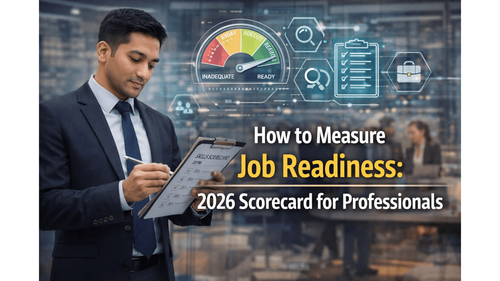

A Proven Framework to Assess Your Career Readiness and Seize Opportunities Faster
Introduction
You’ve built the skills. You’ve put in the work. You’ve delivered results. Yet when a big opportunity appears—a promotion, a new role, a client pitch—you hesitate or feel unprepared.
This is one of the most frustrating realities for working professionals: being capable, but not ready.
The truth is, opportunities don’t arrive when you are fully prepared. They arrive unexpectedly. And in that moment, the deciding factor is not your potential—it is your readiness.
Most professionals focus on building capability but neglect readiness. They assume their experience will speak for itself. It rarely does.
This is where the Professional Opportunity Readiness Scorecard becomes a game-changer. It helps you evaluate whether you are truly prepared—not just on paper, but in positioning, visibility, and confidence—to act when opportunities arise.
Book your free Trial session today with PlanetSpark.
Download the PDF of Resource for more details.
Who Is This Blog For?
- Working professionals aiming for promotions
or leadership roles
- Individuals planning a career switch or industry pivot
- Consultants or freelancers seeking better client opportunities
- Mid-career professionals feeling overlooked despite strong performance
- Anyone who wants to proactively prepare for future career opportunities
Why This Topic Matters Today?
In today’s competitive job market, opportunities are increasingly selective and fast-moving. Employers, clients, and decision-makers are not just looking for qualified individuals—they are looking for those who are ready to deliver immediately.
Common challenges professionals face include:
- Missing opportunities due to lack of preparation
- Strong experience but weak self-presentation
- Limited visibility despite high performance
- Networks that do not actively generate opportunities
Research-backed insights highlight a key truth: professionals who actively manage their readiness are more likely to secure better roles, negotiate effectively, and transition successfully.
Readiness is no longer optional. It is a competitive advantage.
Core Concept or Framework Explained
The Professional Opportunity Readiness Scorecard is built on a five-dimension model that functions like a flywheel. Each dimension reinforces the others, and weakness in one can slow your overall progress.
Clarity
This defines how clearly you understand the opportunity you are pursuing. Without clarity, your efforts become scattered and ineffective.
Credentials
These are your proof points—skills, achievements, certifications, and results that demonstrate your capability.
Connections
Your professional network acts as a gateway to opportunities. Strong relationships often matter more than applications.
Confidence
This is your ability to communicate your value, present your achievements, and advocate for yourself.
Consistency
This reflects the habits and actions you take regularly to build and maintain readiness.
The key insight is powerful: your readiness is only as strong as your weakest dimension.
How This Blog and Guidebook Help You?
This framework transforms how you approach career opportunities.
Instead of reacting when opportunities appear, you start preparing in advance. You gain clarity on what you want, build the right credentials, strengthen your network, and develop the confidence to act decisively.
By applying this scorecard, you will:
- Identify exactly where you are unprepared
- Focus on high-impact improvements
- Build a strong professional presence
- Increase your chances of securing better opportunities
- Create a repeatable readiness system
Step-by-Step Breakdown
Step 1: Clarity – Do You Know What You’re Aiming For?
Clarity is the foundation of readiness.
Most professionals operate with vague goals like “I want to grow” or “I want a better role.” These are not actionable targets.
You need to define:
- The exact role or opportunity you are pursuing
- The industry or domain you want to enter
- The requirements for that opportunity
- Your motivation behind pursuing it
A simple test:
Can you describe your target opportunity in one clear sentence within 15 seconds?
If not, clarity is your priority.
Action steps:
- Define your target opportunity in one sentence
- Analyse 3 real job postings or opportunities
- Identify your strengths and gaps
Step 2: Credentials – Can You Prove Your Value?
Credentials are not just qualifications—they are evidence.
Decision-makers rely on clear, visible proof of your capabilities. Your experience must be translated into measurable results.
Strong credentials include:
- Quantified achievements
- Certifications and relevant qualifications
- Updated professional profiles
- Case studies or portfolios
- External validation such as recommendations
Example of a strong credential statement:
Instead of “Handled marketing campaigns,” say “Led campaigns that reduced customer churn by 22 percent in six months.”
Action steps:
- Build at least 5 quantified achievement statements
- Update your LinkedIn profile with results
- Create visible proof of your work
Step 3: Connections – Is Your Network Working for You?
Most opportunities come through relationships, not job portals.
However, many professionals focus on collecting contacts instead of building meaningful connections.
A strong network includes:
- People who can refer or advocate for you
- Contacts across industries and roles
- Mentors or sponsors who guide your growth
- Regular engagement with your network
Key insight:
Weak ties—acquaintances and second-degree connections—often bring the most valuable opportunities.
Action steps:
- Reconnect with past colleagues
- Initiate meaningful conversations
- Expand your network into new areas
- Add value before asking for help
Step 4: Confidence – Can You Own Your Value?
Confidence is not about personality—it is about clarity and communication.
It shows up in:
- Interviews and presentations
- Professional conversations
- Written communication
- Salary negotiations
You must be able to:
- Clearly articulate your strengths
- Share your achievements with evidence
- Present a compelling professional narrative
Action steps:
- Create a 90-second career story
- Practice explaining your achievements
- Prepare for high-stakes conversations
Step 5: Consistency – Are Your Habits Building Career Capital?
Readiness is not built overnight. It is the result of consistent effort.
Professionals who stay ready follow structured habits:
Weekly habits:
- One networking action
- One skill-building activity
- Document one achievement
Monthly habits:
- Update professional profiles
- Review progress
- Have one career-focused conversation
Quarterly habits:
- Reassess readiness
- Adjust career strategy
A simple yet powerful practice:
Block 30 minutes every week as your “Career Capital Hour.”
Common Mistakes or Pitfalls to Avoid
- Preparing only when desperate
Waiting until you need a job reduces your chances of success
- Confusing activity with progress
High effort without direction leads to poor outcomes
- Underselling your achievements
Vague descriptions weaken your credibility
- Ignoring weak ties in networking
Opportunities often come from outside your immediate circle
- Waiting until you feel fully ready
Perfection delays action and growth
How Should You Use This Guidebook Effectively?
To maximise results, follow a structured approach:
- Complete the scorecard honestly in one sitting
- Identify your lowest-scoring dimension
- Take one action within 48 hours
- Set a 30-day improvement goal
- Reassess your readiness every 30–60 days
Suggested workflow:
- Day 1: Complete assessment and define target
- Week 1: Start actions immediately
- Day 30: Review progress
- Day 90: Reassess and refine strategy
The key is consistency and focused effort.
Key Takeaways
- Readiness is what determines whether you seize or miss opportunities
- Career success depends on five interconnected dimensions
- Your weakest dimension limits your overall readiness
- Credentials must be visible and measurable to matter
- Strong networks create access to hidden opportunities
- Confidence is built through practice and preparation
- Consistency creates long-term career advantage
- Immediate action within 48 hours is critical for momentum
---
Your Next Step: Accelerate Your Career with PlanetSpark
Creating an impact-driven resume is not just about landing your next job—it’s about owning your professional story and presenting it with clarity, confidence, and credibility. When your resume clearly communicates value, results, and impact, opportunities follow naturally.
At PlanetSpark, we are committed to empowering working professionals with practical, outcome-focused resources that drive real career growth. From resume building and workplace communication to leadership presence and professional writing, our programs are designed to help you succeed in today’s fast-evolving job market.
Visit https://www.planetspark.in/resources to explore:
- Career and resume-building guides
- Workplace communication and professional writing resources
- Skill-development tools curated for working professionals
Want a deeper, hands-on experience?
You can also book a free trial session to learn more about PlanetSpark’s Working Professional Courses, designed to accelerate your career through personalised coaching, real-world practice, and expert guidance.
Your career deserves more than generic advice.
It deserves clarity, confidence, and measurable impact.
Start building that advantage today—with PlanetSpark.
Personalized Communication Roadmaps
Record a video to get a AI generated personalized communication reports