
How to Measure Your Interview Readiness: A Professional Guide
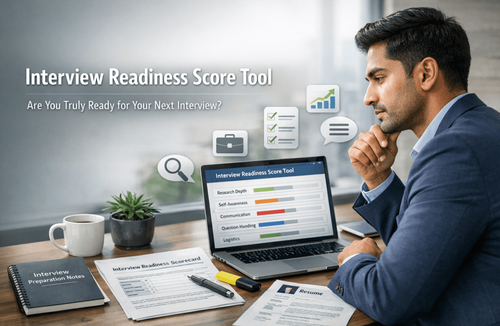

Interview Readiness Score Tool: A Practical Framework to Assess and Improve Your Interview Performance
Many professionals approach interviews with a mixture of optimism and uncertainty. They update their resume, review the company website briefly, rehearse a few common answers, and hope their experience will carry them through the conversation.
Unfortunately, hope is not a strategy.
Research consistently shows that interviewers form a strong first impression within the first few minutes of an interview. That impression is shaped not just by qualifications but by preparation, clarity of thought, and the candidate’s ability to communicate their value under pressure. Yet most professionals invest surprisingly little time preparing for an interview that could shape the next three to five years of their career.
This is where a structured preparation framework becomes invaluable.
The PlanetSpark Interview Readiness Score Tool provides a systematic way for working professionals to evaluate their readiness before stepping into a high-stakes interview. Instead of relying on guesswork, the scorecard measures readiness across five critical dimensions that determine interview performance and hiring outcomes.
By using this framework, professionals can identify preparation gaps, prioritise improvement areas, and enter interviews with genuine confidence rather than uncertainty.
Who Is This Blog For?
- Working professionals preparing for upcoming interviews
- Career switchers planning to transition into a new industry or role
- Early- to mid-career professionals seeking career advancement
- Consultants and managers preparing for competitive hiring processes
- Professionals expecting to begin a job search within the next 30–90 days
Why This Topic Matters Today?
The job market has become increasingly competitive, and the difference between receiving an offer and being passed over often comes down to preparation quality rather than raw experience.
Several realities define modern interviews:
- Hiring managers frequently form initial impressions within the first 90 seconds of a conversation
- Preparation quality is cited by many hiring managers as the biggest differentiator between shortlisted candidates
- Candidates who practise structured storytelling perform significantly better in behavioural interviews
- Most professionals spend less than two hours preparing for interviews that could determine their long-term career direction
These patterns highlight a major preparation gap among professionals.
Many candidates focus heavily on updating their resume but overlook the deeper preparation required to communicate their experience effectively. Without structured preparation, even highly qualified candidates struggle to present their value clearly during interviews.
The Interview Readiness Score Tool was designed to close this gap by helping professionals measure their readiness across multiple performance dimensions and create a targeted preparation strategy before their next interview.
Core Concept or Framework Explained
The scorecard is built around a powerful idea: interview success is not a single skill. It is the combination of several capabilities working together.
According to the framework, world-class interview performance emerges from five distinct dimensions of readiness.
Each dimension represents a pillar of effective interview performance. If even one pillar is weak, the entire interview experience can suffer regardless of how strong the other areas are.
The five dimensions are:
- Research Depth
- Self-Awareness and Positioning
- Communication and Delivery
- Question Handling
- Logistics and Closing
Together, these five areas determine how effectively a candidate communicates their expertise, navigates questions, and leaves a lasting impression on the interviewer.
How This Blog and Guidebook Help You?
The Interview Readiness Score Tool helps professionals move from vague preparation to structured readiness.
Instead of guessing whether you are prepared, the scorecard allows you to:
- Evaluate your interview readiness objectively
- Identify preparation gaps across key interview competencies
- Build a targeted improvement plan before your next interview
- Strengthen your ability to communicate achievements clearly
- Improve your confidence through deliberate practice
This structured approach ensures that preparation time is invested where it creates the greatest impact.
Rather than preparing randomly across multiple areas, professionals can focus on the dimensions where improvement will significantly increase their interview performance.
Step-by-Step Breakdown
Step 1: Evaluate Your Research Depth
Strong research creates the foundation for confident interview performance.
Candidates who demonstrate deep knowledge about a company immediately stand out from those who rely on generic answers. Interviewers interpret detailed research as a sign of genuine interest, motivation, and strategic thinking.
Effective research preparation should include:
- Understanding the company’s strategic priorities
- Reviewing recent news or press coverage
- Studying the responsibilities listed in the job description
- Researching interviewers and their professional backgrounds
- Understanding competitors and industry trends
When candidates connect their answers to the company’s challenges and priorities, their responses become significantly more relevant and persuasive.
Step 2: Develop Strong Self-Awareness and Positioning
Many professionals struggle in interviews not because they lack capability but because they cannot clearly articulate their professional narrative.
Interviewers are not interested in hearing a candidate repeat their resume. They want to understand the story behind the experience.
This includes:
- What motivates the candidate
- What strengths they bring to the role
- How their experience connects to the opportunity
- Why they are uniquely suited for the position
One critical preparation exercise involves developing a clear response to the classic interview prompt:
Tell me about yourself.
The most effective responses typically fall between 75 and 90 seconds and highlight the candidate’s career journey, strengths, and alignment with the role.
Professionals should also be able to:
- Identify their top transferable skills
- Share their most significant professional achievement
- Explain career transitions in a clear and intentional way
- Discuss development areas without weakening their candidacy
Strong positioning transforms experience into a compelling narrative.
Step 3: Strengthen Communication and Delivery
Even the strongest professional experience can be undermined by poor delivery during an interview.
Communication is a performance skill that requires practice.
Common communication challenges include:
- Rambling answers
- Lack of structure
- Weak examples
- Nervous delivery
- Poor listening habits
One widely used framework for behavioural interview responses is the STAR method.
STAR stands for:
- Situation
- Task
- Action
- Result
Using this structure helps candidates deliver answers that are clear, concise, and impactful.
Candidates should also practise delivery by recording mock interviews and reviewing their responses. Watching recordings often reveals habits such as filler words, rushed speech, or unclear explanations that can be improved with practice.
Step 4: Prepare for Different Types of Interview Questions
Experienced interviewers use a variety of question formats to evaluate candidates.
Professionals who perform well in interviews usually prepare a diverse bank of stories that can be adapted to different questions.
Common interview question types include:
Behavioural questions
These questions typically begin with phrases such as:
Tell me about a time when…
Candidates should prepare multiple examples that demonstrate leadership, problem-solving, teamwork, and resilience.
Competency-based questions
These questions assess specific professional capabilities such as leadership style, collaboration, or decision-making.
Candidates should map their competencies to the role’s requirements before the interview.
Situational questions
These questions explore how a candidate might respond to hypothetical scenarios.
Strong answers usually combine structured thinking with real-world examples from past experience.
Curveball questions
These questions test composure and self-awareness. Examples include:
- What is your biggest weakness?
- Why should we not hire you?
Strategic preparation helps candidates respond thoughtfully rather than defensively.
Step 5: Master Interview Logistics and Closing Strategy
Many candidates underestimate the importance of the final stage of an interview.
However, logistics and closing behaviour can strongly influence the final impression an interviewer forms.
Effective preparation includes:
Preparing thoughtful questions
Strong questions demonstrate curiosity, strategic thinking, and engagement. Examples include:
- What does success in this role look like after the first 90 days?
- What challenges is the team currently facing?
- How does leadership define growth in this role?
Planning the follow-up
A personalised thank-you message sent within 24 hours reinforces professionalism and enthusiasm.
The message should:
- Reference a specific discussion from the interview
- Reaffirm interest in the role
- Thank the interviewer for their time
Salary preparation
Candidates should research salary expectations and understand their negotiation strategy before the conversation begins.
Common Mistakes or Pitfalls to Avoid
Even experienced professionals often make preparation mistakes that weaken their interview performance.
Common pitfalls include:
- Researching the company but ignoring the specific role requirements
- Practising answers silently rather than speaking them aloud
- Using the same story repeatedly in behavioural questions
- Providing vague or cliché answers about weaknesses
- Asking no questions at the end of the interview
- Failing to send a follow-up message
- Preparing once and assuming readiness without reassessment
Avoiding these mistakes significantly improves interview outcomes.
How Should You Use This Guidebook Effectively?
The Interview Readiness Score Tool is designed as a repeatable preparation system rather than a one-time exercise.
To use it effectively:
- Read the entire scorecard before scoring yourself
- Rate each dimension honestly
- Calculate your overall readiness score
- Identify the lowest scoring dimensions
- Build a focused improvement plan
Professionals can also follow a structured preparation timeline before an interview.
Example preparation timeline:
- Day 7: Complete the scorecard and identify gaps
- Day 6: Conduct deep company and role research
- Day 5: Write and rehearse your personal narrative
- Day 4: Build a bank of behavioural stories
- Day 3: Conduct and review mock interviews
- Day 2: Finalise questions and logistics
- Day 1: Light review and rest before the interview
This structured approach helps candidates maximise preparation efficiency while maintaining confidence.
Key Takeaways
- Interview success is primarily determined by preparation quality
- Structured preparation outperforms generic practice
- Interview readiness can be evaluated across five key dimensions
- Strong research and self-positioning create the foundation for effective interviews
- Communication delivery improves significantly through recorded practice
- A prepared story bank strengthens responses to behavioural questions
- Logistics, follow-up, and closing strategies strongly influence final impressions
- Regularly reassessing readiness before interviews ensures peak performance
Your Next Step: Accelerate Your Career with PlanetSpark
Creating an impact-driven resume is not just about landing your next job—it’s about owning your professional story and presenting it with clarity, confidence, and credibility. When your resume clearly communicates value, results, and impact, opportunities follow naturally.
At PlanetSpark, we are committed to empowering working professionals with practical, outcome-focused resources that drive real career growth. From resume building and workplace communication to leadership presence and professional writing, our programs are designed to help you succeed in today’s fast-evolving job market.
Visit https://www.planetspark.in/resources to explore:
- Career and resume-building guides
- Workplace communication and professional writing resources
- Skill-development tools curated for working professionals
Want a deeper, hands-on experience?
You can also book a free trial session to learn more about PlanetSpark’s Working Professional Courses, designed to accelerate your career through personalised coaching, real-world practice, and expert guidance.
Your career deserves more than generic advice.
It deserves clarity, confidence, and measurable impact.